Best Cat Food for IBS/IBD: Diets for Feline Chronic Enteropathy (2026)
Search titles say “IBS,” but cats usually have IBD/chronic enteropathy—not human IBS. Creators-verified hydrolyzed Rx picks (Hill’s z/d wet & dry, Royal Canin HP, Purina HA) plus one vet-approved OTC LID wet. Labels only; no cure claims.

In this review 14 sections
CatsLuvUs Copilot Search
Ask this review — not the open web
Answers are generated from this Cats Luv Us review only. We may earn a commission from Amazon links. Not veterinary advice.
Answer from this review
This score is editorial — based on labels, recall history, and veterinary guidance, not a lab test. How we evaluated.
See your veterinarian first—food does not diagnose or cure feline IBD, and cats do not get human-style “IBS” the way listicles imply. For clinic-directed exclusive diet trials we point to Creators-verified Hill’s Prescription Diet z/d wet and dry, with Royal Canin Hydrolyzed Protein HP and Purina HA as alternate hydrolyzed platforms. An OTC limited-ingredient wet such as Natural Balance Duck & Green Pea belongs only when your veterinarian designs that lane. Parasites, hyperthyroidism, food-responsive enteropathy, and intestinal lymphoma still need a workup; meds may be required.
Quick picks — feline IBD / chronic enteropathy diets
How we ranked these foods
This is a label and literature roundup (research_basis=labels). The Cats Luv Us Team compared Hill’s z/d wet and dry nutrient tables, Royal Canin Hydrolyzed Protein HP guaranteed analysis and calorie cards, Purina HA hydrolyzed label cards, Natural Balance Duck & Green Pea wet GA, read Cornell Feline Health Center’s IBD overview, and verified Amazon titles/images through the Creators API. We did not run boarding-hotel feeding trials, invent remission percentages or prices, or paste competitor/Copilot prose.
- Vet-first — chronic vomiting, diarrhea, weight loss, or blood in stool needs diagnostics, not a cart experiment.
- IBS vs IBD language — we honor the search title, then correct to feline IBD / chronic enteropathy.
- Rx hydrolyzed vs OTC LID — clinic hydrolyzed diets are the core picks; OTC limited-ingredient is adjunct-only.
- Label honesty — quote printed GAs / manufacturer DM tables only; no fabricated cure rates.
“IBS” search titles vs feline IBD / chronic enteropathy
Google and legacy Engaging titles often say irritable bowel syndrome (IBS) because that is how many caregivers search. In cats, veterinarians more often discuss inflammatory bowel disease (IBD) or the broader umbrella chronic enteropathy—persistent GI signs after other causes are considered. Human IBS is a different clinical construct. We keep the search phrase in the URL and SEO so you can find this page, then use accurate feline language in the advice.
Food-responsive enteropathy is real: some cats improve on exclusive novel-protein or hydrolyzed diets. Others need antibiotics, anti-inflammatories, immunosuppressants, cobalamin (B12) support, or further workup for lymphoma. Diet is one tool in that sequence—not a guarantee that “IBS symptoms” vanish.
Vet-first: what to rule out before the food aisle
Cornell’s IBD page walks through an extensive workup because the signs overlap with other diseases. Your veterinarian may recommend baseline bloodwork, fecal exams, imaging, FeLV/FIV testing, total T4 (especially in older cats), B12/folate, and—when indicated—intestinal biopsies via endoscopy or surgery to separate IBD from lymphoma.
- Parasites and infectious causes — fecal testing and deworming are common early steps.
- Hyperthyroidism — middle-aged/older cats with weight loss and GI signs need thyroid consideration.
- Food-responsive enteropathy — exclusive diet trials under supervision.
- Intestinal lymphoma — can mimic IBD; biopsy and histology matter when signs persist.
- Medications — metronidazole, corticosteroids, or stronger immunosuppressants may still be required even with a perfect diet.
Hydrolyzed Rx diets vs novel-protein / limited-ingredient paths
Hydrolyzed veterinary diets (Hill’s z/d, Royal Canin Hydrolyzed Protein HP, Purina HA) break proteins into smaller peptides so the immune system is less likely to recognize them. They are clinic-channel foods meant for exclusive trials.
Novel-protein / limited-ingredient diets use a protein the cat has not eaten before (historically rabbit, duck, venison—Cornell). “Novel” is individual history, not marketing: duck is not novel if the cat already ate duck treats. OTC limited-ingredient cans can support a veterinarian-designed trial but are easier to contaminate with toppers and shared bowls.
Highly digestible GI diets (for example Hill’s i/d, Purina EN, Royal Canin Gastrointestinal lines) are another clinic lane for some acute or chronic digestive cases. We mention them for completeness; this ranking centers hydrolyzed platforms plus one OTC LID adjunct.
Picks at a glance
| Product | Role | Protein approach | Format | Channel |
|---|---|---|---|---|
| Hill’s z/d wet | Rx hydrolyzed | Hydrolyzed chicken liver | Wet | Clinic / Rx |
| Hill’s z/d dry | Rx hydrolyzed | Hydrolyzed chicken liver | Dry | Clinic / Rx |
| Royal Canin HP | Rx hydrolyzed | Hydrolyzed soy protein | Dry | Clinic / Rx |
| Purina HA | Rx hydrolyzed | Hydrolyzed soy + chicken liver | Dry | Clinic / Rx |
| Natural Balance Duck & Green Pea | OTC LID adjunct | Duck-focused limited ingredient | Wet | OTC (vet-approved use) |
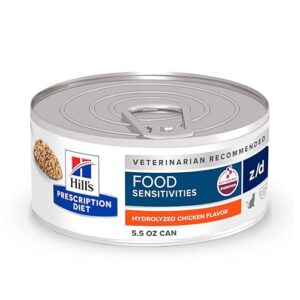
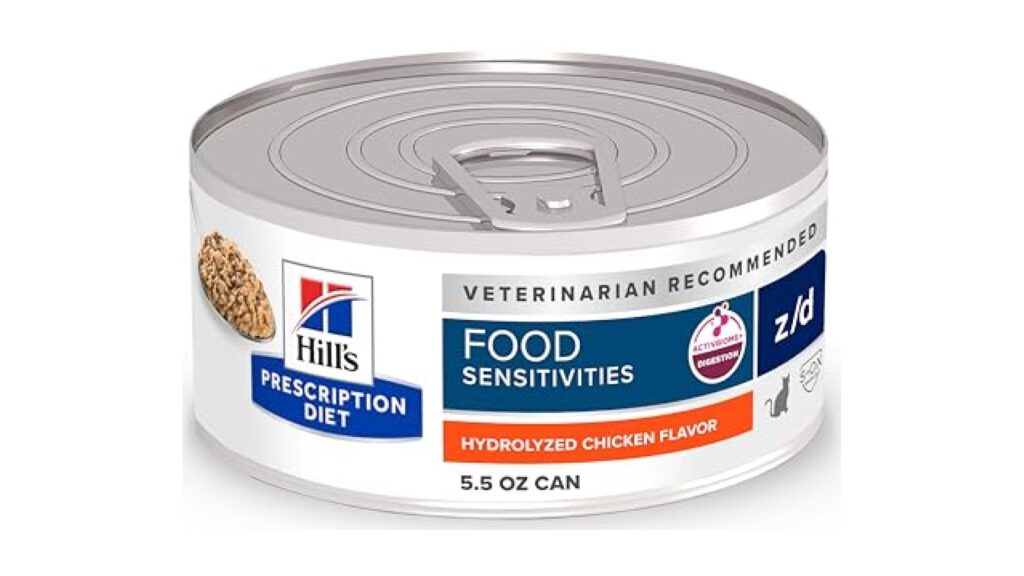
Hill’s Prescription Diet z/d Skin/Food Sensitivities Wet Cat Food
Best for: Cats that need hydrolyzed protein in a moist texture under vet care
- Type
- Hydrolyzed prescription wet
- Line
- z/d wet cans
- Use
- Often paired with z/d dry
- Caveat
- Rx channel; follow vet transition plan
Hill’s Prescription Diet z/d Skin/Food Sensitivities (wet) is the hydrolyzed canned diet we treat as the default clinic-directed wet when an exclusive dietary trial is on the table for suspected food-responsive chronic enteropathy. Hill’s lists hydrolyzed chicken liver, water, corn starch, coconut oil, ground pecan shells, then calcium carbonate, fish oil, powdered cellulose, dicalcium phosphate, flaxseed, dried beet pulp, potassium chloride, dried citrus pulp, and the vitamin–mineral system with taurine. Calorie content on the Hill’s product page: 173 kcal per 5.5 oz can (1,109 kcal/kg). Dry-matter nutrient table (manufacturer): about 34.9% protein, 18.9% fat, 1.9% crude fiber, calcium ~0.78%, phosphorus ~0.75%, taurine ~0.42%—confirm the embossed code on your can.
Hill’s positions z/d for adverse food reactions affecting skin and digestion, highlights highly hydrolyzed proteins “broken down to avoid detection by the immune system,” and states animal feeding tests using AAFCO procedures support adult maintenance. Exclusive feeding is the point of a trial: treats, another pet’s kibble, hunted prey, or flavored medicines can invalidate results. Cornell’s IBD overview likewise stresses hypoallergenic diet trials with all other food sources removed. Clinic channel: Amazon may show the case, but authorization and monitoring still run through your veterinarian. Verified Creators listing: .
Pros
- Moist hydrolyzed option
- Same z/d clinical lane as the dry
Cons
- Can cost adds up
- Still not DIY allergy food
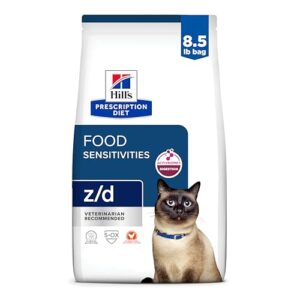
Hill’s Prescription Diet z/d Skin/Food Sensitivities Dry Cat Food
Best for: Vet-directed elimination diets needing a widely stocked hydrolyzed dry
- Type
- Hydrolyzed prescription dry
- Line
- z/d Skin/Food Sensitivities
- Channel
- Veterinary authorization typical
- Creators cues
- Hydrolyzed animal protein framing; skin/food sensitivity positioning
- Caveat
- Not an OTC experiment—use only under vet direction
Hill’s Prescription Diet z/d Skin/Food Sensitivities dry is the kibble sibling of the wet hydrolyzed diet. Hill’s lists brewers rice, hydrolyzed chicken liver, rice protein concentrate, soybean oil, chicken liver flavor, then coconut oil, ground pecan shells, calcium carbonate, lactic acid, potassium chloride, fish oil, glyceryl monostearate, flaxseed, dried beet pulp, dried citrus pulp, and the vitamin–mineral system with taurine. Calorie content: 385 kcal per cup (3,847 kcal/kg). Dry-matter nutrient table (manufacturer): about 34.3% protein, 17.3% fat, 1.4% crude fiber, calcium ~0.75%, phosphorus ~0.59%, taurine ~0.36%.
Same exclusive-feeding rule as the can. Bag sizes on Amazon can vary—match what your clinic authorized.amazon.com/dp/?tag=catsluvus03-20" target="_blank" rel="sponsored nofollow noopener">.
Pros
- Widely recognized Rx hydrolyzed dry
- Skin/food sensitivity positioning on Creators card
- Pairs with z/d wet for mixed feeding
Cons
- Requires veterinary channel for legitimate use
- Hydrolyzed diets are not treat toppers
- Price vs grocery allergy foods
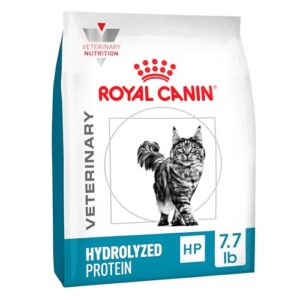
Royal Canin Veterinary Hydrolyzed Protein HP Adult Dry Cat Food (7.7 lb)
Best for: Adult cats on a veterinarian-directed exclusive hydrolyzed trial using Royal Canin’s HP formula
- Channel
- Veterinary / prescription diet—ask your veterinarian
- First ingredients (Royal Canin US)
- Brewers rice, hydrolyzed soy protein, chicken fat, powdered cellulose, natural flavors
- Calories (Royal Canin)
- 330 kcal/cup (3,923 kcal/kg)
- Guaranteed analysis (as fed, manufacturer)
- Protein min 24.1% / Fat min 18.0% / Fiber max 5.9% / Moisture max 7.5%
- Standout label notes
- Hydrolyzed soy protein peptides; EPA+DHA callout; digestive-fiber blend
- AAFCO statement (Royal Canin)
- Formulated to meet AAFCO Cat Food Nutrient Profiles for maintenance
Royal Canin Veterinary Hydrolyzed Protein HP is the alternate clinic hydrolyzed dry we keep on the shortlist when a veterinarian wants Royal Canin’s hydrolyzed soy-protein platform. The US product page lists brewers rice, hydrolyzed soy protein, chicken fat, powdered cellulose, natural flavors, then dried plain beet pulp, calcium sulfate, fish oil, potassium chloride, vegetable oil, and the vitamin–mineral system with taurine and GLA safflower oil. Guaranteed analysis (manufacturer): crude protein min 24.1%, crude fat min 18.0%, crude fiber max 5.9%, moisture max 7.5%, with EPA+DHA min 0.20%. Calorie content: 3,923 kcal/kg or about 330 kcal/cup. Royal Canin states the diet is formulated to meet AAFCO Cat Food Nutrient Profiles for maintenance.
Hydrolyzed diets appear in feline chronic-enteropathy diet-trial literature (including Royal Canin hypoallergenic/hydrolyzed platforms in research settings). That is context for clinic decision-making—not a promise that this bag remits every vomiting cat. Verified Creators listing: .
Pros
- True veterinary hydrolyzed platform used in CE diet-trial literature contexts
- Published calorie and GA figures for clinic math
- Creators-verified 7.7 lb listing
- Useful when Hill’s z/d is refused or unavailable
Cons
- Dry-only in this Creators pick—moisture plan still matters
- Hydrolyzed soy protein panel is not a grocery “limited ingredient” duck can
- Maintenance AAFCO wording—confirm kitten status with the clinic
- Exclusive trial rules still apply
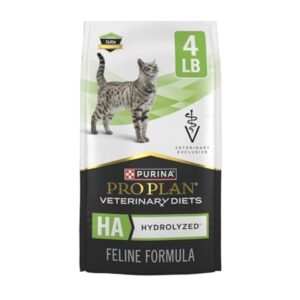
Purina Pro Plan Veterinary Diets HA Hydrolyzed Dry Cat Food
Best for: Vet protocols that specify Purina HA hydrolyzed dry
- Type
- Hydrolyzed prescription dry
- Line
- HA Hydrolyzed
- Size cue
- Creators 4 lb bag
- Caveat
- Veterinary diet
Purina Pro Plan Veterinary Diets HA Hydrolyzed is the third clinic hydrolyzed dry on this shortlist. US Vet Direct / label cards list rice starch, hydrolyzed soy protein isolate, partially hydrogenated canola oil preserved with TBHQ, hydrolyzed chicken liver, then calcium sulfate, powdered cellulose, hydrolyzed chicken, corn oil, and the vitamin–mineral system with taurine. Calorie content on the US Vet Direct card we checked: 3,428 kcal/kg (~291 kcal/cup). Guaranteed analysis on typical US cards runs roughly 30–31% min protein and ~9% min fat—always confirm the printed bag, because regional cards differ.
Purina positions HA for cats needing hydrolyzed protein sources and a single carbohydrate source. Some US adequacy statements cover kitten growth plus adult maintenance; Canadian cards may say maintenance only—match the statement to your cat’s life stage with the veterinarian. Verified Creators listing: .
Pros
- Purina veterinary hydrolyzed option
- Smaller bag for trials
Cons
- 4 lb bag means more reorders
- Rx only
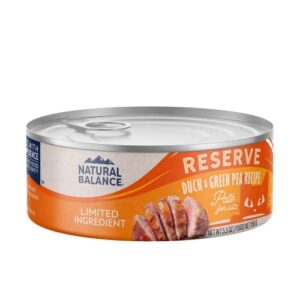
Natural Balance Limited Ingredient Duck & Green Pea Wet Cat Food (5.5 oz, 24 cans)
Best for: Vet-approved OTC limited-ingredient wet feeding when duck is truly novel for that cat and Rx hydrolyzed food is not the chosen lane
- Role
- OTC limited-ingredient wet adjunct—veterinarian-approved only
- Protein theme (brand)
- Duck as animal protein lead with green peas (confirm can panel)
- Calories (Natural Balance)
- 174 kcal / 5.5 oz can (1,114 kcal/kg)
- Guaranteed analysis (brand)
- Protein min 8.5% / Fat min 5.0% / Fiber max 1.5% / Moisture max 78% / Taurine min 0.05%
- AAFCO statement (brand)
- Formulated to meet AAFCO Cat Food Nutrient Profiles for maintenance
Natural Balance Limited Ingredient Duck & Green Pea wet is the only OTC can we rank here—and only as a veterinarian-approved adjunct, not as a DIY IBD cure. Brand nutrition cards list calorie content 174 kcal per 5.5 oz can (1,114 kcal/kg) and guaranteed analysis of crude protein min 8.5%, crude fat min 5.0%, crude fiber max 1.5%, moisture max 78%, taurine min 0.05%. The brand states the recipe is formulated to meet AAFCO Cat Food Nutrient Profiles for maintenance, with duck positioned as the animal protein lead alongside green peas. Confirm the full ingredient panel on your can—formulas revise.
Cornell notes novel-protein diets (rabbit, duck, venison historically) as common first food-trial choices when the protein is truly new to that cat. OTC limited-ingredient foods can still contain flavor coatings or shared lines that surprise a strict trial. If your veterinarian wants a tighter antigen control, stay on a hydrolyzed Rx diet instead. Verified Creators listing: .
Pros
- Moisture-forward wet format many chronic GI cats tolerate better than dry alone
- Limited-ingredient marketing with duck as the featured animal protein
- Creators-verified multipack
- Useful when a veterinarian designs a novel-protein OTC trial and duck is truly new
Cons
- Not a prescription hydrolyzed diet—do not self-substitute for z/d, HP, or HA
- “Novel” only if the cat has never eaten duck (including treats/toppers)
- Adult maintenance AAFCO wording—not a kitten growth claim on the brand card we checked
- Ingredient panels revise—read the can in your hand
Clinic channel and Amazon honesty
Affiliate links use our Amazon Associates tag catsluvus03-20 on amazon.com listings verified through Creators. Prescription diets may still require veterinary authorization depending on seller and jurisdiction. Many caregivers fill z/d, HP, and HA through the clinic pharmacy even when a case appears online. If a third-party seller looks unauthorized or the bag art does not match what your clinic showed you, stop and call the clinic.
What we skipped on purpose
- Invented IBD/IBS cure rates — literature response ranges exist, but we will not invent percentages for ranked products.
- Boarding hotel taste-trial anecdotes —
research_basis=labels. - Claiming food “alleviates IBS” as a medical guarantee — dietary management options only.
- Raw DIY elimination recipes from forums — balance and pathogen risk.
- Probiotic / enzyme miracle bottles as ranked picks — discuss with your veterinarian; not substitutes for a workup.
These picks fit when
- Your veterinarian has started a chronic enteropathy / IBD workup and chosen a diet-trial lane
- You can feed a hydrolyzed Rx diet exclusively for the trial window
- You want Creators-verified ASINs with clinic-channel disclosure
- You understand diet supports care—it does not replace exams, labs, biopsies, or meds
Skip the cart and call a vet when
- Your cat is crashing, dehydrated, or has not eaten
- You want a blog to replace fecal testing, T4, imaging, or biopsy decisions
- You plan to “mostly” feed the trial diet while keeping treats and shared bowls
- You expect invented cure rates or boarding feeding trials
Transitioning without wrecking the trial
Unless your veterinarian orders a faster switch (common when starting an exclusive hydrolyzed diet), move over about 7 days: gradually increase the new food while tapering the old. For a true elimination trial, clear other foods out of the plan—other pets may need separate feeding stations. Warm wet food slightly, offer smaller more frequent meals, and call the clinic for vomiting, complete refusal, or worsening lethargy. Gradual transitions still must end in exclusive feeding if that is the diagnostic goal.
Recalls note
During this research pass (2026-09-25 PT) we did not find active FDA recall listings that pull the specific ASINs above. Brand histories change—verify rumors against the FDA recalls & withdrawals page and the lot code on your can or bag.
Who this guide is for
Good fit: caregivers shopping after a chronic GI workup; households deciding whether an exclusive hydrolyzed trial is realistic; readers who searched “IBS cat food” and need accurate IBD/chronic-enteropathy framing without fake boarding trials.
Poor fit: cats in acute crisis without care; anyone replacing prescribed diagnostics or meds with grocery rotation; shoppers hunting invented cure-rate charts.
Cat IBS / IBD food FAQ
Do cats get IBS like humans?
Not in the same way listicles imply. Caregivers often search “IBS,” but veterinarians usually discuss feline IBD or chronic enteropathy. We keep the search phrase for findability and use accurate feline terms in the advice.
Can cat food cure IBD or “alleviate IBS” for good?
No honest guide should promise that. Some cats have food-responsive disease and improve on exclusive hydrolyzed or novel-protein diets. Others need medication, B12, or further workup for lymphoma. Diet is management under veterinary supervision—not a medical guarantee.
What should be ruled out before a diet trial?
Parasites, metabolic disease, hyperthyroidism (especially in older cats), infectious causes, and intestinal lymphoma are common considerations. Cornell emphasizes an extensive workup because signs overlap. Follow your veterinarian’s diagnostic plan.
What is a hydrolyzed diet?
Proteins are broken into smaller peptides so they are less likely to trigger an immune response. Hill’s z/d, Royal Canin Hydrolyzed Protein HP, and Purina HA are Creators-verified clinic examples on this page.
Novel protein vs hydrolyzed—which is better?
There is no universal winner. Choice depends on diet history, how exclusive you can be, and clinic preference. Novel only works if the protein is truly new to that cat.
How long does a food trial take?
Cornell notes it may take several weeks or longer. Many clinicians use roughly 6–8 weeks of exclusive feeding for chronic enteropathy diet trials—follow your veterinarian’s timeline, not a blog stopwatch.
Can I use OTC limited-ingredient food instead of Rx?
Only if your veterinarian designs that lane. OTC LID foods can help some cats but are easier to contaminate and are not the same as hydrolyzed prescription diets. We rank Natural Balance Duck & Green Pea as an adjunct, not a stealth Rx replacement.
Is wet food better than dry for GI cats?
Moisture often helps. Exclusive hydrolyzed trials can be wet, dry, or mixed within the same therapeutic line. Compliance beats format ideology.
Do treats or flavored medicines ruin a trial?
Yes, they can. Cornell states table scraps, flavored medications, and treats must be eliminated during a food trial. Ask about unflavored pill options.
Did Cats Luv Us run feeding trials on these?
No. This guide uses labels and literature only (research_basis=labels). We do not invent boarding feeding trials.
Are Amazon prescription listings clinic-authorized?
Creators verified the ASINs we list, but authorization and authenticity still matter. Many caregivers prefer clinic pharmacy fills—ask your veterinarian which channel they trust.
When is chronic GI disease an emergency?
Collapse, labored breathing, relentless vomiting, black tarry stool, complete food refusal, or a profoundly weak/dehydrated cat needs same-day veterinary or emergency care—not a diet experiment.
Bottom line
For “IBS”-titled searches that really mean feline IBD / chronic enteropathy, your veterinarian’s workup comes first. Choose exclusive Hill’s z/d wet and/or dry when the clinic picks that hydrolyzed lane, with Royal Canin Hydrolyzed Protein HP or Purina HA as alternate Rx platforms. Keep Natural Balance Duck & Green Pea for veterinarian-approved OTC limited-ingredient plans only. Skip miracle cure marketing. Traveling? Cats Luv Us can keep your cat on the exact food your clinic already dialed in.
Sources
- Cornell Feline Health Center — Inflammatory Bowel Disease
- Hill’s Prescription Diet — z/d wet nutrient table
- Hill’s Prescription Diet — z/d dry nutrient table
- Royal Canin US — Feline Hydrolyzed Protein HP (ingredients, GA, kcal)
- Purina Pro Plan Veterinary Diets HA — US Vet Direct / label cards (hydrolyzed soy protein isolate; kcal/cup)
- Natural Balance — Duck & Green Pea wet GA & kcal
- Mandigers et al., JFMS-style hydrolyzed-diet case series in cats with chronic GI signs (literature context)
- Nature Scientific Reports 2022 — hydrolyzed protein diet and fecal microbiota in cats with chronic enteropathy (literature context)
- Clinician’s Brief / CE nutrition summaries — hydrolyzed, novel-protein, highly digestible diet classes for feline CE
- Amazon Creators API getItems/searchItems (2026-09-25 PT): , , , ,
- Competitor topic map only (not copied): WebVet IBD feeding explainers; SERP “IBS cat food” listicles
Going away? Keep your cat's routine on track.
Cats Luv Us Boarding Hotel & Grooming in Laguna Niguel, Orange County.