Best Diabetic Cat Foods in Australia: Clinic Labels (2026)
Best diabetic cat foods in Australia, from the five listings already on this page: Hill's m/d wet and dry, Purina DM wet, a Royal Canin dry listing, and one grocery wet.

In this review 12 sections
CatsLuvUs Copilot Search
Ask this review — not the open web
Answers are generated from this Cats Luv Us review only. We may earn a commission from Amazon links. Not veterinary advice.
Answer from this review
This score is editorial — based on labels, recall history, and veterinary guidance, not a lab test. How we evaluated.
Food supports the plan the veterinarian already wrote. It does not replace insulin.
Best diabetic cat foods in Australia, on this page, means the prescription diets already linked here, plus one grocery wet that is not a diabetic diet. Food does not cure diabetes. The veterinarian diagnoses the disease, chooses the therapy, and decides whether a diet change belongs in the plan. Hill’s m/d wet and Purina DM wet are the canned clinic foods. Hill’s m/d dry and the Royal Canin dry listing are for the plan that includes kibble. Tiki Cat After Dark stays in the grocery lane unless the clinic says otherwise.
Match the prescription before the grocery can
- 5.5 oz US page
- 13.1% carb NFE, dry matter
- 7-day transition
- 156 g AU loaf
- Carbohydrates max 1.75% as fed
- Veterinarian-directed
- Glycoadvanced listing
- AU Diabetic starch 18.8%
- Confirm the prescribed SKU
- US page lists 8.5 lb
- 15.1% carb NFE, dry matter
- Confirm the bag weight
- Grocery shreds
- Moisture max 83%
- Not a diabetic diet
How we evaluated
This evaluation uses published product labels, guaranteed analyses, and recall records.
We read Hill’s US nutrient pages for m/d wet and dry, Purina Australia’s DM loaf card, Royal Canin Australia’s Diabetic dry page, and the Tiki Cat After Dark Chicken card. The score is an editorial label fit. Nobody ran a glucose curve, and nobody adjusted a dose.
Editorial evaluation from published labels / literature — not a lab test or boarding trial.
Editorial picks are not sold to brands. How we make money.
Affiliate disclosure: Cats Luv Us is a participant in the Amazon Services LLC Associates Program. Product links on this page are affiliate links. If you buy through them we earn a commission, at no extra cost to you. This never changes which products we recommend.
Best diabetic cat foods in Australia are clinic diets
Best diabetic cat foods in Australia, for a cat that already has a diagnosis, are the diets a veterinarian can prescribe. On this page those are Hill’s m/d wet, Purina DM wet, Hill’s m/d dry, and the Royal Canin dry listing. Tiki Cat After Dark Chicken is here because it was already linked, and because caregivers ask about a grocery wet. It stays labeled as grocery food.
A grocery roundup that leads with grain-free cans answers a different question. Grain-free is an ingredient line. Diabetes care is a clinic plan: the diagnosis, the therapy, the monitoring, and then the food the clinic named. Cornell’s feline diabetes page is the overview to read with those instructions. Food is one part of management.
- Canned clinic foods. Hill’s m/d wet and Purina DM loaf.
- Dry clinic foods. Hill’s m/d dry, and Royal Canin when the bag matches the prescription.
- Grocery wet. Tiki Cat After Dark Chicken, only with veterinary approval.
- Left off this page. Homemade recipes, herbal glucose products, and a second Royal Canin wet that was not already linked.
Dry-matter percents and as-fed maximums are different math
A single carbohydrate leaderboard hides the basis of the number. Hill’s publishes carbohydrate on a dry-matter table. Purina Australia publishes an as-fed maximum next to a moisture maximum of 78%. Royal Canin Australia publishes starch and NFE as analytical constituents on Diabetic dry. Tiki publishes a moisture maximum and a protein minimum, and no diabetic carbohydrate claim. Read the column that names the basis before you compare two cans.
| Food | Channel | Format | Figure we can quote | Where it is printed |
|---|---|---|---|---|
| Hill’s m/d wet | Prescription | Wet, US page 5.5 oz | Carb NFE 13.1% dry matter; protein 52.1% dry matter; 172 kcal/can | Hill’s US wet page |
| Purina DM loaf | Prescription, Australia | Wet, 156 g | Carbohydrates max 1.75% as fed; protein min 12%; 1,128 kcal/kg | Purina Australia loaf card |
| Royal Canin dry listing | Prescription | Dry | AU Diabetic: starch 18.8%; protein 46%; 385 kcal/100 g | AU Diabetic page, not a Glycoadvanced carb line |
| Hill’s m/d dry | Prescription | Dry, US page 8.5 lb | Carb NFE 15.1% dry matter; protein 52.6% dry matter; 463 kcal/cup | Hill’s US dry page |
| Tiki After Dark Chicken | Grocery | Wet shreds, 2.8 or 5.5 oz | Moisture max 83%; protein min 12% | Tiki brand card |
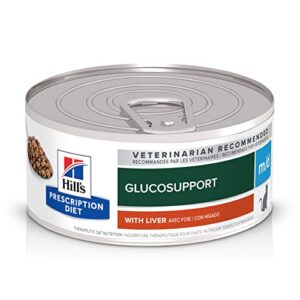
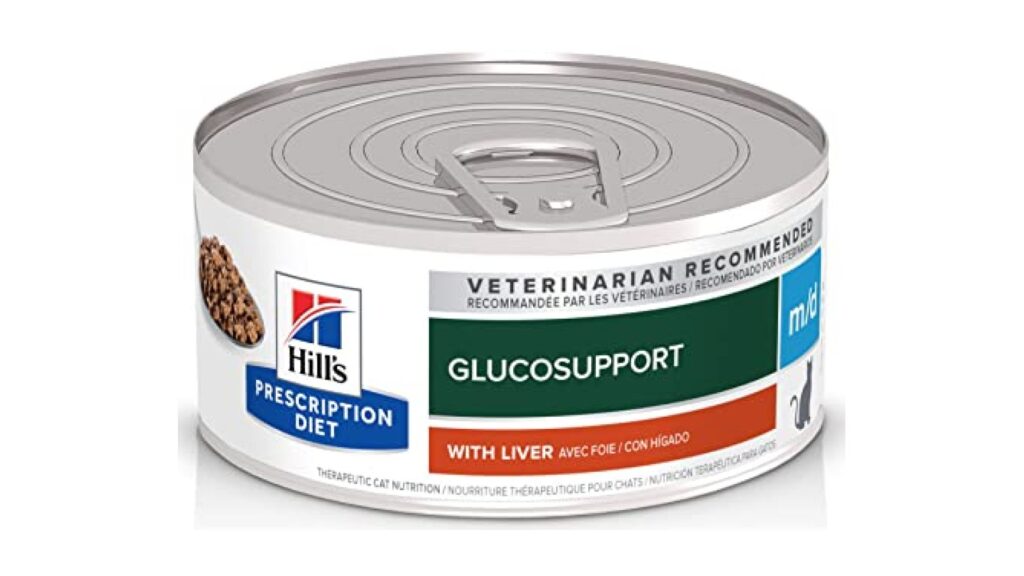
Hill’s Prescription Diet m/d GlucoSupport wet, liver
Best for: A veterinarian who wants the canned m/d formula
- US page size
- 5.5 oz (156 g) can
- Calories
- 1,106 kcal/kg; 172 kcal per can
- Dry-matter protein
- 52.1%
- Dry-matter fat
- 24.8%
- Dry-matter carbohydrate (NFE)
- 13.1%
- Dry-matter crude fiber
- 2.7%
- Dry-matter carnitine
- 804.9 ppm
- Australia
- Clinic can may say GlucoSupport or Glucose/Weight Management
Hill’s Prescription Diet m/d GlucoSupport wet, liver, is the canned clinic formula on the US nutrient page. That page lists a 5.5 oz (156 g) can. Australian clinics may print GlucoSupport or Glucose/Weight Management on the same diet family. The button opens an amazon.com listing so you can see a title and a photo. Match the can your clinic authorized. A US can and an Australian can are two lots until the labels say otherwise.
The ingredient list on the US wet page begins with pork liver, pork by-products, water, chicken fat, corn starch, potato protein, calcium sulfate, powdered cellulose, natural flavor, guar gum, and fish oil, then the vitamin and mineral system that includes L-carnitine. Calories are 1,106 kcal per kg and 172 kcal per can. The dry-matter table lists protein 52.1%, fat 24.8%, carbohydrate (NFE) 13.1%, crude fiber 2.7%, and carnitine 804.9 ppm. Those dry-matter percents sit on a moisture-free basis. They are a different sum from an as-fed carbohydrate maximum on a can that is mostly water.
Hill’s describes this food as clinically tested nutrition to help manage glucose and weight, and it prints an S+OXSHIELD urinary claim. The page also carries the AAFCO animal feeding tests statement for adult maintenance. The transition line is 7 days. Your veterinarian monitors glucose and the rest of the plan. The can does not replace that plan.
Pros
- The US page publishes a dry-matter table, calories, and a 5.5 oz can size
- Hill's names a 7-day transition and veterinary monitoring
Cons
- The amazon.com can is not automatically the Australian clinic can
- A 13.1% dry-matter carbohydrate is not an as-fed percent
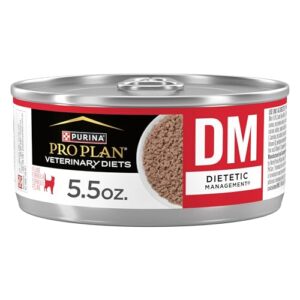
Purina Pro Plan Veterinary Diets DM Dietetic Management, wet loaf
Best for: A veterinarian who prescribed the DM loaf, not a different DM pouch
- AU pack
- 156 g cans; the page lists a 24-count and also a 12-count
- Protein
- Minimum 12.0%
- Fat
- Minimum 4.5%
- Fibre
- Maximum 2.0%
- Moisture
- Maximum 78.0%
- Carbohydrates
- Maximum 1.75%, as fed
- Energy
- 1,128 kcal/kg
- Direction
- Use only as directed by your veterinarian
Purina Pro Plan Veterinary Diets DM Dietetic Management Feline Formula, the loaf on Purina Australia, is a veterinarian-directed diet for diabetes mellitus. The page lists a 156 g can in a 24-count and also mentions a 12-count. The direction on the card is to use it only as your veterinarian directs.
The analysis on that card is crude protein minimum 12.0%, fat minimum 4.5%, fibre maximum 2.0%, moisture maximum 78.0%, ash maximum 3.1%, carbohydrates maximum 1.75%, and 1,128 kcal per kg. The carbohydrate maximum is as fed, on a can that is mostly water. It is not a dry-matter number. It is not interchangeable with the 13.1% dry-matter NFE on the Hill’s wet page. Putting those two percents in one ranking column mixes two kinds of math.
Purina’s own wording says the diet is clinically proven to help reduce exogenous insulin requirements, that it is high in protein and low in carbohydrate, that it may help reduce post-prandial hyperglycemia, and that it includes St/Ox Defense. Those sentences belong to the brand. This page did not measure an insulin dose. The loaf card we read did not publish an ingredient order we can quote line for line, so this page does not invent one. Confirm the lot in your hand.
DM Tender Pieces with Chicken, in pouches, is a different product. That card lists its own analysis, including a different energy figure. The button on this row stays with the loaf listing already linked here. If the carton in the cart is a pouch, match the prescription before you borrow the loaf numbers.
Pros
- Purina Australia prints an as-fed carbohydrate maximum on the loaf card
- The card says the diet is for diabetes mellitus and is veterinarian-directed
Cons
- 1.75% as fed is not comparable with a dry-matter carbohydrate until you convert it
- The DM Tender Pieces pouch is a different SKU with different numbers
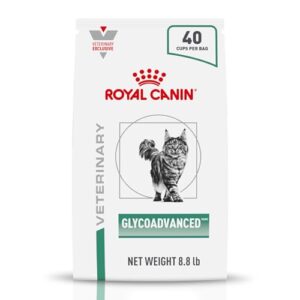
Royal Canin Glycoadvanced dry, amazon.com listing
Best for: A clinic plan that names Glycoadvanced, or classic Diabetic when that is the bag dispensed
- Linked listing
- Glycoadvanced dry on amazon.com
- AU page with numbers
- Classic Diabetic dry, diabetic-3906
- AU protein
- 46.0%
- AU fat
- 12.0%
- AU NFE
- 25.7%
- AU starch
- 18.8%
- AU energy
- 385 kcal per 100 g
- Named carb sources
- Barley and tapioca
The dry button on this row opens Royal Canin Glycoadvanced on amazon.com. Australian clinic pages still lead with classic Diabetic dry. Use Glycoadvanced when it is the SKU your veterinarian prescribed. This page does not invent a carbohydrate percentage for the US Glycoadvanced bag.
The figures in this paragraph come from Royal Canin Australia’s Diabetic dry page. Analytical constituents there are protein 46.0%, fat 12.0%, NFE 25.7%, crude fibres 3.8%, dietary fibre 11.3%, starch 18.8%, omega-6 2.75%, omega-3 0.72%, arginine 2.73%, EPA and DHA 0.30%, calcium 0.92%, phosphorus 0.91%, sodium 0.40%, and metabolizable energy 385 kcal per 100 g. Composition begins with dehydrated poultry protein, barley, wheat gluten, maize gluten, soya protein isolate, and tapioca. The carbohydrate sources named on that page are barley and tapioca. The brand frames the diet as glucomodulation, high protein, and reduced starch. Those starch and NFE figures are the Australian Diabetic panel. They are not a dry-matter conversion of the Hill’s table, and they are not a number we measured on the Glycoadvanced listing.
Royal Canin notes that a diet change can change insulin sensitivity. Monitor glucose and the insulin response with the clinic. A separate Royal Canin wet Diabetic exists. It is not one of the five foods linked on this page, so it is not added here.
Pros
- The Australian Diabetic page publishes starch, NFE, protein, and energy
- Royal Canin says a diet change can change insulin sensitivity
Cons
- The linked listing is Glycoadvanced, while the published starch figure is on classic Diabetic
- This page does not invent a carbohydrate percent for the US Glycoadvanced bag
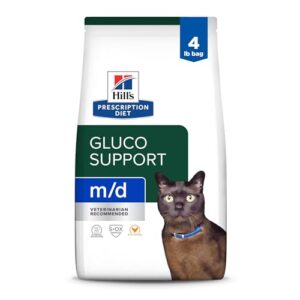
Hill’s Prescription Diet m/d GlucoSupport dry, chicken
Best for: A veterinarian who wants m/d dry, or an m/d wet and dry mix
- US page size
- 8.5 lb
- Linked bag
- Confirm the weight on the listing; AU clinics often sell about 1.8 kg
- Calories
- 3,983 kcal/kg; 463 kcal per cup
- Cup weight
- 4.1 oz
- Dry-matter protein
- 52.6%
- Dry-matter fat
- 21.8%
- Dry-matter carbohydrate (NFE)
- 15.1%
- Dry-matter crude fiber
- 4.3%
Hill’s m/d GlucoSupport dry, chicken, is the kibble in this clinic family. The US nutrient page lists an 8.5 lb bag. The amazon.com listing linked here has circulated as a smaller bag. Australian clinics often dispense a bag near 1.8 kg. Read the weight on the listing and on the bag the clinic handed you. This page does not claim that a smaller bag’s panel matches the 8.5 lb page line for line.
Ingredients on the US dry page begin with chicken by-product meal, corn protein meal, chicken, chicken fat, wheat gluten, potato protein, powdered cellulose, spray-dried pork stock, corn starch, and sweet potatoes. Calories are 3,983 kcal per kg and 463 kcal per cup. Hill’s defines that cup as 4.1 oz. The dry-matter table lists protein 52.6%, fat 21.8%, carbohydrate (NFE) 15.1%, and crude fiber 4.3%.
The clinical description matches the wet page: nutrition aimed at glucose and weight, with the AAFCO animal feeding tests statement for adult maintenance. Dry m/d belongs in the bowl when the veterinarian says kibble, or a wet-and-dry mix, is the plan. It is a prescription food. A grocery kibble with a similar bag color is a different product.
Pros
- The US dry page publishes calories per cup and a dry-matter table
- Dry m/d is a prescription food with the same clinical framing as the wet
Cons
- The US page size is 8.5 lb, and the bag in an Australian clinic is often a different weight
- Dry matter carbohydrate is higher here than on the m/d wet table
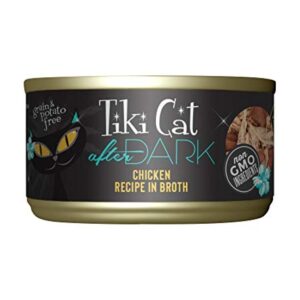
Tiki Cat After Dark Chicken recipe in broth
Best for: A Sphynx household adding moisture, when the can in the case matches the calorie you counted
- Guaranteed analysis
- Protein 12% min, fat 2.2% min, fiber 0.7% max, moisture 83% max.
- Two can sizes
- 66 kcal per 2.8 oz can, or 128 kcal per 5.5 oz can.
- Feeding line
- Three 2.8 oz cans, or 1 and 1/2 of the 5.5 oz cans, per day for a 7 lb adult.
- Not this recipe
- The quail shreds page is 10% protein and 68 kcal per can.
Tiki Cat After Dark Chicken is a grocery wet. It is not a prescription diabetic diet. The brand card lists shredded chicken in broth with organ meat. The ingredient list begins with chicken, chicken broth, chicken liver, chicken gizzard, and chicken heart, then the mineral and vitamin system. Guaranteed analysis is crude protein minimum 12%, crude fat minimum 2.2%, crude fiber maximum 0.7%, and moisture maximum 83%. Calories are 66 kcal per 2.8 oz can and 128 kcal per 5.5 oz can. The line is sold in both can sizes. The card also says grain-free and potato-free.
High moisture and a short meat list are why a veterinarian sometimes allows a grocery wet when a cat refuses the clinic can, or during a transition. Any swap while a cat is on insulin needs the same glucose checks the clinic already set. After Dark does not carry a glucomodulation claim. The feeding lines on the card, including the kitten line, are ordinary feeding lines. A diabetic cat’s amount is the clinic’s call.
Pros
- The page prints both can calories, so a variety case cannot hide the size
- Chicken, broth, liver, gizzard, and heart are the first ingredients
Cons
- The chicken page we opened does not print the maintenance sentence that sits on a different After Dark pâté
- A kitten line says up to twice the adult amount, which is not a growth statement
The Australian clinic SKU and the amazon.com listing
Prescription diabetic diets in Australia usually move through veterinary clinics and authorised retailers that ask for a prescription. The buttons on this page open amazon.com listings. A listing is a way to see a title and a photo. It is not proof that the can in a Brisbane or Melbourne clinic is the same lot, the same bag weight, or the same words on the front.
Hill’s Australian packaging may say GlucoSupport or Glucose/Weight Management. Purina Australia publishes the DM loaf as a veterinarian-directed diet in 156 g cans. Royal Canin Australia’s starch and protein figures sit on classic Diabetic dry. The linked dry listing is Glycoadvanced. Buy that listing when it is the prescribed SKU. When the clinic dispensed classic Diabetic, use the bag the clinic dispensed.
A diet change can move an insulin plan
A new food can change how sensitive a cat is to insulin. Royal Canin prints that warning on the Diabetic page. Hill’s tells you to transition over 7 days and to let the veterinarian monitor. Purina says to use DM only as your veterinarian directs. Purina’s card also says the diet is clinically proven to help reduce exogenous insulin requirements. That is the brand’s claim. It is not a dose this page measured, and it is not a reason to change a dose at home.
Call the clinic the same day if the cat stops eating, vomits and will not settle, seems weak, has a seizure, or breathes with an open mouth. Those signs need a veterinarian. They are not a cue to experiment with a different can overnight.
Grocery wets stay in their own lane
Grain-free, potato-free, and high-protein grocery foods are ordinary grocery foods until a veterinarian says otherwise. Tiki Cat After Dark Chicken earns its place because the card is specific: shredded chicken, liver, gizzard, and heart, moisture maximum 83%, and calories for both can sizes. That transparency is useful. It is not a diabetic-diet claim.
This page leaves out herbal glucose products and homemade recipes. A homemade bowl can miss nutrients a cat needs every day. A clinic diet is already built as a complete food for the life stage on its label. If the cat refuses every clinic can, the next call is the clinic, not a recipe from a forum.
These foods fit when
- The five foods were already linked, and the nutrient lines come from manufacturer cards
- Wet clinic diets, dry clinic diets, and the grocery wet stay in separate lanes
- As-fed carbohydrate and dry-matter carbohydrate are labeled as different math
Call the clinic before you shop when
- You want a grocery can to stand in for a prescription
- You want one carbohydrate percent that ignores moisture
- The cat has stopped eating, is weak, or is vomiting
Who each food is for
- Canned m/d: the clinic named Hill’s m/d wet. Read the 5.5 oz US table, then match the Australian can.
- DM loaf: the clinic named Purina DM wet. Use the 1.75% figure as an as-fed maximum, and skip the pouch numbers unless the pouch is what was prescribed.
- Glycoadvanced or classic Diabetic dry: the clinic named a Royal Canin dry. Confirm which name is on the bag before you use the 18.8% starch line.
- m/d dry: the clinic wants kibble or a mix. Confirm 8.5 lb versus the bag weight in your hand.
- After Dark: the clinic has allowed this grocery can. Keep the insulin checks in place.
Transition over about seven days
Unless the veterinarian orders a faster switch, move the new food in over about 7 days. That is the transition Hill’s prints. Watch appetite, water drinking, and glucose the way the clinic already taught you. Call if the cat refuses the bowl or the readings leave the range you were given.
Prices move, so this page does not print them. The useful check is whether the listing name matches the prescription, and whether you can keep buying that same SKU. Cats Luv Us can keep a traveling cat on the schedule and the diet the clinic already set. Bring the food the veterinarian named.
Bottom line
Best diabetic cat foods in Australia, among the foods already linked here, are clinic diets with published numbers. Hill’s m/d wet is the 5.5 oz US can with carbohydrate (NFE) 13.1% on a dry-matter basis and 172 kcal per can. Purina DM wet is the Australian loaf with carbohydrates maximum 1.75% as fed and 1,128 kcal per kg. Royal Canin’s linked listing is Glycoadvanced dry; the starch figure of 18.8% belongs to the Australian Diabetic page. Hill’s m/d dry lists 463 kcal per cup and carbohydrate (NFE) 15.1% dry matter, on an 8.5 lb US page that may not match the bag weight. Tiki Cat After Dark Chicken is a grocery wet with moisture maximum 83%. Match the prescription, keep the insulin plan, and treat food as support.
Best diabetic cat foods in Australia
What are the best diabetic cat foods in Australia on this page?
The prescription foods already linked: Hill’s m/d wet, Purina DM wet, Royal Canin’s dry listing, and Hill’s m/d dry. Tiki Cat After Dark is the grocery wet, and it is not a diabetic diet. The veterinarian chooses among them. This page compares labels.
Does a diabetic cat food replace insulin?
No. Food can sit inside the plan. It does not cure diabetes, and it does not authorize a pause in insulin. Cornell’s feline diabetes overview is the plain-language page to read beside the clinic’s instructions.
Why is Purina's 1.75% carbohydrate different from Hill's 13.1%?
Purina Australia prints carbohydrates maximum 1.75% as fed, on a loaf with moisture maximum 78%. Hill’s prints carbohydrate (NFE) 13.1% on a dry-matter table for the wet m/d can. One number still contains the water. The other has the water removed. They do not belong in the same unsorted list.
Is the amazon.com bag the Australian clinic bag?
Treat them as the same food only when the name, size, and prescription match. Hill’s US wet page is a 5.5 oz can. The US dry page is 8.5 lb, while many Australian clinic bags are nearer 1.8 kg. Royal Canin’s published starch figure is on classic Diabetic dry. The linked listing is Glycoadvanced.
Can Tiki Cat After Dark be used as a diabetic diet?
It is a grocery shredded-chicken can with moisture maximum 83%. Use it when the veterinarian has allowed that can. It does not carry the diabetic-diet claims printed on m/d, DM, or Royal Canin Diabetic.
What should change on the insulin plan when the food changes?
Ask the clinic before the swap. Royal Canin says a diet change can change insulin sensitivity. Watch appetite and the glucose checks you were already given. Call the same day for weakness, a seizure, vomiting that does not stop, open-mouth breathing, or a cat that will not eat.
Are grain-free grocery foods diabetic diets?
Grain-free and potato-free are ingredient claims. They are not a prescription for diabetes. A clinic diet is the one the veterinarian named, from a company that sells it as a diabetic diet.
How long should a food transition take?
Hill’s prints 7 days. Use a faster switch only when the veterinarian orders one. Stop and call if the cat refuses the food or the glucose readings move outside the range the clinic gave you.
Sources
- Hill's Prescription Diet m/d GlucoSupport wet nutrient table
- Hill's Prescription Diet m/d GlucoSupport dry nutrient table
- Purina Australia, PPVD DM Dietetic Management Feline Formula
- Royal Canin Australia, Diabetic dry
- Tiki Cat After Dark Chicken nutrient card
- Cornell Feline Health Center, Feline Diabetes
Going away? Keep your cat's routine on track.
Cats Luv Us Boarding Hotel & Grooming in Laguna Niguel, Orange County.