Top 10 Cat Treats Your Feline Will Love
A label reading of the Inaba Ciao Churu creamy puree 3-pack this page already links, plus the chicken-recipe tube sheet on the brand site.

In this review 9 sections
CatsLuvUs Copilot Search
Ask this review — not the open web
Answers are generated from this Cats Luv Us review only. We may earn a commission from Amazon links. Not veterinary advice.
Answer from this review
This score is editorial — based on labels, recall history, and veterinary guidance, not a lab test. How we evaluated.
Best cat treats, on this page, means a tube you can count, not a list of bags that were never opened.
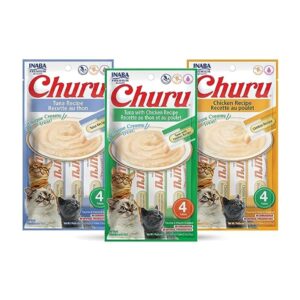
Best cat treats are the ones whose label you can finish reading. The score is an editorial label fit. It is not a feeding result. The product linked here is an Inaba Ciao Churu creamy puree 3-pack. The marketplace title says tuna puree, 12 tubes. The flavor line also says chicken and tuna. The chicken-recipe sheet on the brand site is a separate 4-pack: 6 kcal a tube, 91 percent moisture maximum, and not a meal.
At a glance
- Creamy puree, 12 tubes on the listing
- Title says tuna; flavor line says chicken and tuna
- Chicken-recipe sheet: 6 kcal and not a meal
How we evaluated
This evaluation uses published product labels, guaranteed analyses, and recall records.
We read the Inaba listing this page already linked, the chicken-recipe page on the Inaba site, and the Cornell, WSAVA, FDA, and AAFCO pages on treats and complete foods. The 6 kcal figure belongs to the chicken-recipe sheet. It is used only when that sheet is the carton in your hand. Nobody here fed these tubes to a cat. The score is an editorial label fit.
Editorial evaluation from published labels / literature — not a lab test or boarding trial.
Editorial picks are not sold to brands. How we make money.
Affiliate disclosure: Cats Luv Us is a participant in the Amazon Services LLC Associates Program. Product links on this page are affiliate links. If you buy through them we earn a commission, at no extra cost to you. This never changes which products we recommend or how we rank them.
Best cat treats are a label you can finish
Best cat treats are not a trophy bag. A cat will love plenty of foods that do not belong in the day’s calories. This page keeps the one treat it actually links, an Inaba Ciao Churu creamy puree 3-pack, and then walks through ten lines that decide whether any treat, including this one, earns a place in the bowl. Ten unopened bags would only repeat the same ten lines.
The score is an editorial label fit. It is not a taste test, a hydration study, or a promise that a picky cat will eat the tube.
Ten lines on the label
1. Meal or treat. A complete food says it is complete and balanced for a life stage, or it cites an AAFCO profile or feeding trial. A treat says intermittent, supplemental, or “not a meal.” The Inaba chicken-recipe sheet uses the plain version: feed as a treat, not as a meal. If that sentence is missing, do not guess.
2. Calories per piece. The chicken-recipe sheet prints 6.0 kcal per tube and 430 kcal per kilogram. A variety bundle that does not print a number is not automatically 6 kcal. Count the tube you open.
3. The day’s share. Cornell’s feeding page says treats should not exceed about 10 to 15 percent of daily calories. The WSAVA guide for cat treats says less than 10 percent, and it says to ask the clinic for the cat’s own number. A weight-loss plan should use the tighter cap. Three tubes at 6 kcal are 18 kcal. That is fine inside a 20 kcal allowance and too much inside a 10 kcal allowance. The percentage is not a reason to skip the veterinarian’s number.
4. Moisture next to protein. The chicken-recipe sheet prints 7 percent minimum protein beside 91 percent maximum moisture. That protein figure is as-fed. Most of the tube is water. The water is the point of a puree. It is not a reason to call the tube a high-protein meal, and it is not a reason to throw the tube out for looking “low protein” next to a freeze-dried bite.
5. The first ingredients. Water, then a named animal, is a normal puree order. The chicken sheet says water, then chicken. “Meat” with no species would be a weaker line. Natural flavors and natural scallop flavor sit further down. Scallop flavor means a chicken name is not a seafood-free food.
6. One recipe or a mix. The linked 3-pack does not describe one recipe cleanly. The title says tuna puree. The flavor field says chicken and tuna. A bullet says tuna or farm-raised chicken. A chicken variety case from the same brand can hold cheese, scallop, shrimp, or crab in some of the tubes. Those are different foods. Read the tube in your hand. Cheese adds milk. Crab and shrimp add shellfish. A cat who vomits one of those is not failing the whole brand.
7. Grain-free is a recipe style. The listing says grain-free. The chicken sheet uses tapioca starch and guar gum instead of a grain. It also adds vitamin E, taurine, and green tea extract. None of that turns a treat into a diet. Carrageenan is absent on that sheet. Absence of one thickener is not a health claim.
8. Life stage. The 3-pack listing says all life stages. That is a flavor-page line, not an AAFCO growth statement. A kitten still needs a complete growth food. A tube can be a treat on top of that food. It should not be the food.
9. Dental, hairball, and urinary claims live on other labels. A puree does not scrape teeth. A dental treat that has been accepted for plaque or tartar says so, and the Veterinary Oral Health Council list is the seal shoppers use for that claim. A hairball tube is a different recipe. This listing does not make those claims. Do not borrow them.
10. A prescribed diet outranks a favorite tube. Kidney, urinary, hydrolyzed, and weight foods are built as the whole bowl. Cornell notes that treats are usually not complete. Adding a tuna-or-chicken puree can break a plan that was limiting phosphorus, a protein, or calories. If a veterinarian has already chosen the diet, ask before the tube. A matching therapeutic treat, when one exists, is a different bag from this one.
What this 3-pack is, once the lines are read
Use it when you want a lickable treat: squeezed for a training rep, poured into a bowl, or stirred into the meal you already measured. The listing gives you 12 tubes, four in each 2 ounce pack. That is a lot of calories if every tube disappears the day the box arrives. Portion from the calorie line, then put the box away.
An opened tube goes in the refrigerator. The chicken-recipe sheet says to serve it soon. Do not leave puree out on a warm counter. Offer water anyway. A wet treat is not a water bowl.
Skip it when the job is a crunch you can toss down a hall, a single-ingredient freeze-dried bite with nothing but one meat, or a dental chew. Skip it when the title you ordered and the flavor line on the page do not match the cat’s limits. A household avoiding fish should not trust a page that says tuna in the title and chicken in the flavor field. Wait for the carton.
Flaws that are printed, not tasted
The useful flaw is the mismatch. A shopper who wanted only chicken can receive a bundle whose title says tuna. A shopper who wanted only tuna can receive a flavor line that includes chicken. That is a label problem, and it is visible before you pay.
The second flaw is borrowing the 6 kcal line from a different pack. The chicken-recipe 4-pack is the sheet with the full guaranteed analysis. The 3-pack listing does not reprint that table. Until the carton does, the calorie math is a model, not a measured serving of this bundle.
The third flaw is the pill bullet. Hiding medicine in a favorite puree works only when the medicine and the puree are both allowed. It fails when the cat eats the puree and leaves the pill, and it fails when the puree is outside the diet. The listing is describing a texture. It is not describing a veterinary product.
Conclusion
Best cat treats are a small, counted share of a complete diet. The treat linked here is an Inaba creamy puree in a 12-tube bundle whose title and flavor line disagree. The chicken-recipe sheet, when it is the tube you open, is 6 kcal, about 91 percent moisture, and not a meal. Read those lines, keep prescribed diets intact, and leave the next nine bags on the shelf until their labels are as clear as this one.
Inaba Ciao Churu creamy puree, 3-pack
Best for: Hand-feeding or topping a meal when the carton in your hand matches the recipe you meant to buy
- Listing pack
- 3 packs, 4 tubes each, 12 tubes
- Package size on the listing
- 2 oz (56 g) per pack
- Listing flavor line
- Chicken, tuna
- Chicken-recipe calories
- 6 kcal per tube
- Chicken-recipe moisture
- 91 percent maximum
- Role on the brand sheet
- Treat, not a meal
The Amazon listing linked on this page is Inaba Ciao Churu creamy puree in a 3-pack. That listing says each pack is 2 ounces (56 grams) and holds 4 tubes, so the bundle is 12 tubes. The title calls it tuna puree. The flavor field says chicken and tuna, and a bullet says the puree is made with deep-sea tuna or farm-raised chicken. It says the tubes are grain-free and preservative-free, and that you can squeeze them by hand, pour them into a bowl, or use them on wet or dry food. It also says a pill can go into the puree. That is a feeding trick, not a statement that the tube replaces a prescribed diet.
The chicken-recipe page on the Inaba site is a 4-pack of 0.5 ounce tubes, 2 ounces total. Its ingredient list is water, chicken, tapioca starch, natural flavors, natural scallop flavor, guar gum, vitamin E supplement, taurine, and green tea extract. The guaranteed analysis is 7.00 percent minimum crude protein, 0.20 percent minimum crude fat, 0.30 percent maximum crude fiber, 91.00 percent maximum moisture, 310 IU/kg minimum vitamin E, and 0.025 percent minimum taurine. Calories are 430 kcal per kilogram, 6.0 kcal per tube metabolizable energy. The feeding line says to feed it as a treat, that it is not a meal, to offer water, and to refrigerate an opened tube and serve it soon. Use those numbers only if the carton you open is that chicken recipe. Natural scallop flavor means the chicken sheet is not seafood-free.
Pros
- The listing says you can hand-feed it, pour it, or use it as a topper
- The chicken-recipe sheet prints calories, moisture, and a not-a-meal line
Cons
- The marketplace title says tuna while the flavor line says chicken and tuna
- The chicken-recipe calorie line is a different pack until the carton confirms it
Frequently asked questions
What are the best cat treats?
The best cat treats are the ones that fit the calories and the diet the cat is already on. This page links one product: an Inaba Ciao Churu creamy puree 3-pack. It is a lickable tube, not a crunchy dental treat and not a prescription weight treat. Read the carton. The marketplace title and the flavor line do not say the same thing.
How many Churu tubes can a cat have?
Start from calories, not from how fast the tube disappears. The chicken-recipe sheet says 6 kcal per tube. Cornell says treats should stay around 10 to 15 percent of daily calories. The WSAVA cat treat guide says less than 10 percent. If a veterinarian has set a 20 kcal treat budget, three tubes of that 6 kcal recipe are 18 kcal. That example is arithmetic. It is not a feeding chart for the 3-pack, and it is not advice for a cat on a weight plan. Ask your veterinarian for the number that belongs to your cat.
Are lickable purees a complete cat food?
No. The chicken-recipe sheet says the tube is not a meal. A complete food carries an AAFCO statement for a life stage, or it says it is complete and balanced. A treat that is mostly water can still be useful as a topper. It does not replace the food that statement is printed on. The FDA’s complete-and-balanced page is the plain-language version of that difference.
Can I hide a pill in this puree?
The listing says you can put a pill, capsule, or liquid into the puree. Do that only if the veterinarian who prescribed the medicine says food is allowed with it, and only if the tube itself is allowed. A cat on a hydrolyzed diet, a kidney diet, or a strict calorie plan may not get a tuna-or-chicken puree. The tube is not a pill pocket, and it is not a therapeutic treat.
Does grain-free make this a healthier treat?
Grain-free means the recipe leaves grains off the ingredient list. On the chicken-recipe sheet the thickener is tapioca starch, and guar gum is in the list. Those are not grains, and they are still ingredients. Grain-free does not mean low calorie, single protein, or safe for a cat whose diet was chosen to avoid chicken or fish. The chicken sheet still has natural scallop flavor.
Sources
Going away? Keep your cat's routine on track.
Cats Luv Us Boarding Hotel & Grooming in Laguna Niguel, Orange County.