
Understanding Prescription Cat Treats: What You Need to Know
A label reading of the Hill's Prescription Diet Metabolic cat treats already linked here: a 2.5 ounce crunchy weight treat, not a meal and not a hydrolyzed bag.

In this review 10 sections
CatsLuvUs Copilot Search
Ask this review — not the open web
Answers are generated from this Cats Luv Us review only. We may earn a commission from Amazon links. Not veterinary advice.
Answer from this review
This score is editorial — based on labels, recall history, and veterinary guidance, not a lab test. How we evaluated.
Prescription cat treats are a specific bag for a specific plan. This one is the Metabolic weight treat.
Prescription cat treats are not a healthier version of a grocery tube. The score is an editorial label fit. It is not a feeding result. The bag linked here is Hill’s Prescription Diet Metabolic cat treats, 2.5 ounces, chicken flavor, crunchy hearts. The brand says they are for intermittent or supplemental feeding, and it prints a daily cap by ideal weight. Retailers still ask for a veterinarian’s authorization.
At a glance
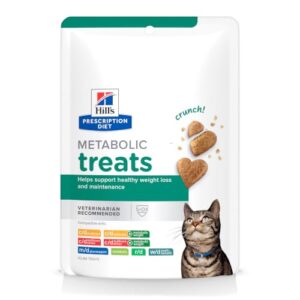
- 2.5 oz Metabolic weight treats
- Supplemental feeding only
- Not a hydrolyzed or grain-free bag

How we evaluated
This evaluation uses published product labels, guaranteed analyses, and recall records.
We read the Hill’s Metabolic treats page, the Hill’s Hypo treats page, retailer copies of the Metabolic guaranteed analysis and calorie line, and the FDA, AAFCO, Cornell, and WSAVA pages on complete foods and treat calories. The 27 kcal example is arithmetic on the brand’s 1.21 kcal line. Nobody here fed these treats to a cat. The score is an editorial label fit.
Editorial evaluation from published labels / literature — not a lab test or boarding trial.
Editorial picks are not sold to brands. How we make money.
Affiliate disclosure: Cats Luv Us is a participant in the Amazon Services LLC Associates Program. Product links on this page are affiliate links. If you buy through them we earn a commission, at no extra cost to you. This never changes which products we recommend or how we rank them.
Prescription cat treats are a named bag, not a category of healthy snacks
Prescription cat treats are easy to misunderstand. The word sounds like a medicine. On this bag it means a Hill’s Prescription Diet food that retailers sell only after a veterinarian authorizes it. The food linked here is Metabolic cat treats: a 2.5 ounce bag of chicken-flavor crunchy hearts for adult cats on a weight plan. It is not a kidney treat, not a hydrolyzed allergy treat, and not a grocery puree with a serious label.
The score is an editorial label fit for how clearly that job is printed. It is not a weight-loss result. A cat can refuse the heart. A perfect label still fails at the bowl.
What the Metabolic bag actually says
The brand page says the treats support healthy weight loss and weight maintenance, with moderate calories, increased fiber, controlled protein and phosphorus, and low sodium. It says they are a complement for cats eating Prescription Diet c/d Multicare, c/d Multicare plus Metabolic Weight, c/d Multicare Stress, c/d Multicare Stress plus Metabolic Weight, m/d GlucoSupport, Metabolic, r/d, or w/d Multi-Benefit. It also names Science Diet Adult Perfect Weight and Science Diet Adult Light. It says the treats are formulated to be compatible with Prescription Diet foods that carry the S+OXSHIELD mark, which the brand describes as a urinary environment that reduces the risk of struvite and calcium oxalate crystals. That sentence is the brand’s claim. It is not a urine test from this page, and it does not turn the bag into a urinary diet you can start on your own.
The same page says to ask a veterinarian, to use the treats only as directed, and that the product is for intermittent or supplemental feeding only. That last line is the one that keeps the bag in the treat role. The meal stays the therapeutic food. The hearts are the counted extra.
How to read the numbers without mixing two tables
Two tables get confused.
The guaranteed analysis on retailer copies is an as-fed promise: at least 33 percent crude protein, at least 10 percent crude fat, and at most 10 percent crude fiber. Those are minimums and a maximum. They are not an assay of the cup you pour.
The brand’s dry-matter table removes moisture so foods can be compared. It lists 39.2 percent protein, 13.9 percent fat, 31.4 percent carbohydrate, 8.7 percent fiber, 0.82 percent phosphorus, and 0.5 percent sodium. Do not put 39.2 next to 33 and call one of them wrong. They are different math. Do not put 0.82 percent phosphorus next to a kidney diet and decide the diets match. A kidney diet is chosen by the veterinarian who has the bloodwork. This page does not make that choice.
Calories have the same split. The brand prints 1.21 kcal per treat. A retailer copy prints 1 kcal per treat. Until you read your bag, do not multiply the chart by the number you like better. The chart itself, for ideal body weight, runs from 10 treats a day at 6 pounds on the weight-loss line to 34 treats a day at 18 pounds on the maintenance line. The 10 pound row is 14 and 22. Twenty-two times 1.21 is about 27 kcal. Cornell’s feeding page still holds ordinary treats to about 10 to 15 percent of the day’s calories. The WSAVA cat treat guide says less than 10 percent. A therapeutic chart does not erase that idea. If 27 kcal is more than the clinic allowed, the clinic’s number wins.
A different disease is a different bag
Hill’s also sells Hypo cat treats. That page is hydrolyzed chicken liver, brewers rice, and corn starch, and it says the treats are for cats with food sensitivities and are compatible with Prescription Diet d/d, Gastrointestinal Biome, i/d, and z/d. The protein is hydrolyzed on purpose. The Metabolic bag is not that recipe. Chicken by-product meal, corn gluten, and wheat gluten are the opposite of a hydrolyzed plan.
A pill pocket is a third object. It is a soft cup for hiding a tablet. It is not this crunchy heart, and a grocery lickable tube is not this heart either. Hiding a dose in an unauthorized snack can break both the diet and the medicine. Ask before you improvise.
Weight, urinary disease, diabetes, and food allergy can show up in the same cat. The bag that is allowed is the one named in the plan, in the amount on the chart, beside the food the chart was written for. Buying a therapeutic treat because the cat seems heavy, itchy, or thirsty skips the step the authorization box is there for.
Who this bag is for
It fits an adult or senior cat whose veterinarian already has them on Metabolic or on another food the brand page lists, and who still wants a crunchy reward. It fits a house that will count hearts the way it counts the meal. It is a poor fit if you wanted a grain-free tube, a single-ingredient freeze-dried bite, or a treat you can share with a second cat who is not on the same diet. Feed the treat where you can see who ate it.
It is the wrong bag for a kitten. The page describes adult cats. It is the wrong bag if the clinic has not seen the cat. Authorization on a website is not a suggestion to diagnose weight, crystals, or diabetes from a label.
Transition language on the brand site is written for changing the food over about seven days. Treats are the small side of that change. Add them only when the new food is the one the veterinarian named, and stop if appetite or stool changes. That is a reason to call the clinic, not a reason to shop for a different prescription flavor on your own.
Conclusion
Prescription cat treats are a match between one bag and one plan. The bag linked here is Hill’s Metabolic cat treats: 2.5 ounces, chicken-flavor hearts, supplemental only, with a printed daily cap and a list of Hill’s foods it is meant to accompany. It is not a hydrolyzed treat, not a meal, and not a grocery snack with a clinical name. Read the calorie line on the bag you opened, and leave the rest of the bowl where the veterinarian put it.
Hill’s Prescription Diet Metabolic cat treats, 2.5 oz
Best for: An adult cat on Metabolic or another diet the bag names, when treats have to stay inside that plan
- Bag size
- 2.5 oz
- Form and flavor
- Crunchy heart, chicken
- Brand calories
- 1.21 kcal per treat
- Role on the bag
- Supplemental, not a meal
- Retailer guaranteed analysis
- 33% protein min, 10% fat min, 10% fiber max
- First ingredient
- Chicken by-product meal
The Amazon listing linked on this page is Hill’s Prescription Diet Metabolic weight-management cat treats. The brand page describes a 2.5 ounce bag of chicken-flavor crunchy heart-shaped treats for adult cats, for healthy weight loss and weight maintenance. The ingredient list starts with chicken by-product meal, brewers rice, corn gluten meal, and powdered cellulose, then tomato pomace, flaxseed, chicken fat, and wheat gluten. L-carnitine, taurine, and mixed tocopherols are on the list. Rice, corn, and wheat mean the bag is not grain-free. Chicken by-product meal is not the same phrase as deboned chicken.
The brand calorie line is 3448 kcal per kilogram and 1.21 kcal per treat. A Chewy copy of the same treats prints 1 kcal per treat. Use the bag in your hand. Retailer copies of the guaranteed analysis print 33.0 percent minimum crude protein, 10.0 percent minimum crude fat, and 10.0 percent maximum crude fiber. The brand’s dry-matter table is a different set of numbers: 39.2 percent protein, 13.9 percent fat, 31.4 percent carbohydrate, 8.7 percent fiber, 0.82 percent phosphorus, 0.5 percent sodium, and 0.19 percent taurine. Dry matter is the food with the water removed. It is not the guaranteed analysis, and it is not a number we measured.
The feeding line says to feed it as a treat or reward, that it is for intermittent or supplemental feeding only, and to use it only as the veterinarian directs. For a cat with an ideal weight of 10 pounds, the chart allows 14 treats a day on a weight-loss line and 22 on an adult-maintenance line. At 6 pounds those caps are 10 and 15. At 18 pounds they are 22 and 34. Twenty-two treats at the brand’s 1.21 kcal is about 27 kcal. That arithmetic uses the brand calorie line. It is not a reason to ignore a tighter calorie cap from the clinic.
Pros
- The brand page names the diets this treat is meant to sit beside
- It prints calories and a daily cap by ideal weight
Cons
- Some retailer calorie lines say 1 kcal, and the brand line says 1.21
- Rice, corn gluten, and wheat gluten mean this is not a grain-free or hydrolyzed treat
Frequently asked questions
What are prescription cat treats?
They are treats sold through a veterinary channel for a named job. The bag on this page is Hill’s Prescription Diet Metabolic cat treats, for weight loss and weight maintenance in adult cats. Retailers mark it as needing a veterinarian’s authorization. The bag does not contain a drug. It is a food with a narrow feeding role, and the label says it is not a meal.
Can I use these treats for kidney disease, diabetes, or a food allergy?
Not because the word prescription is on the bag. This recipe is the weight treat. The brand says it can complement specific Hill’s foods, including Metabolic, r/d, w/d, m/d, and some c/d Multicare combinations. A hydrolyzed food-sensitivity treat is a different Hill’s bag, the Hypo treats, built around hydrolyzed chicken liver and named for other diets. A kidney plan is its own diet. Do not swap bags because both require a veterinarian.
How many Metabolic treats can I give?
Use the chart on the bag, then the calorie cap your veterinarian set. The brand chart, for a 10 pound ideal weight, is 14 treats a day on the weight-loss line and 22 on the maintenance line. Cornell still puts ordinary treats around 10 to 15 percent of daily calories, and the WSAVA cat treat guide says less than 10 percent. If the chart and the calorie budget disagree, call the clinic that wrote the plan. Do not fill the gap with grocery treats.
Are prescription treats a complete diet?
No. This bag says intermittent or supplemental feeding only. The cat still needs the complete food in the plan. Replacing that food with treats, or adding a tuna puree on the side, changes the recipe the diet was built around. The FDA complete-and-balanced page is the plain-language version of why a supplemental statement is not a meal.
Why do calorie lines disagree?
The brand page prints 1.21 kcal per treat and 3448 kcal per kilogram. A retailer copy prints 1 kcal per treat. Both numbers are on public pages for this treat. They are not the same serving. Read the bag you opened. The dry-matter percentages on the brand site are also not the guaranteed-analysis minimums a retailer prints.
Sources
Going away? Keep your cat's routine on track.
Cats Luv Us Boarding Hotel & Grooming in Laguna Niguel, Orange County.