F1 vs F2 Savannah Cat (2026): Generations, Care & Ownership
F1 Savannahs have a serval parent; F2s have a serval grandparent. We compare generation labels, size and energy tendencies, legality practicality, and care needs using TICA and breed literature—not boarding trials or invented “wild blood” percentages.

In this review 11 sections
CatsLuvUs Copilot Search
Ask this review — not the open web
Answers are generated from this Cats Luv Us review only. We may earn a commission from Amazon links. Not veterinary advice.
Answer from this review
This score is editorial — based on labels, recall history, and veterinary guidance, not a lab test. How we evaluated.
Choose F1 only if legality, experience, space, and budget all clear; most households are better matched to F2—or later SBT generations—than to a serval-parent kitten.
Short answer: an F1 Savannah has a serval parent; an F2 has a serval grandparent. That filial step usually means F1s run larger and more intense on average, while F2s still need serious enrichment but are often described as a half-step more adaptable. Neither is a starter cat.
We do not invent genetic percentages. TICA’s breed story and registration codes (including SBT for three generations of Savannah-to-Savannah breeding) matter more than viral “wild blood” charts. Confirm state and city legality before you wire a deposit. If you proceed, budget for height, puzzles, and training gear—optional Amazon examples include a ~70-inch Yaheetech tree, a PetSafe Large harness, and a Nina Ottosson puzzle.
Optional gear for large, active Savannah households
How we compared F1 vs F2 (literature, not litter tests)
This is a breed-generation care and ownership guide for people researching Savannah cats. The Cats Luv Us Team did not board F1 and F2 Savannahs side-by-side for a scorecard. We mapped TICA’s Savannah breed materials, the TICA Savannah Breed Section’s filial explanations, and published size compilations, then translated that into practical household questions: legality, space, energy, and who should walk away.
Amazon cards below are optional enrichment gear verified through the Creators API (tag catsluvus03-20, rel="sponsored nofollow noopener").
What F1, F2, F3–F5, and SBT actually mean
In Savannah breeding language, F means filial generation—how many generations removed the cat is from an African serval ancestor:
- F1 — one parent is a serval (typically a serval sire and a domestic or Savannah dam).
- F2 — a serval appears as a grandparent (commonly an F1 bred to a Savannah or other domestic outcross).
- F3, F4, F5… — each step moves another generation away from that serval ancestor.
TICA registration also uses letter codes that track outcross depth. In plain English used by the breed section: A means one parent is an outcross (for example a serval), B and C push that outcross further back, and SBT (Stud Book Tradition) means at least three generations of Savannah-to-Savannah breeding. Championship showing generally requires SBT cats, which in practice start around F4 and later—not F1/F2 kittens fresh from a serval pairing.
What we will not do: quote viral “50% / 25% serval blood” figures as fact. Filial labels describe pedigree position. Actual genome share varies with which individuals were bred; inventing tidy percentages is how marketing posts mislead buyers.
Size and energy tendencies (not guarantees)
Early generations are usually the tallest and most athletic. The Savannah Cat Association publishes breeder-submitted height/weight compilations with an explicit caveat: some generations have few submissions, so averages move as data arrives. Treating those numbers as tendencies—not purchase contracts—is the honest reading.
From that public compilation (adults; samples vary):
| Generation / sex | Avg height (in) | Avg weight (lb) | Read as |
|---|---|---|---|
| F1 females | ~16.3 | ~19.4 | Often tallest class |
| F1 males | ~16.5 | ~22.9 | Often heaviest class |
| F2 females | ~14.0 | ~13.3 | Still tall vs many domestics |
| F2 males | ~14.8 | ~16.4 | Overlap with smaller F1s possible |
Individual F5s can outgrow sleepy F2s. Males usually outsize females. Long legs and large ears make Savannahs look heavier than the scale says—an SCA anecdote notes spectators guessing 18–22 lb on a 14 lb F3. Plan cage-free home space for a jumper, not a sofa potato.
Energy: breed writing and owner literature consistently describe F1s as the most intense—highly active, deeply bonded to a small human circle, often wary of strangers. F2s keep much of that athleticism and curiosity but are frequently painted as a step more socially flexible. Both generations need daily interactive play, vertical routes, and brains-on puzzles. Apartment life is possible only with deliberate enrichment—not “they’ll nap like a Persian.”
Temperament and household fit
TICA’s ideal Savannah is confident, alert, curious, and friendly. Real homes meet real personalities. Patterns that show up again and again in reputable breed explainers:
- Bonding: many early-generation cats shadow one or two people dog-style.
- Strangers: F1s more often keep distance; F2s may warm up faster if socialized.
- Kids & noise: busy toddler houses are a poor default match for either generation.
- Other pets: strong prey drive means birds, rodents, and small pets are high-risk housemates; dog introductions need professional-level management.
- Water & height: fascination with faucets and high perches is common lore—design the home accordingly.
None of that licenses “wild animal” fearmongering or “they’re just big tabbies” sales talk. Interview the breeder about this kitten’s parents, early handling, and return policy.
Legality and ownership practicality
There is no single U.S. federal ban on private Savannah pet ownership. Rules live in state wildlife / agriculture codes and often in city or county overlays. Early generations (commonly F1–F3, sometimes defined by other hybrid criteria) are the ones most often banned or permit-only. Later generations and SBT cats are legal in far more places—but “far more” is not “everywhere.”
Secondary roundups (Petful, Catster, Hepper, and similar) repeatedly flag patterns such as: some states restricting ownership to roughly F4+ or F5+; a smaller set prohibiting Savannahs outright; and local bans inside otherwise permissive states (examples often cited include certain large cities). Those lists go stale. Before you pay a deposit:
- Call or email your state wildlife or agriculture agency with the kitten’s generation and registration papers.
- Check city/county ordinances where the cat will live and where you might move in the next decade.
- Ask the breeder for documented generation codes—not verbal “mostly F5” shrugs.
- Remember landlords and insurers can say no even when the statute is silent.
USDA-APHIS Animal Welfare Act licensing is aimed at regulated businesses (certain breeders, exhibitors, transporters)—it is not a pocket permit that makes an illegal pet legal. If you breed or exhibit, talk to counsel/APHIS; if you want one pet cat, focus on state/local possession rules.
Care needs that actually differ by lifestyle
Generation predicts tendencies; care math is mostly about athleticism + brain:
- Vertical space: tall trees, shelves, and scratch posts sized for long bodies. A ~70-inch class tower (Yaheetech example or Heybly 71-inch) is a starting point, not the whole gym.
- Daily interactive play: wand toys, fetch, training sessions—budget time, not only money.
- Puzzle feeders: hunt-simulate meals (Nina Ottosson Buggin’ Out class puzzles).
- Secure outdoor access: enclosed catio or carefully trained harness work (PetSafe Large / vest-style rabbitgoo)—never unsupervised free roam in suburbia.
- Veterinary partnership: find a clinic comfortable with large, active cats before pickup day. We are not listing treatments or supplements as “Savannah medicine.”
- Diet: feed a complete feline diet appropriate to life stage per your veterinarian—ignore social-media raw-only dogma that skips calcium balance and pathogen risk.
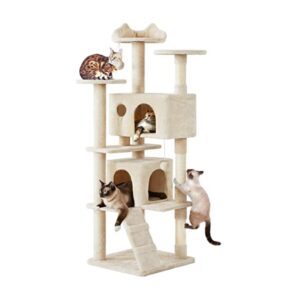
Yaheetech 70in Multi-Level Sturdy Cat Tree
Best for: Indoor Siberian households that need height and scratch posts in one footprint
- Height class
- ~70 in multi-level
- Creators brand
- Yaheetech
- Use case
- Vertical play + perch + sisal scratch
Yaheetech’s ~70-inch multi-level tree () is here as vertical territory, not as a breed product. Early-generation Savannahs are tall, long-legged climbers; breed literature and owner reports consistently flag height and scratch outlets as non-optional. This Creators-verified tower stacks condos, perches, sisal posts, and hanging toys into one footprint.
Read the weight guidance on the carton before you assume it is for a 20+ lb athlete. Bolt or wedge unstable trees, and pair furniture with daily interactive play—trees alone do not burn F1/F2 energy.
Pros
- Height suits a powerfully built, high-jumping forest type
- Useful enrichment for both sexes; boredom is not a male-only problem
- Media already in library from prior breed-care reviews
Cons
- Confirm base stability on your floor type; large males need secure footing
- Not a substitute for interactive play sessions
- Assembly required; measure ceiling clearance
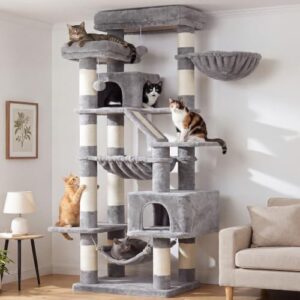
Heybly Cat Tree, 71-Inch-Tall Tower (HCT034W)
Best for: Owners comparing a second tall-tree ASIN for base size, color, or stock
- Listed height
- About 71 in
- Perches
- 2 perches (listing)
- Extras
- Hanging pompoms / toys
- Assembly
- Universal screws; listing emphasizes sturdy base
Heybly’s 71-inch HCT034W () is a second tall-tower example so shoppers are not stuck on a single SKU. Creators listing copy highlights multi-level climbing, hanging toys, and a base meant for large indoor cats.
For F1/F2 planning, think in circuits: tree → window perch → scratcher → puzzle. One tower is a start; bored early-generation cats invent their own parkour on fridge tops and drapes.
Pros
- Comparable height to other ~70-inch class trees
- Simple multi-level layout for climbing circuits
- Easy-clean marketing for fur-heavy households
Cons
- Still mass-market furniture—inspect joints after a powerful launch
- Two perches may feel sparse for multi-cat homes
- Not a medical or behavioral therapy device
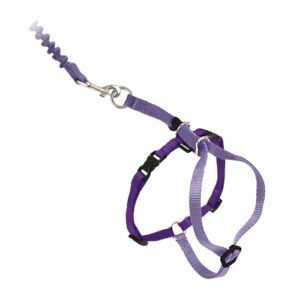
PetSafe Come With Me Kitty Harness and Bungee Leash (Large, Lilac)
Best for: Cats that hate bulky vests; owners who will obsess over girth fit and indoor training
- Type
- H-style harness + bungee leash
- Leash
- Bungee / shock-absorbing lead
- Fit cues (maker)
- Girth behind front legs; O-ring on ribcage; chest slide off the throat
- Wear note (maker)
- Do not leave harness on when not in use
PetSafe Come With Me Kitty (Large) () is a classic cat harness + bungee leash pairing. Athletic Savannahs are often walked by experienced owners—but only after positive indoor fitting sessions, and only where it is legal and safe.
This is optional enrichment gear, not a requirement of the breed standard. If your cat panics or slips the harness, stop and rethink (vest-style escape-proof options below, or a secure catio instead of sidewalk time).
Pros
- Minimal fabric—often better tolerated than heavy vests
- Bungee lead softens sudden jolts
- PetSafe publishes clear fit/acclimation steps
- Long-running SKU with multiple size/colorways
Cons
- Thin straps = less escape margin if girth loosens
- Head-loop dressing still bothers some cats
- Creators feature bullets are thin—read PetSafe size chart carefully
- Not a substitute for a wrap/vest on dedicated Houdini cats
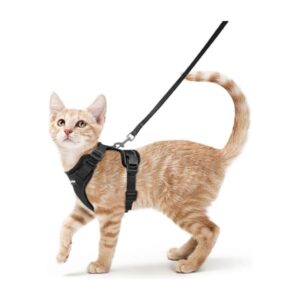
rabbitgoo Cat Harness and Leash Set, Escape Proof Vest
Best for: Owners whose cat backs out of simpler strap harnesses during training
- Fit band (listing)
- Neck ~8.5–11 in; chest ~11.8–18.1 in (verify size chart)
- Style
- Vest / air-mesh
- Leash attachment
- Reinforced back D-ring
rabbitgoo’s escape-oriented vest harness () is the alternate when a slim H-harness slides off a determined Savannah. Creators listing emphasizes soft air-mesh, four adjustable straps, and a back D-ring.
Affiliate honesty: we are not claiming this product is designed for hybrids. Measure your cat, practice indoors, and treat every outdoor minute as supervised. If local exotic-pet rules restrict early-generation ownership, a harness does not create a legal loophole.
Pros
- Vest coverage harder to wriggle out of than minimal straps for some cats
- Breathable mesh for warm climates
- Four-point adjustability
Cons
- Size chart may still be small for the largest males—measure twice
- No harness is truly escape-proof if poorly fitted
- Outdoor walks remain a judgment call around roads, dogs, and wildlife
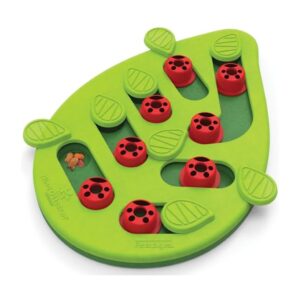
Catstages Nina Ottosson Buggin’ Out Puzzle & Play
Best for: Smart Sibs that invent trouble when under-stimulated
- Style
- Level-2 sliding treat puzzle
- Creators brand
- Catstages / Nina Ottosson
- Use case
- Solo enrichment between play sessions
Nina Ottosson Buggin’ Out () is a Level-2 cat puzzle feeder under the Catstages line. Early-generation Savannahs are routinely described as intensely curious and hunt-driven; a puzzle that holds about a quarter cup across many compartments is a practical, low-cost way to burn brain energy indoors.
Use it as part of a rotation with wand play and climbing—not as the only enrichment. Skip if your veterinarian has prescribed a strict measured diet you cannot portion into puzzles safely.
Pros
- Matches “intelligent problem-solver” breed marketing with an actual toy, not a myth
- Useful for males and females alike
- Portion treats so puzzle calories do not silently fatten a slow-maturing large breed
Cons
- Some cats flip the whole board—supervise early sessions
- Not a substitute for human interactive play
- Choking risk if plastic breaks—inspect regularly
Who should consider F1 vs F2 (vs later)
| Profile | Lean F1? | Lean F2? | Consider F4+/SBT instead? |
|---|---|---|---|
| First-time cat owner | Usually no | Usually no | Yes — or another breed |
| Experienced with high-drive breeds; legal F1 jurisdiction; big budget/space | Maybe | Also fine | Still worth comparing |
| Family with young kids / many guests | Poor default | Cautious maybe | Often better |
| Jurisdiction bans early gens | No | Maybe / no | Yes if legal |
| Wants show-eligible SBT path | No (too early) | No (too early) | Yes |
| Apartment with weak enrichment plan | No | No | Only with a serious enrichment plan |
Bottom line: F1 is a specialist purchase. F2 is still a specialist purchase with slightly broader household tolerance on average. Many loving Savannah homes are happiest with later SBT generations that keep the look and athletic spark without early-generation legal and intensity overhead.
Cost, lifespan, and health honesty
Purchase prices swing hard by generation, cattery reputation, and region; F1 kittens commonly command the highest deposits. We will not invent dollar figures that go stale by next season—ask multiple TICA-oriented breeders for current ranges and what is included (registration, spay/neuter contracts, vaccines, transport).
Lifespan chatter for Savannahs often lands in the low-to-mid teens when care is solid, but that is not a warranty. Health-wise, work with your veterinarian on ordinary feline wellness (parasite control, dental care, injury risk from high jumps). Hybrid marketing that promises disease-proof “wild vigor” is a red flag. Conversely, panic blogs that treat every Savannah as an untouchable exotic ignore decades of domestic breeding under TICA rules for later generations.
What we like
- Clear filial definitions without invented DNA percentages
- Size tendencies anchored to published breeder-submitted averages
- Legality framed as verify-local, not a fake nationwide chart
- Care section tied to enrichment products you can actually buy
What we don't
- Individual cats vary more than generation labels imply
- Affiliate ASIN set is enrichment gear, not Savannah-specific medical products
- State exotic-pet statutes change—any published list can go stale
F1 vs F2 Savannah — FAQ
What is the main difference between an F1 and an F2 Savannah cat?
An F1 has a serval parent. An F2 has a serval grandparent. That pedigree step usually tracks with larger average size and more intense energy in F1s, but individuals vary—and we do not convert those labels into invented DNA percentages.
Are F1 Savannah cats legal everywhere in the U.S?
No. Legality is set by state and often city/county rules. Early generations are the most frequently restricted. Verify with your wildlife or agriculture agency using the kitten’s documented generation before you buy.
How big do F1 vs F2 Savannahs get?
Breeder-submitted compilations (Savannah Cat Association) show F1 averages roughly in the mid-teens inches at the shoulder and high-teens to low-20s pounds, with F2 averages somewhat lower—but ranges overlap and sample sizes differ by generation. Plan for a tall athlete either way.
Are F2 Savannahs better with families than F1s?
They are often described as a step more socially flexible, but neither generation is an automatic “family cat.” Socialization, household noise, and supervision matter more than the letter on the pedigree. Many families do better with later SBT generations—or a different breed.
What does SBT mean?
Stud Book Tradition: at least three generations of Savannah-to-Savannah breeding in the pedigree. SBT cats are the ones generally eligible for TICA championship classes and typically appear at F4 and later.
Do I need special enrichment for early-generation Savannahs?
Yes—daily interactive play, tall climbing furniture, and food puzzles are baseline, not optional extras. Optional Amazon examples we verified via Creators: tall ~70-inch trees, Large cat harnesses for trained walks, and Level-2 puzzle feeders.
Can you walk a Savannah on a harness?
Some experienced owners do, after slow indoor training and only in safe, legal settings. Use a well-fitted cat harness (Large sizes for bigger chests) and supervise every minute. A harness does not replace a secure catio or indoor enrichment.
Sources
- TICA — Savannah breed overview & history (registration 2001; Championship 2012): tica.org/breed/savannah
- TICA Savannah Breed Standard (SV) PDF — general description & temperament ideal: sv.pdf
- TICA Official Savannah Breed Section — filial generations & SBT explanation: savannahbreedsection.com
- Savannah Cat Association — size-by-generation breeder-submitted data (limited-sample caveat): savannahcatassociation.org/savannah-cat-size
- USDA-APHIS — Animal Welfare licensing overview (commercial regulated activities): aphis.usda.gov/awa/apply
- Secondary legality pattern maps (verify locally; lists change): Petful / Catster / Hepper Savannah legality explainers (2025–2026 editions referenced in research notes)
- Amazon Creators API — product titles/images for enrichment ASINs , , , , (partner tag catsluvus03-20)
Going away? Keep your cat's routine on track.
Cats Luv Us Boarding Hotel & Grooming in Laguna Niguel, Orange County.