Applehead vs Wedgehead Siamese (2026): Type Labels Explained
“Applehead” and “wedgehead” are pet-world nicknames for Siamese head types—not official CFA breed names. We unpack the show-standard shift, how traditional looks overlap (imperfectly) with registered Thai cats, and what temperament and health literature actually support—without invented percentages or boarding scorecards.

In this review 12 sections
CatsLuvUs Copilot Search
Ask this review — not the open web
Answers are generated from this Cats Luv Us review only. We may earn a commission from Amazon links. Not veterinary advice.
Answer from this review
This score is editorial — based on labels, recall history, and veterinary guidance, not a lab test. How we evaluated.
Treat applehead and wedgehead as informal type labels: choose CFA (or TICA) modern show Siamese when you want the long wedge ideal; choose a registered Thai or documented traditional program when you want moderate old-style type; choose any healthy pointed companion when nicknames matter less than temperament fit and transparent health practices.
Short answer: Wedgehead is everyday slang for the modern show Siamese—the long tapering head and svelte tubular body written into CFA’s (and TICA’s) Siamese standards. Applehead is everyday slang for a rounder-cheeked, more moderate traditional look. Neither word is an official CFA breed name. Overlap with TICA/WCF Thai is real but not automatic—papers beat Instagram labels.
For the breed-package deep dive (TICA Thai vs CFA Siamese), see our related guide Thai vs Siamese cats. Optional enrichment examples include a ~70-inch Yaheetech tree, a PetSafe Large harness, and a Nina Ottosson puzzle. Soft boarding note: vocal pointed cats hate being ignored—ask any hotel, including Cats Luv Us, how staff engage social breeds.
Optional gear for vocal, active Siamese-type households
How we compared applehead vs wedgehead (literature, not litter tests)
This is a type-label and ownership guide for people who typed “applehead vs wedgehead Siamese” into a search box. The Cats Luv Us Team did not board rounder-headed and show-wedge Siamese side-by-side for a scorecard. We mapped CFA’s Siamese breed page and standard, National Siamese Cat Club historical writing on “traditional” type, TICA Thai materials (including the explicit applehead caveat), TICA’s modern Siamese group standard, and high-level veterinary health literature—then translated that into household questions: what the nicknames mean, how show fashion shifted, where Thai registration fits, and which health questions actually belong on a contract.
Amazon cards below are optional enrichment gear verified through the Creators API (tag catsluvus03-20, rel="sponsored nofollow noopener").
Nicknames, not CFA breed names
If you remember one sentence from this article, make it this:
- Wedgehead — everyday slang for the modern show Siamese ideal: a long tapering head that forms a triangle from nose to ear tips, large ears continuing those lines, and a long, svelte, tubular body. That is the look CFA’s written Siamese standard describes, and it matches the oriental wedge language in TICA’s Siamese breed-group standard.
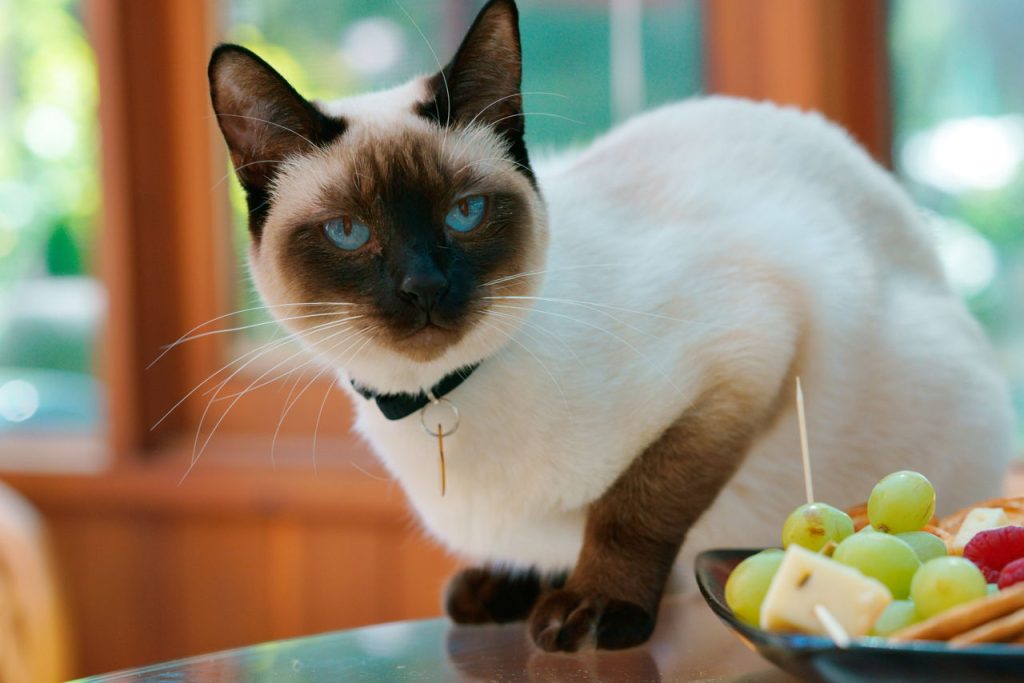
- Applehead — everyday slang for a rounder-cheeked, more moderate traditional pointed look: heavier bone than today’s top show Siamese, a less extreme profile, and (often) a thicker-feeling short coat. It is a colloquial American label, not a universal registry name.
Both nicknames usually still mean a colorpoint cat with blue eyes. The fight is about conformation and marketing language—not whether the coat is pointed.
How the show look shifted (and why people still argue)
Search results love a simple villain story: either “breeders ruined Siamese into alien wedges” or “appleheads are mongrels pretending to be royal.” Real registry writing is messier—and more honest.
CFA’s public breed story acknowledges a widespread perception that the look changed, then argues that top show Siamese stayed on a long, refined path while the 1950s popularity boom also produced cats with rounder heads, heavier bone, and washed-out eye color for pet demand. CFA’s current standard still centers a long tapering wedge, flat skull, strikingly large ears, almond eyes slanted with the wedge, and a graceful tubular body—balance and refinement, not a cartoon “coffin head.”
National Siamese Cat Club traditional writing (Debbi Stevenson) pushes further against the “applehead = original” claim: early English descriptions (Harrison Weir 1889; Frances Simpson 1902) and mid-century CFA language already talked about long, tapering, pointed heads and slender bodies. That essay also argues many rounder “traditional” pets likely reflect early outcrosses and 1940s–50s colorpoint pet breeding—not a secretly preserved pure original—and it rejects unsupported claims that appleheads automatically live longer or dodge the same genetic strengths and weaknesses as show Siamese.
Thai / old-style advocates tell a parallel story from the other side of the ring: from the 1950s onward, some breeders kept (or returned to) a moderate early-20th-century look while mainstream show Siamese became more extreme; 1980s clubs formed around that moderate type; the World Cat Federation granted the old-style package championship status under the name Thai around 1990; later imports of native pointed cats from Thailand (Wichienmaat) helped expand gene pools; TICA materials describe Preliminary New Breed status in 2007 and Advanced New Breed in 2009.
Cats Luv Us take: you can care about early import language and care about preserving moderate type under Thai standards. What you should not do is buy a kitten on a viral nickname alone, or accept invented “original blood percentage” charts with no papers.
CFA, TICA, and Thai crossover (without rewriting the whole Thai article)
| Question | Practical answer |
|---|---|
| Does CFA register “applehead Siamese” as its own breed? | No. CFA recognizes Siamese under the modern wedge standard; no separate CFA Thai / applehead breed on the current recognized list. |
| What does “wedgehead” map to in CFA? | Everyday slang for cats bred and judged toward CFA’s long-wedge Siamese ideal. |
| What does “applehead” sometimes map to in TICA? | Often the look people mean when they want moderate old-style type—but TICA’s official breed name for that package is Thai, and TICA says applehead is colloquial and not universally synonymous. |
| Does TICA still have modern Siamese? | Yes. TICA maintains a Siamese (oriental wedge) breed group alongside Thai. “Which association?” is part of “which cat?” |
| European name history? | WCF’s ~1990 Thai championship status is the common citation for separating old-style from modern show Siamese in Europe. |
Practical takeaway for shoppers: if show CFA Siamese matters, ask for CFA Siamese registration and look at parents against the wedge standard. If registered moderate old-style matters, ask for Thai papers (TICA or another registry that actually recognizes Thai)—not a Facebook album titled “rare applehead royals.”
Appearance: rounder traditional mug vs modern wedge triangle
Side-by-side photos still beat adjectives—but written standards beat marketing captions.
| Trait | Applehead / traditional (colloquial) | Wedgehead / modern show Siamese |
|---|---|---|
| Head nickname | Rounder cheeks; less extreme profile; “apple” is slang, not a skull diagnosis | Long tapering wedge; nose-to-ear-tips triangle |
| Closest formal map | Often overlaps with TICA Thai moderate type (rounded upper head + projecting muzzle wedge)—not automatically the same | CFA Siamese standard / TICA Siamese group wedge language |
| Ears | Medium to moderately large; less “finish the triangle” drama | Strikingly large, wide at base; continue the wedge lines |
| Eyes | Often described as rounder aperture in pet-world writing; still typically blue in pointed cats | Almond, slanted with the wedge; deep vivid blue in CFA’s four traditional colors |
| Body / bone | Heavier, more substantial / “stockier” than top show Siamese | Graceful tubular body; fine bones with firm muscle; long neck, legs, tail |
| Coat feel (pet descriptions) | Sometimes thicker / “flannel” short coat in informal writing | Short, fine, glossy, close-lying |
| Pattern | Colorpoint family (pale body, darker points, blue eyes) | Same pattern family; CFA championship colors: seal, chocolate, blue, lilac |
TICA’s trademark language for Thai is worth repeating here because applehead ads misuse it: a laterally rounded upper head with a projecting wedge-shaped muzzle—not a western round doll head and not an extreme show triangle. If a seller’s photos look halfway between nicknames, believe the registration papers more than the hashtags.
Temperament: stereotypes without invented science
CFA describes Siamese as unmatched communicators—intelligent, insistent, warmth-seeking, and intensely people-oriented. TICA’s Thai introductions likewise frame social, people-focused companions. Internet folklore that “appleheads are the quiet cuddly ones” and “wedgeheads are neurotic screamers” is too tidy.
Both nickname camps are routinely described as vocal and social. Individuals, early socialization, and household enrichment drive day-to-day noise and clinginess more than cheek roundness. Plan for a talkative roommate either way.
Practical takeaway: if you work long hours alone and want a low-engagement cat, neither nickname is a set-and-forget choice. A second compatible cat, interactive play, vertical space, and puzzle feeders help—but they do not replace people time.
Health notes (vet-sourced—no invented %)
We will not invent tidy risk percentages for “all appleheads” or “all wedgeheads.” Ask breeders what they screen for, and partner with your veterinarian. Literature and registry honesty that do belong on this page:
- Dental disease: Cornell’s Feline Health Center notes that genetics play a role and lists Siamese among purebreds that tend to be at greater dental risk, alongside ordinary plaque-driven disease that affects many cats as they age. Budget for dental exams and home care—not breed myth.
- Amyloidosis (Siamese/Oriental-type association): CFA’s Siamese page flags amyloidosis (liver problems) as an ongoing research concern and urges buyers to ask about line history. University of Missouri’s feline genetics program describes a familial AA-amyloidosis form in Siamese/Oriental lines that predominantly affects the liver. Classic veterinary reports (for example Van der Linde-Sipman et al., 1997) documented generalized AA-amyloidosis in Siamese and Oriental cats. This is not a guaranteed diagnosis for every pointed cat—nor something to shrug off because a listing says “applehead.”
- Progressive retinal atrophy (PRA): CFA notes a recessive PRA gene detectable by genetic testing; responsible breeders can avoid carrier × carrier matings.
- Nickname honesty: The National Siamese Cat Club’s traditional essay argues appleheads share ancestry and genetic strengths/weaknesses with show Siamese rather than holding a magic health exemption. Extreme conformation in any breed can raise welfare questions—ask about breathing, bite, and mobility when you meet parents—but do not treat “round head = healthy / wedge = doomed” as science.
Care that actually matters for pointed vocal cats
Head shape does not rewrite the basics. The practical delta vs a low-key domestic shorthair is mostly people time + brain + height:
- Grooming: short coats—CFA notes hand-grooming or a rubber brush often suffices; they still shed.
- Vertical space: tall trees and shelves. A ~70-inch class tower (Yaheetech example or Heybly 71-inch) is a starting point.
- Daily interactive play: wand toys and training sessions—budget time, not only money.
- Puzzle feeders: hunt-simulate meals (Nina Ottosson Buggin’ Out class puzzles).
- Optional leash work / secure outdoors: carefully trained harness walks (PetSafe Large / vest-style rabbitgoo) or a catio—never unsupervised free roam in suburbia.
- Travel / boarding: vocal breeds often stress when ignored. If you need boarding in Orange County, ask how staff engage social cats—Cats Luv Us is built around supervised hotel-style care, not a silent warehouse stack of cages. Soft recommendation, not a hard sell: match enrichment expectations before you book any facility.
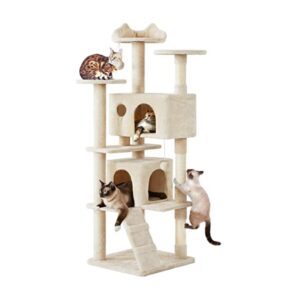
Yaheetech 70in Multi-Level Sturdy Cat Tree
Best for: Indoor Siberian households that need height and scratch posts in one footprint
- Height class
- ~70 in multi-level
- Creators brand
- Yaheetech
- Use case
- Vertical play + perch + sisal scratch
Yaheetech’s ~70-inch multi-level tree () is here as vertical territory, not as a breed product. Applehead and wedgehead nicknames disagree about skull shape; they agree that pointed companions are usually climbers and commentators. This Creators-verified tower stacks condos, perches, sisal posts, and hanging toys into one footprint.
Read the weight guidance on the carton. Bolt or wedge unstable trees, and pair furniture with daily wand play. A tree does not replace the human attention these cats are famous for demanding.
Pros
- Height suits a powerfully built, high-jumping forest type
- Useful enrichment for both sexes; boredom is not a male-only problem
- Media already in library from prior breed-care reviews
Cons
- Confirm base stability on your floor type; large males need secure footing
- Not a substitute for interactive play sessions
- Assembly required; measure ceiling clearance
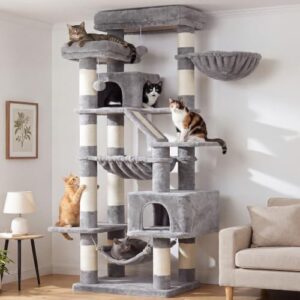
Heybly Cat Tree, 71-Inch-Tall Tower (HCT034W)
Best for: Owners comparing a second tall-tree ASIN for base size, color, or stock
- Listed height
- About 71 in
- Perches
- 2 perches (listing)
- Extras
- Hanging pompoms / toys
- Assembly
- Universal screws; listing emphasizes sturdy base
Heybly’s 71-inch HCT034W () is a second tall-tower example so shoppers are not stuck on a single SKU. Creators listing copy highlights multi-level climbing, hanging toys, and a base meant for large indoor cats.
For either Siamese type nickname, think in circuits: tree → window perch → scratcher → puzzle → human lap. One tower is a start; under-stimulated vocal cats invent parkour on fridge tops and drapes.
Pros
- Comparable height to other ~70-inch class trees
- Simple multi-level layout for climbing circuits
- Easy-clean marketing for fur-heavy households
Cons
- Still mass-market furniture—inspect joints after a powerful launch
- Two perches may feel sparse for multi-cat homes
- Not a medical or behavioral therapy device
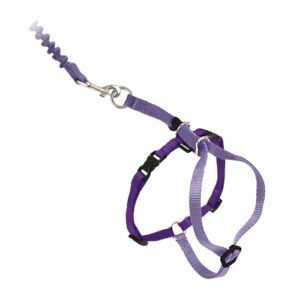
PetSafe Come With Me Kitty Harness and Bungee Leash (Large, Lilac)
Best for: Cats that hate bulky vests; owners who will obsess over girth fit and indoor training
- Type
- H-style harness + bungee leash
- Leash
- Bungee / shock-absorbing lead
- Fit cues (maker)
- Girth behind front legs; O-ring on ribcage; chest slide off the throat
- Wear note (maker)
- Do not leave harness on when not in use
PetSafe Come With Me Kitty (Large) () is a classic cat harness + bungee leash pairing. Some pointed-breed households enjoy carefully trained supervised walks—but only after positive indoor fitting sessions, and only where it is safe and legal.
Optional enrichment gear, not a requirement of any head-type nickname. If your cat panics or slips the harness, stop and rethink (vest-style options below, or a secure catio instead of sidewalk time).
Pros
- Minimal fabric—often better tolerated than heavy vests
- Bungee lead softens sudden jolts
- PetSafe publishes clear fit/acclimation steps
- Long-running SKU with multiple size/colorways
Cons
- Thin straps = less escape margin if girth loosens
- Head-loop dressing still bothers some cats
- Creators feature bullets are thin—read PetSafe size chart carefully
- Not a substitute for a wrap/vest on dedicated Houdini cats
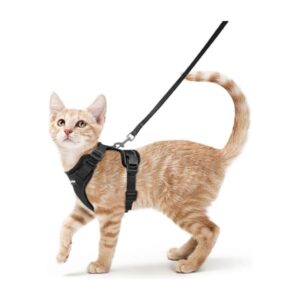
rabbitgoo Cat Harness and Leash Set, Escape Proof Vest
Best for: Owners whose cat backs out of simpler strap harnesses during training
- Fit band (listing)
- Neck ~8.5–11 in; chest ~11.8–18.1 in (verify size chart)
- Style
- Vest / air-mesh
- Leash attachment
- Reinforced back D-ring
rabbitgoo’s escape-oriented vest harness () is the alternate when a slim H-harness slides off a determined athlete. Creators listing emphasizes soft air-mesh, four adjustable straps, and a back D-ring.
Affiliate honesty: we are not claiming this product is designed for applehead or wedgehead Siamese. Measure your cat, practice indoors, and treat every outdoor minute as supervised.
Pros
- Vest coverage harder to wriggle out of than minimal straps for some cats
- Breathable mesh for warm climates
- Four-point adjustability
Cons
- Size chart may still be small for the largest males—measure twice
- No harness is truly escape-proof if poorly fitted
- Outdoor walks remain a judgment call around roads, dogs, and wildlife
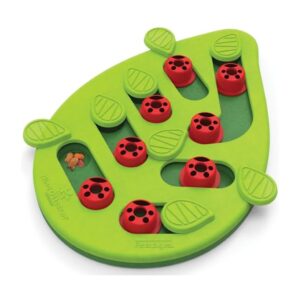
Catstages Nina Ottosson Buggin’ Out Puzzle & Play
Best for: Smart Sibs that invent trouble when under-stimulated
- Style
- Level-2 sliding treat puzzle
- Creators brand
- Catstages / Nina Ottosson
- Use case
- Solo enrichment between play sessions
Nina Ottosson Buggin’ Out () is a Level-2 cat puzzle feeder under the Catstages line. Vocal, social pointed cats often need brain work as much as lap time; a puzzle that holds about a quarter cup across many compartments is a practical, low-cost way to burn mental energy indoors.
Use it as part of a rotation with wand play and climbing—not as the only enrichment. Skip if your veterinarian has prescribed a strict measured diet you cannot portion into puzzles safely.
Pros
- Matches “intelligent problem-solver” breed marketing with an actual toy, not a myth
- Useful for males and females alike
- Portion treats so puzzle calories do not silently fatten a slow-maturing large breed
Cons
- Some cats flip the whole board—supervise early sessions
- Not a substitute for human interactive play
- Choking risk if plastic breaks—inspect regularly
Who should lean applehead-traditional vs modern wedge
| Profile | Lean traditional / applehead look? | Lean modern wedge? |
|---|---|---|
| Wants CFA show-wedge silhouette / CFA ring path | Usually no | Yes — CFA Siamese papers |
| Wants registered moderate old-style pointed cat | Yes — seek Thai registration (TICA/WCF/etc.), not the nickname alone | Usually no (wrong standard) |
| Wants a pointed companion; papers secondary | Either look-alike OK if temperament + health practices fit | Either look-alike OK if temperament + health practices fit |
| Needs a quiet, low-engagement cat | Poor average fit | Poor average fit |
| Confused by “rare applehead” ads | Ask for Thai (or other) registration + health testing in writing | Ask for CFA/TICA Siamese registration if show type matters |
| Already read Thai vs Siamese guide | Use this page for nickname clarity; that page for breed packages | Same |
Bottom line: pick modern wedge when you want the CFA/TICA show Siamese package. Pick traditional/applehead looks when you want a moderate old-style pointed cat—and prefer Thai papers when the registry name matters. Pick a healthy pointed individual from a transparent seller when Instagram labels matter less than living with a chatty friend.
What we like
- Separates informal nicknames from CFA/TICA/WCF breed packages
- Shows both CFA/NSCC and Thai/old-style historical narratives without crowning a fake winner
- Appearance table tied to written standards, not meme drawings
- Health notes limited to vet-sourced associations without invented %
What we don't
- Individual cats vary more than any applehead/wedgehead stereotype
- Affiliate ASIN set is enrichment gear, not head-type medical products
- Full Thai vs modern Siamese registry comparison lives in the related article—kept to a soft link here
Applehead vs wedgehead Siamese — FAQ
Are applehead and wedgehead official Siamese breeds?
No. They are informal type nicknames. CFA recognizes the Siamese under a modern wedge show standard; it does not list separate “applehead” or “wedgehead” breeds. TICA likewise maintains a wedge-oriented Siamese standard and a separate moderate Thai breed—not an “applehead” breed name.
Is an applehead Siamese the same as a Thai?
Sometimes overlapping, not identical. TICA’s Thai materials say some people treat Thai as synonymous with “applehead Siamese” and others do not. A rounder-headed pointed pet is not automatically a registered Thai. Ask for Thai registration (where that is the goal), not the nickname alone. For the full Thai vs CFA Siamese package comparison, see our Thai vs Siamese guide.
Did modern wedgeheads ruin the original Siamese look?
It depends which history you trust—and both camps cite early sources. CFA’s breed page and National Siamese Cat Club traditional essays argue early imports and mid-century standards already described long tapering heads, while the 1950s pet boom also produced rounder, heavier cats. Thai/old-style advocates argue moderate early-20th-century and native Thai pointed cats were sidelined as show type became more extreme. We present both narratives; we do not invent a single “true original” verdict.
Does CFA recognize traditional or applehead Siamese as a separate breed?
No. CFA recognizes the Siamese (founding-era breed with today’s long-wedge standard) and does not list a separate Thai or “traditional Siamese” breed on its current recognized-breed roster. If you want Thai as a named breed, look to TICA, WCF, and other registries that adopted Thai standards.
Are appleheads quieter or healthier than wedgeheads?
Do not count on either claim. Breed literature for modern Siamese and for Thai/old-style programs emphasizes social, communicative companions. Health talking points that belong on the page are dental care (Cornell notes Siamese among higher-risk purebreds), PRA testing where relevant (CFA), and amyloidosis line history (CFA + veterinary literature)—not invented longevity percentages for a nickname. The National Siamese Cat Club’s traditional essay likewise rejects unsupported claims that appleheads automatically live longer or dodge shared genetics.
What health questions should pointed-cat buyers ask?
Ask about dental care plans, PRA genetic testing where the lines use it, and any amyloidosis history the breeder will discuss honestly. Ask for registration pathway in writing. We do not invent prevalence percentages. Partner with your veterinarian on ordinary feline wellness regardless of skull nickname.
Which type fits a first-time owner?
Either nickname can work if you want a chatty, interactive companion and can fund enrichment, dental care, and attention. If you want a quiet, independent cat that entertains itself all day, meet many individuals—or look at other temperaments—before paying a pointed-breed premium. Prefer papers and meet-the-parents over viral “royal applehead” ads.
Sources
- CFA — Siamese breed page (history; 1950s popularity boom vs show type; temperament; grooming; PRA + amyloidosis honesty; standard language): cfa.org/breed/siamese
- CFA — Siamese Breed Standard (long tapering wedge; tubular body; point/eye language): siamese-standard.pdf
- CFA — Recognized breeds list (context: Siamese present; no separate Thai / applehead entry): cfa.org/breeds
- National Siamese Cat Club — Traditional / applehead essay by Debbi Stevenson (early Weir/Simpson language; 1950s pet-market type; rejects unsupported applehead health/longevity claims): nationalsiamese.com/traditional.htm
- TICA — Thai breed overview (Wichienmaat / old-style; moderate type; applehead colloquial caveat; WCF 1990 note; import history): tica.org/breed/thai
- TICA — Thai Breed Introduction PDF (head trademarks; 2007 Preliminary / 2009 Advanced New Breed notes): TICA-Thai-Breed-Introduction.pdf
- TICA — Thai breed standard PDF (TH): th.pdf
- TICA — Siamese breed group standard PDF (wedge / oriental type): si.pdf
- Cornell Feline Health Center — When Kitty Needs a Dentist (Siamese among higher-risk purebreds noted): Cornell FHC dental
- University of Missouri CVM — Feline amyloidosis research (Siamese/Oriental hepatic AA form): Missouri CVM amyloidosis
- Van der Linde-Sipman et al. (1997) — Generalized AA-amyloidosis in Siamese and Oriental cats: PubMed 9220576
- Cats Luv Us — Thai vs Siamese cats (related registry deep dive, post 82567): Thai vs Siamese guide
- Amazon Creators API — product titles/images for enrichment ASINs , , , , (partner tag catsluvus03-20)
Going away? Keep your cat's routine on track.
Cats Luv Us Boarding Hotel & Grooming in Laguna Niguel, Orange County.