Best Wet Cat Food for Kittens: Growth Statement First (2026)
Best wet cat food for kittens, on this page, is five packs already linked. The growth statement comes first. The calorie line has to match the can in the carton.

In this review 14 sections
CatsLuvUs Copilot Search
Ask this review — not the open web
Answers are generated from this Cats Luv Us review only. We may earn a commission from Amazon links. Not veterinary advice.
Answer from this review
This score is editorial — based on labels, recall history, and veterinary guidance, not a lab test. How we evaluated.
Read the growth line, then the calories on that can
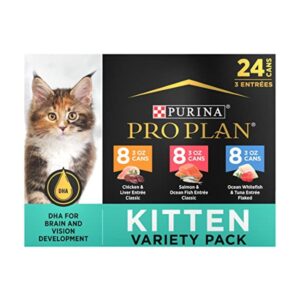
Best wet cat food for kittens, on this page, is five packs already linked. Purina Pro Plan DEVELOPMENT is the 24-can variety whose chicken-and-liver recipe carries animal-feeding-test language for growth and about 103 kcal per 3 oz can. Hill’s Science Diet is six 2.9 oz liver-and-chicken cans plus six 2.9 oz salmon cans, formulated for growing kittens and for gestating or lactating cats. The calorie line of 198 kcal sits with a feeding table labeled for 5.5 oz cans, so it does not automatically belong on this smaller pack. Fancy Feast is a 24-can pâté mix. The ocean whitefish recipe is formulated for growth and prints about 90 kcal per 3 oz can. Tiki Cat Baby shreds are 2.4 oz cans, and the chicken-salmon-liver recipe prints about 67 kcal. Sheba Perfect Portions Kitten is twin trays. The brand calls the chicken pâté complete and balanced for kittens. Retailer cards print about 42 kcal for that chicken tray and about 41 kcal for salmon. Soft food is moisture. It is not a vaccine, a dewormer, or a weight check.
Five packs, five different cans
- Feeding-test language on chicken and liver
- 103 kcal per 3 oz can
- Three or more meals
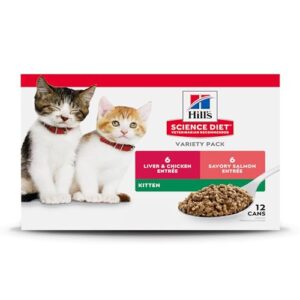
- Also names nursing cats
- Six and six, both 2.9 oz
- 198 kcal is the 5.5 oz table
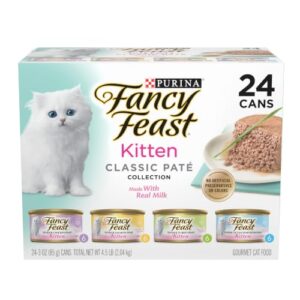
- Ocean whitefish is formulated for growth
- 90 kcal per 3 oz can
- Four recipes in the 24-pack
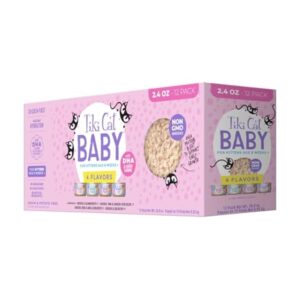
- 2.4 oz cans
- 67 kcal on one recipe
- Listing says 8 weeks and older
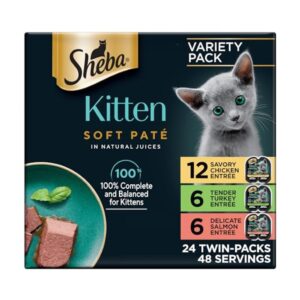
- Twin trays
- 42 kcal on the chicken card
- 48 servings on the listing
How we evaluated
This evaluation uses published product labels, guaranteed analyses, and recall records.
We read the current Purina, Hill’s, Fancy Feast, Tiki, and Sheba pages named in the sources, and the titles of the five listings already linked. The score is an editorial label fit. Nobody fed these cans for this page, and nobody weighed a kitten.
Editorial evaluation from published labels / literature — not a lab test or boarding trial.
Editorial picks are not sold to brands. How we make money.
Affiliate disclosure: Cats Luv Us is a participant in the Amazon Services LLC Associates Program. As an Amazon Associate I earn from qualifying purchases. Product links on this page are affiliate links. If you buy through them we earn a commission, at no extra cost to you. This never changes which products we recommend.
What this best wet cat food for kittens page is comparing
Best wet cat food for kittens is a life-stage problem before it is a flavor problem. A can can say kitten on the front and still carry an adult-maintenance statement on the back. These five listings are already wet, already aimed at kittens, and already different from each other in ounces, calories, and whose name is on the statement.
- Pro Plan DEVELOPMENT, 24 cans of 3 oz. Chicken and liver is the recipe with the feeding-test sentence.
- Hill’s Science Diet, 12 cans of 2.9 oz. Six liver and chicken, six salmon. The statement also names nursing cats.
- Fancy Feast, 24 cans of 3 oz. Four pâté recipes. Ocean whitefish is the label file we read.
- Tiki Cat Baby shreds, 12 cans of 2.4 oz. Four recipes, including chicken and egg. The listing says 8 weeks and older.
- Sheba Perfect Portions Kitten. Twin trays in chicken, turkey, and salmon. The listing counts 48 servings.
The adequacy statement is the filter
AAFCO’s consumer guide calls the nutritional adequacy statement the way you match the animal to the product. Recognized life stages include gestation and lactation, growth, maintenance, and all life stages. Complete means the nutrients are all there. Balanced means the ratios are right. Growth and maintenance are not the same quantities. A growing kitten is not an adult cat on a smaller spoon.
The statement is usually small print on the back or the side. Two complete wordings show up. One says the food is formulated to meet the AAFCO nutrient profiles for a named life stage. The other says animal feeding tests using AAFCO procedures substantiate complete and balanced nutrition for a named life stage. Feeding directions, when the food is complete, have to say how much to give per weight of the animal. A treat or a topper can skip that statement. A kitten’s only food cannot.
Side by side, from the current pages
| Pack | What is in it | Statement we could read | Calorie line | You still do |
|---|---|---|---|---|
| Pro Plan, 24 x 3 oz | Three recipes | Feeding tests, growth, on chicken and liver | 103 kcal on that can | Read the other two foils |
| Hill’s, 12 x 2.9 oz | Six and six | Formulated for growth and for nursing cats | 198 kcal is the 5.5 oz table | Use the small can’s own calorie |
| Fancy Feast, 24 x 3 oz | Four pâtés | Formulated for growth, on ocean whitefish | 90 kcal on that can | Do not copy one ingredient list |
| Tiki, 12 x 2.4 oz | Four recipes, including egg | Confirm the can. The listing says 8 weeks and older | 67 kcal on chicken, salmon, and liver | The feeding line is per pound |
| Sheba twin trays | Chicken, turkey, salmon | Brand line: complete and balanced for kittens | 42 kcal on the chicken card | Do not double-count the twin |
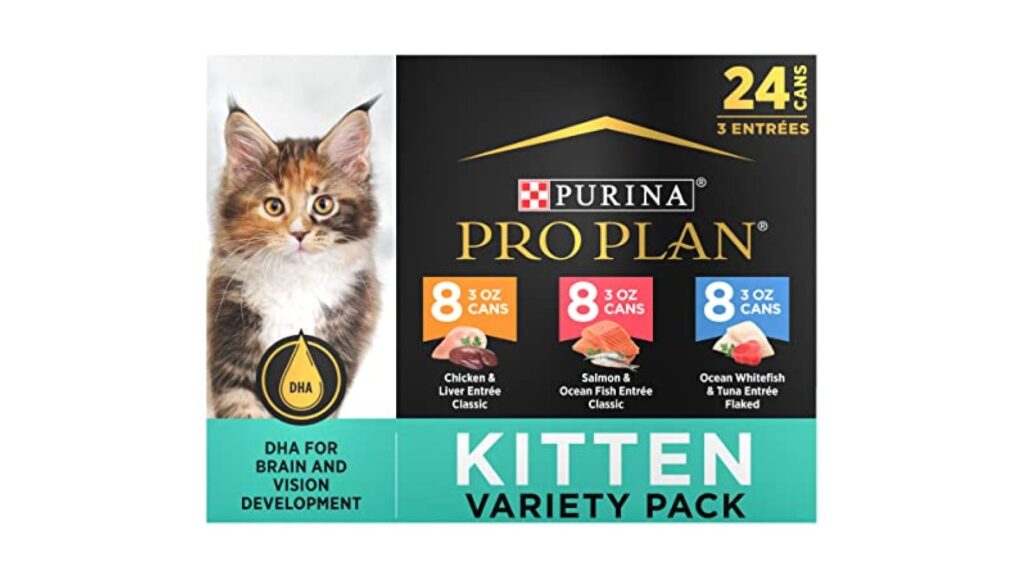
Purina Pro Plan DEVELOPMENT Kitten Favorites, 24 count
Best for: A healthy kitten when you want growth language from a feeding test on the chicken-and-liver can
- Carton
- 24 cans, 3 oz. Chicken and liver, salmon and ocean fish, ocean whitefish and tuna flaked.
- Chicken and liver path
- US shop page: animal feeding tests using AAFCO procedures for growth of kittens.
- That can
- 1212 kcal/kg, 103 kcal/can. Feed 1 can per 1.5 to 2 lb, split into 3 or more meals.
- Guaranteed analysis
- Chicken and liver: protein 12% min, fat 6% min, fiber 1.5% max, moisture 76.5% max, taurine 0.05% min.
- Name on the shop page
- The feeding-test sentence uses Pro Plan Focus Kitten Chicken and Liver. The listing says DEVELOPMENT.
The listing is Purina Pro Plan DEVELOPMENT Kitten wet food, 24 cans of 3 oz, with chicken and liver, salmon and ocean fish, and ocean whitefish and tuna flaked. The US shop page for the chicken-and-liver recipe says animal feeding tests using AAFCO procedures substantiate that Pro Plan Focus Kitten Chicken and Liver Entrée Classic provides complete and balanced nutrition for growth of kittens. That sentence uses the Focus name. The variety listing uses DEVELOPMENT. Treat them as the same chicken-and-liver family only after the foil matches. The shop page lists chicken, liver, fish, and meat by-products ahead of the water, then rice and guar gum. Guaranteed analysis on that page: crude protein 12.0% min, crude fat 6.0% min, crude fiber 1.5% max, moisture 76.5% max, ash 3.5% max, taurine 0.05% min. Calorie content is 1212 kcal/kg, 103 kcal/can. Feed 1 can per 1.5 to 2 lb of body weight daily, divided into three or more meals, then adjust for body condition. Refrigerate the unused portion.
The product description names DHA for brain and vision and antioxidants for a developing immune system. A US variety-pack card prints DHA at 0.01% minimum on the chicken-and-liver recipe, with the same 12% protein and 6% fat floor. That card is not a promise that the salmon can and the whitefish can print the same DHA line. A Canadian chicken-and-liver page uses formulation language and prints 99 kcal/can. This page follows the US shop page. Do not move the Canadian number onto a US can, or the feeding-test sentence onto a can you have not read.
Pros
- The growth path on the chicken-and-liver recipe is a feeding test, and the calorie is printed per can
- The feeding line says three or more meals, which matches a young kitten's day
Cons
- The other two recipes in the carton are not the can that sentence describes
- A Canadian chicken-and-liver page uses formulation language and a different calorie
Hill’s Science Diet Kitten, liver and chicken plus savory salmon, 12 count
Best for: A weaned kitten, or a pregnant or nursing cat, when you will use the calorie on the 2.9 oz can
- Carton
- 12 cans of 2.9 oz. Six liver and chicken, six savory salmon.
- Adequacy
- Formulated for growing kittens and for gestating or lactating adult female cats.
- Who it names
- From weaning until 1 year, and pregnant or nursing cats. Not adult maintenance.
- Calorie trap
- 198 kcal/can and 1270 kcal/kg sit with a feeding table labeled for 5.5 oz cans.
- Liver and chicken, dry matter
- Protein 43.9%, fat 28%, carbohydrate 16.7%. That is not the as-fed guarantee.
The listing is Hill’s Science Diet Kitten wet food, 12 cans of 2.9 oz: six Liver and Chicken Entrée and six Savory Salmon Entrée. Hill’s shop page describes the same split. Both are minced. The liver-and-chicken recipe page lists water, pork liver, pork by-products, chicken, chicken fat, and egg product, then corn starch, soybean meal, and corn protein meal, with fish oil, fructooligosaccharides, taurine, and carrageenan later. The first named animal ingredient is pork liver. The name Liver and Chicken does not mean chicken is first. Hill’s says the recipe is formulated to meet the nutritional levels established by the AAFCO Cat Food Nutrient Profiles for growing kittens and gestating or lactating adult female cats. Recommended for kittens from weaning until 1 year old and for pregnant or nursing cats. Not recommended for adult cats, cats 7 and older, or obese or obese-prone cats.
The calorie line on that recipe page is 1270 kcal/kg and 198 kcal/can. The feeding table beside it is labeled for 5.5 oz cans. This variety pack is 2.9 oz. Do not feed the 5.5 oz table as if each small can were 198 kcal. Dry-matter figures on the same page are about 43.9% protein, 28% fat, and 16.7% carbohydrate. Dry matter is the food with water removed. It is not the percentage in the spoon. Hill’s also says to keep fresh water available, to cover and refrigerate the unused portion, and to mix the new food in over 7 days. The salmon cans in this pack need their own foil. A liver-and-chicken statement does not automatically reprint itself on the salmon label.
Pros
- The statement covers kittens and gestating or lactating cats, which the Pro Plan sentence we read does not
- The carton split is printed: six and six, both 2.9 oz
Cons
- The 198 kcal line belongs to the 5.5 oz table, and this pack is the smaller can
- Adult cats, cats 7 and older, and cats already heavy are on the not-recommended line
Fancy Feast Kitten Tender Feasts, 24 count
Best for: A healthy kitten when you want a smaller calorie can and will read each recipe's ingredient list
- Carton
- 24 cans, 3 oz. Ocean whitefish, turkey, chicken, and salmon.
- Ocean whitefish path
- Formulated to meet AAFCO Cat Food Nutrient Profiles for growth of kittens.
- That can
- 1067 kcal/kg, 90 kcal/can. Feed 1 can per 3 to 3.5 lb, split into 3 or more meals.
- That guarantee
- Protein 11.5% min, fat 4% min, fiber 1.5% max, moisture 78% max, taurine 0.07% min.
- Color line
- The listing says no artificial colors or preservatives. The ocean whitefish file we read has no added-color ingredient.
The listing is Fancy Feast wet kitten food, 24 cans of 3 oz, in ocean whitefish, turkey, chicken, and salmon. The description says the formulas include a touch of real milk and that the food is complete and balanced for the first year. The ocean whitefish label file is the one we could read in full. Ingredients start with ocean whitefish, then meat by-products, liver, fish broth, chicken, milk, and egg product. Guaranteed analysis: crude protein 11.5% min, crude fat 4.0% min, crude fiber 1.5% max, moisture 78.0% max, ash 3.5% max, calcium 0.3% min, taurine 0.07% min. The adequacy line says Fancy Feast Kitten Tender Ocean Whitefish Feast is formulated to meet the nutritional levels established by the AAFCO Cat Food Nutrient Profiles for growth of kittens. Calorie content is calculated at 1067 kcal/kg, 90 kcal/can. Feed 1 can per 3 to 3.5 lb of body weight daily, divided into three or more meals.
That feeding line is a different math problem from Pro Plan’s 1 can per 1.5 to 2 lb. A 90 kcal can is not a 103 kcal can, and neither is a Sheba tray. The variety listing says the food is made without artificial colors or preservatives. The ocean whitefish file we read does not list an added color. Do not treat that as proof that the chicken, turkey, and salmon cans in the same 24-pack use the same ingredient line. Read the can you open. Adult Fancy Feast maintenance cans are a different statement. They are not a substitute for this growth line.
Pros
- The ocean whitefish can has a growth statement and a printed calorie that is lower than the Pro Plan can
- The feeding line is three or more meals, by body weight
Cons
- Chicken, turkey, and salmon in the same pack are different recipes
- The listing's no-color sentence is wider than one recipe file
Tiki Cat Baby Shreds variety, 12 count
Best for: A kitten at the age the listing names, when you want a 2.4 oz can and will confirm the adequacy line
- Carton
- 12 cans, 2.4 oz. Chicken and salmon (2), chicken tuna and chicken liver (3), chicken duck and duck liver (3), chicken and egg (4).
- Listing age
- The variety listing says high-protein formulas for kittens age 8 weeks and older.
- One recipe
- Chicken, salmon, and chicken liver: 15% protein min, 5% fat min, 78% moisture max, 67 kcal per can.
- That feeding line
- About 1 and 3/4 cans per day per 1 lb of kitten.
- Printed extras
- EPA plus DHA 0.13% min, calcium 0.33% min, phosphorus 0.29% min, taurine 0.2% min.
The listing is Tiki Cat Baby shreds, 12 cans of 2.4 oz. The current variety count is chicken and salmon (2), chicken, tuna, and chicken liver (3), chicken, duck, and duck liver (3), and chicken and egg (4). The listing says high protein and fat formulas for kittens age 8 weeks and older, with DHA, added taurine, and balanced calcium and phosphorus. The chicken, salmon, and chicken liver recipe page lists chicken, chicken broth, salmon, chicken liver, sunflower seed oil, dried egg, tricalcium phosphate, and inulin, then taurine and salmon oil. Guaranteed analysis: crude protein 15% min, crude fat 5% min, crude fiber 1% max, moisture 78% max, EPA plus DHA 0.13% min, calcium 0.33% min, phosphorus 0.29% min, taurine 0.2% min. Calories are 1215 kcal ME/kg and 67 kcal ME/can. For kittens, the page says feed about 1 and 3/4 cans per day per 1 lb of body weight.
That feeding line is busy. A kitten who needs that many cans is not eating one can and stopping, and a 67 kcal can is not a Pro Plan can. The same recipe page describes mousse and shreds as a texture for leaving milk. The variety listing’s age line is 8 weeks and older. Those are both brand sentences. They are not a weaning calendar. Confirm the nutritional adequacy sentence on the can in this pack. The public recipe page we used prints the analysis, the calorie, and the feeding line. It does not paste the small-print adequacy paragraph into the page text. The other three recipes in the 12-pack need their own foils. Chicken and egg is in this carton. An older three-recipe description of the same pack is incomplete.
Pros
- The can is small, and one recipe prints both the calorie and the calcium and phosphorus floors
- The carton count of each recipe is on the listing, including chicken and egg
Cons
- The 67 kcal line is one recipe, and that recipe is 2 cans of the 12
- The public recipe page we used prints the analysis and the feeding line, not a pasted adequacy paragraph
Sheba Perfect Portions Kitten pâté, chicken, turkey, and salmon
Best for: A kitten whose person wants two small servings in one tray and will read which calorie the foil uses
- Carton
- 24 twin trays. Listing flavors are chicken, turkey, and salmon. The listing counts 48 servings.
- Brand line
- Sheba calls the chicken pâté 100% complete and balanced for kittens, in two portioned trays.
- Chicken card
- Protein 10% min, fat 5% min, moisture 80% max, DHA 0.016% min. 1131 kcal/kg, 42 kcal ME/tray.
- Salmon card
- About 41 kcal ME/tray and moisture max 81% on the salmon recipe card.
- Color
- The chicken ingredient card includes iron oxide color. The no-artificial-flavor line is not a no-color claim.
The listing is Sheba Perfect Portions Kitten pâté, a 24-count of 2.6 oz twin packs in chicken, turkey, and salmon, sold as 48 servings. Sheba’s chicken page says the pâté is 100% complete and balanced for kittens, with two portioned trays, and that it is formulated without grains, corn, or soy and without artificial flavors or preservatives, with a cross-contact caveat. That page does not, in the public summary, print a calorie. The chicken recipe card used by retailers lists chicken, water, poultry by-product, pork broth, and dried egg product, then fish oil, and it includes iron oxide color. Guaranteed analysis on that card: crude protein 10.0% min, crude fat 5.0% min, crude fiber 1.5% max, moisture 80.0% max, ash 3.0% max, DHA 0.016%, vitamin E 80 IU/kg, taurine 0.06% min. Caloric content is 1131 kcal ME/kg, 42 kcal ME/tray. The salmon card prints 1082 kcal ME/kg, 41 kcal ME/tray, and moisture max 81%.
A twin pack is two servings. The card’s word is tray. A shop answer has also described the chicken figure as one portion, meaning half the twin. Do not multiply 42 by 24 and call it the case until the foil says whether 42 is the half or the whole. Sheba’s feeding article says the chicken pâté guidelines are 4 to 7 servings a day. That is the brand’s range. Body condition still decides, and a 42 kcal portion is not a 103 kcal can. The iron oxide line means the no-artificial-flavor sentence is not a no-color claim. Adult Perfect Portions trays are a different life stage. For the rest of the Sheba line, see the Sheba cat food review. This page only needs the kitten multipack.
Pros
- The tray is already split, which fits small meals without an open can in the refrigerator
- The chicken card prints DHA and vitamin E as numbers, not only as a badge
Cons
- A tray calorie and a twin-pack calorie are easy to double-count
- Turkey in this multipack was not the card we read
One container is not one meal
Moisture on these labels runs from 76.5% maximum on Pro Plan chicken and liver to 78% on Fancy Feast ocean whitefish and on the Tiki recipe, 80% on the Sheba chicken card, and 81% on the Sheba salmon card. That is why wet food is the usual answer when a kitten ignores the water bowl. Hill’s still says to keep fresh water available at all times. The bowl stays.
The calorie gap is the part a flavor roundup skips. A Pro Plan chicken-and-liver can is about 103 kcal. A Fancy Feast ocean whitefish can is about 90 kcal, and its feeding line is 1 can per 3 to 3.5 lb, not Pro Plan’s 1 can per 1.5 to 2 lb. A Tiki chicken-salmon-liver can is about 67 kcal, with a line of about 1 and 3/4 cans per pound of kitten. A Sheba chicken card says about 42 kcal per tray. Hill’s 198 kcal figure is printed next to a 5.5 oz chart. The pack on this page is 2.9 oz. Feed the chart that matches the can in your hand, then change the amount if the kitten is getting heavy or staying thin.
Nursing cats are named on one of these statements
Hill’s liver and chicken is formulated for growing kittens and for gestating or lactating adult female cats. The recommended-for line is weaning until 1 year, and pregnant or nursing cats. The not-recommended line is adult cats, cats 7 and older, and cats who are obese or prone to it. That is a specific label. It is not a house rule for every kitten can.
The Pro Plan chicken-and-liver sentence on the US shop page names growth of kittens. It does not, in the wording we read, add gestation or lactation. Fancy Feast ocean whitefish names growth of kittens. Sheba’s chicken page says the pâté is complete and balanced for kittens. A queen eating from a variety pack needs the statement on the recipe she is actually eating. The salmon can in the Hill’s 12-pack is not automatically the liver-and-chicken sentence.
Texture is not a weaning calendar
Tiki’s chicken, salmon, and chicken liver page describes mousse and shreds as a texture for the move off milk. The variety listing that contains that recipe says the formulas are for kittens age 8 weeks and older. Sheba says the kitten pâté is easy to chew and helps the move to solid food. Hill’s starts its recommendation at weaning. None of those sentences is a week-by-week orphan schedule.
A slurry of complete kitten food and a milk replacer is a clinic or rescue practice for kittens who are still learning to lap. This page did not time that transition. A kitten who is cold, who stops gaining, or who is still on a bottle needs a veterinarian. The can does not replace that visit. If the problem is an upset stomach after the clinic has already looked, the sensitive-stomach kitten foods page is the other list.
DHA, taurine, and minerals, only where they are printed
DHA shows up as a badge on more kitten cans than it shows up as a number. Where it is a number, use the number. A US variety-pack card prints DHA at 0.01% minimum on Pro Plan chicken and liver. Tiki’s chicken-salmon-liver recipe prints EPA plus DHA at 0.13% minimum. Sheba’s chicken card prints DHA at 0.016% and vitamin E at 80 IU/kg. A can without a DHA badge can still carry a growth statement. The badge is not the statement.
Taurine minimums we could read: 0.05% on Pro Plan chicken and liver, 0.07% on Fancy Feast ocean whitefish, 0.2% on the Tiki recipe, and 0.06% on the Sheba chicken card. Tiki also prints calcium at 0.33% minimum and phosphorus at 0.29% minimum, as fed. Hill’s dry-matter table lists calcium at 1.5% and phosphorus at 1.23%. Dry matter is a comparison tool after the water is removed. Do not set an as-fed Tiki percentage next to a dry-matter Hill’s percentage and call one of them low.
These packs fit when
- Each pack is tied to a statement or a brand completeness line we could actually read
- Calories are attached to a can size, so a tray is not treated as a 5.5 oz can
- Carton contents are counted, including Tiki's chicken-and-egg cans
- Nursing cats are named only where Hill's names them
Skip them when
- You need a can that says adult maintenance and you hoped the word kitten on the front was enough
- You will not match the calorie line to the ounces in the pack
- A veterinarian has already prescribed a different diet
- You wanted one number that fits every kitten
Who should buy which listing
- You want a feeding-test sentence and a 3 oz calorie you can see: Pro Plan DEVELOPMENT, and check that the can in your hand is the chicken-and-liver recipe.
- You need the label to name pregnant or nursing cats: Hill’s liver and chicken. Ignore the 198 kcal line unless your can is the 5.5 oz size.
- You want a 3 oz pâté with a printed growth statement and about 90 kcal: Fancy Feast ocean whitefish. The other three recipes in the 24-pack get their own read.
- You want a 2.4 oz can and the listing’s age line is acceptable: Tiki Baby shreds. The 67 kcal figure is the chicken, salmon, and liver recipe, which is 2 of the 12 cans.
- You want the meal already split: Sheba’s twin trays. Confirm whether 42 kcal is one portion or the whole tray before you multiply.
- The cat is an adult and the question is wet food in general: the wet cat food page is a different life stage.
When the can is the wrong tool
Call a veterinarian for vomiting that continues, diarrhea, blood in the stool, a kitten who hides or goes flat, a weight curve that does not rise, known parasites, or a bottle baby who is in trouble. Diet is the daily food. It is not the diagnosis. A hydrolyzed diet, a novel-protein trial, or a prescription gastrointestinal food is a clinic decision. None of the five packs on this page is that prescription.
Also skip the pack when you will not read the foil. Variety cartons are how a salmon can inherits a chicken sentence it does not carry. The Cats Luv Us boarding desk can keep a kitten on the growth food you already bought. Bring that food. Do not expect a different can to appear because the stay was short.
Bottom line
Best wet cat food for kittens starts with the adequacy statement, then the calorie on the can you will open. Pro Plan’s chicken-and-liver recipe is the feeding-test can, at about 103 kcal. Hill’s liver and chicken is the formulated can that also names nursing cats, and its 198 kcal line belongs to the 5.5 oz table, not automatically to this 2.9 oz pack. Fancy Feast ocean whitefish is formulated for growth at about 90 kcal. Tiki’s chicken-salmon-liver recipe is about 67 kcal in a 2.4 oz can, inside a 12-pack the listing marks for 8 weeks and older. Sheba’s chicken card is about 42 kcal per tray, in a twin pack the listing counts as two servings. Adult maintenance is a different statement. A kitten who is not gaining needs a clinic before a new flavor.
Best wet cat food for kittens
Can adult wet food be a kitten's only food?
Not when the nutritional adequacy statement says adult maintenance. AAFCO’s label guide treats that statement as the way you match life stage to the can. Growth, or all life stages, is the wording that covers a kitten. The word kitten on a banner is not that sentence. A veterinarian can still direct a specific therapeutic plan. That plan is the clinic’s, not a grocery substitution.
What does a growth statement look like?
Two wordings show up on these pages. One says the food is formulated to meet the AAFCO Cat Food Nutrient Profiles for growth. Hill’s liver and chicken, and Fancy Feast ocean whitefish, use that path. Hill’s also names gestating or lactating cats. The other says animal feeding tests using AAFCO procedures substantiate complete and balanced nutrition for growth. The US shop page for Pro Plan chicken and liver uses that path. Sheba’s chicken page says 100% complete and balanced for kittens, which is a brand sentence, not the small print. Both complete paths can be legitimate. Neither is a growth miracle.
Are these cans the same number of calories?
No. Pro Plan chicken and liver prints 103 kcal per 3 oz can. Fancy Feast ocean whitefish prints 90 kcal per 3 oz can. Tiki’s chicken, salmon, and chicken liver recipe prints 67 kcal per 2.4 oz can. Sheba’s chicken card prints 42 kcal ME/tray, and the salmon card prints 41. Hill’s prints 198 kcal per can next to a 5.5 oz feeding table, and the variety pack linked here is 2.9 oz. Count the container you opened.
Does the Hill's 198 kcal line apply to the 2.9 oz variety?
Do not assume it does. The recipe page pairs 198 kcal/can and 1270 kcal/kg with a feeding table headed for 5.5 oz cans. This pack is twelve 2.9 oz cans. Use the calorie printed on the can in the carton. The 5.5 oz table is the wrong chart for a smaller can.
Can a pregnant or nursing cat eat these foods?
Hill’s liver and chicken says yes for that recipe: the statement names gestating or lactating adult female cats, and the recommended-for line includes pregnant or nursing cats. The Pro Plan chicken-and-liver sentence we read names growth of kittens, not gestation. Do not stretch one statement onto the other recipes in a variety pack, or onto a queen, without reading that foil.
When does the Tiki variety listing say to start?
The shreds variety listing says kittens age 8 weeks and older. The chicken, salmon, and chicken liver recipe describes mousse and shreds as a texture for leaving milk, and it tells you to feed about 1 and 3/4 cans per day per pound of kitten. A kitten younger than the listing’s age line, or a kitten who is not gaining, needs a clinic. The texture is not a weaning schedule.
How often should a kitten eat?
The feeding lines we read say to divide the day. Pro Plan chicken and liver says three or more meals. Fancy Feast ocean whitefish says three or more meals. Sheba’s feeding article gives a range of 4 to 7 servings for the chicken pâté. AAFCO says a complete food has to state an amount per weight of the animal, and that eating far more or far less than that amount is not the diet you thought you bought. Adjust for body condition. Leave water out. Hill’s says that in those words.
Does a kitten food have to print DHA?
No. DHA is a callout on several of these labels. Pro Plan’s description names it, and a variety-pack card prints 0.01% minimum on chicken and liver. Tiki’s chicken-salmon-liver recipe prints EPA plus DHA at 0.13% minimum. Sheba’s chicken card prints DHA at 0.016%. A growth statement can still be valid on a can that does not splash DHA on the front. The statement is the completeness claim. The DHA line is an extra number when it is actually printed.
How long do these labels say to stay on kitten food?
Hill’s liver and chicken says from weaning until 1 year, and it also covers pregnancy and nursing. Fancy Feast’s description of this variety says the first year. Sheba’s general feeding article discusses a later switch to adult food. Follow the statement on the can you are feeding. Adult maintenance is the next life stage when growth is over, not a can you slip in early because it is soft.
What if a new wet food comes with vomiting or diarrhea?
Stop hopping flavors and call a veterinarian. Parasites, infection, and a kitten who is not gaining can look like a picky day. Hill’s transition line is 7 days of mixing. That mix does not treat disease. For foods aimed at an upset stomach after a clinic has looked, see the kitten food for a sensitive stomach page. This roundup is the growth statement, not a gastrointestinal diet.
Sources
- AAFCO, Reading Labels
- AAFCO, Selecting the Right Pet Food
- Purina shop, Pro Plan Focus Kitten Chicken and Liver Entrée
- Hill's Science Diet, Kitten Liver and Chicken Entrée
- Hill's shop, Kitten liver and chicken plus savory salmon, 2.9 oz, 12 cans
- Fancy Feast Kitten Tender Ocean Whitefish Feast, label file
- Tiki Pets, Baby Mousse and Shreds Chicken, Salmon and Chicken Liver
- Sheba, Kitten Paté Chicken
Going away? Keep your cat's routine on track.
Cats Luv Us Boarding Hotel & Grooming in Laguna Niguel, Orange County.