Best Wet Cat Food: Four Cans to Read Before You Buy
A label reading of four grocery wet foods: an Open Farm chicken stew, a Wellness pâté variety pack, Merrick chicken pâté, and a Wellness CORE duck pouch.

In this review 11 sections
CatsLuvUs Copilot Search
Ask this review — not the open web
Answers are generated from this Cats Luv Us review only. We may earn a commission from Amazon links. Not veterinary advice.
Answer from this review
This score is editorial — based on labels, recall history, and veterinary guidance, not a lab test. How we evaluated.
Best wet cat food on this page is the can whose label matches the cat, not a single trophy.
Best wet cat food, on this page, means four grocery cans. The score is an editorial label fit for how clearly those cans can be checked. It is not a feeding result. Merrick is the straightforward adult chicken pâté. The other three are a broth stew, a three-recipe variety case, and a small duck-and-chicken pouch.
At a glance
- One chicken pâté
- 5.5 oz cans, 24 to a case
- Adult maintenance on the brand page
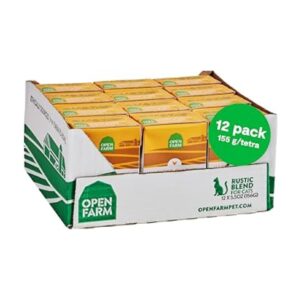
- Chicken stew in a carton
- Meal or topper
- 7% protein minimum beside 82% moisture
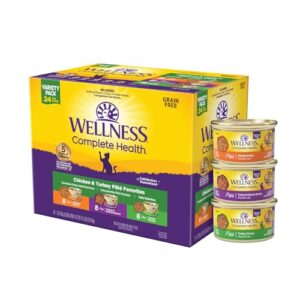
- Three pâtés in one case
- 3 oz cans, 24 to a case
- One recipe includes salmon
How we evaluated
This evaluation uses published product labels, guaranteed analyses, and recall records.
We read the four Amazon listings on this page, then the Open Farm, Merrick, and Wellness CORE brand pages and the AAFCO and FDA pages on complete pet food. The Wellness variety pack is described from the listing title and from retailer copies of its three recipe labels. Percentages below are the printed guaranteed analysis, or an estimate we show as an estimate. Nobody here fed these cans to a cat.
Editorial evaluation from published labels / literature — not a lab test or boarding trial.
Editorial picks are not sold to brands. How we make money.
Affiliate disclosure: Cats Luv Us is a participant in the Amazon Services LLC Associates Program. Product links on this page are affiliate links. If you buy through them we earn a commission, at no extra cost to you. This never changes which products we recommend or how we rank them.
Best wet cat food starts with the job, not a trophy
Best wet cat food is the can that fits the cat in front of you. This page compares four grocery cans: an Open Farm chicken rustic blend, a Wellness Complete Health pâté variety pack, a Merrick chicken pâté, and a Wellness CORE duck pouch. A prescription urinary, kidney, or diabetic diet is a veterinarian’s decision. These four are not those diets.
The score on this page is an editorial label fit. It is not a feeding result, a clinic trial, or a promise that a cat will prefer one can. Cats are particular. A perfect label still fails if the cat walks away from the bowl.
How to read a wet food can
Start with the nutritional adequacy statement. AAFCO is the Association of American Feed Control Officials. The useful sentence says the food is complete and balanced for a life stage, either because it was formulated to meet the nutrient profiles or because it passed feeding trials. Adult maintenance is not the same sentence as growth, and it is not the same sentence as all life stages. A kitten needs a growth or all-life-stages statement. The FDA’s complete-and-balanced page is the plain-language version of that rule. If the sentence is missing, do not guess that the food is a full diet.
Then read the guaranteed analysis next to the moisture line. Wet food prints crude protein as an as-fed minimum, and most of the can is water. Open Farm prints 7% minimum protein and 82% maximum moisture. Merrick prints 10% minimum protein and 78% maximum moisture. Those are not worse, on their face, than a dry food that prints 34% protein and 12% moisture. The water is the point of buying wet food.
A rough comparison divides the protein minimum by the dry share. The dry share is 100 minus the moisture maximum. For Open Farm, 7 divided by 18 is about 39%. For Merrick, 10 divided by 22 is about 45%. For the Wellness chicken sheet and the CORE duck pouch, 10.5 divided by 22 is about 48%. Call those estimates. Moisture is a maximum, so the real food may be drier, and the protein figure is a minimum, so the real food may be higher. The estimate is only there to stop a false comparison with kibble. It is not a laboratory assay, and it is not the number to write on a feeding chart.
After the numbers, read the first ingredients and the texture. A named meat, poultry, or fish should be near the top. “Meat” or “poultry” with no species is a weaker label than chicken, turkey, duck, or salmon. Texture is a separate choice. A rustic blend or stew is broth and shreds. A pâté is a loaf. A gravy can is slices in liquid. A cat who licks the gravy and leaves the meat is telling you about texture, not about the AAFCO statement.
Grain-free, on these labels, means the recipe leaves cereal grains off the ingredient list. It does not mean low carbohydrate, single protein, or appropriate for a disease. Open Farm still lists red lentils and chickpeas. Merrick’s chicken pâté still has guar gum and fish oil. The CORE duck pouch still has tapioca starch. A grain-free badge is a recipe style.
Match the can to the cat in front of you
Use the four cans by the cat you feed.
Open Farm Harvest Chicken rustic blend, 5.5 oz cartons, 12 to a pack. Choose this when you want a chicken stew, as the whole meal or on top of dry food. The brand page leads with humanely raised chicken and chicken bone broth, then pumpkin, carrots, red lentils, and chickpeas. It says the recipe meets the AAFCO profiles for maintenance, and the brand also says adult and senior cats. The guaranteed analysis is 7% minimum protein, 6% minimum fat, 2% maximum fiber, and 82% maximum moisture. The feeding line for a complete meal is about one carton a day for every 5 to 8 lb of body weight. As a topper, the brand says to cut about 1/4 cup of dry food for every half carton. An opened carton goes in the refrigerator. The brand says to use it within four days. This is a poor fit if you are trying to avoid legumes, or if you wanted a firm pâté.
Wellness Complete Health pâté variety pack, chicken and turkey favorites, 3 oz cans, 24 to a case. Choose this when an adult cat gets bored with one flavor and you are willing to open three different recipes. The listing is not a single chicken-and-turkey loaf. Retailer copies of the label describe chicken pâté, turkey pâté, and turkey with salmon. Those sheets cluster around 10% to 10.5% minimum protein, 78% maximum moisture, and 0.10% minimum taurine, with an adult-maintenance statement on each recipe. Fat is not the same on every can, and one sheet does not match the next, so the can in your hand wins. Skip the case if salmon or fish is a problem. Skip it if you wanted one recipe you can reorder without sorting cans.
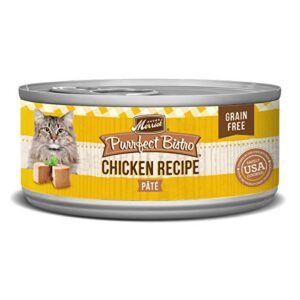
Merrick Purrfect Bistro grain-free chicken pâté. Choose this when you want one chicken loaf for an adult cat.5 oz cans. The brand ingredient list starts with deboned chicken, chicken liver, chicken broth, and dried egg product. Guar gum and menhaden fish oil are in the recipe, so a chicken name does not make it fish-free. The brand guaranteed analysis is 10% minimum protein, 5% minimum fat, 1% maximum fiber, 78% maximum moisture, and 0.1% minimum taurine, formulated for maintenance of adult cats. Be careful with the feeding math. The brand sheet that says one can per 4 lb, and 101 kcal per can, is the 3 oz can. The listing linked here is 5.5 oz. Read kilocalories on that label before you portion a large can like a small one. Cover what you do not serve and refrigerate it. Follow the time limit printed on the can.
Wellness CORE Tiny Tasters duck pâté, 1.75 oz pouches, 12 to a pack. Choose this when leftovers are the problem. One pouch is one serving. The brand list starts with duck, then chicken, then chicken broth. That order matters. Duck is the name on the front, and chicken is still a main ingredient, so this pouch is not an elimination diet for a chicken allergy. Tapioca starch, locust bean gum, guar gum, and xanthan gum are in the recipe. The guaranteed analysis is 10.5% minimum protein, 7.5% minimum fat, 1% maximum fiber, 78% maximum moisture, and 0.10% minimum taurine. Fed alone, the brand guide is about 3 to 4 pouches a day for each 6 to 8 lb. Fed with kibble, cut about 1/8 cup of dry food per pouch. Read the adequacy statement on the pouch before this becomes the only food.
Flaws that are printed on the label
Each of the four has a limit you can see without opening a laboratory.
Open Farm’s rustic blend is wet enough to help a cat who will not drink, and the same water makes the as-fed protein look tiny. Lentils and chickpeas will bother an owner who wanted a meat-and-broth can with nothing else. Agar agar is a thickener. The calorie line has to come from the carton in the shipment, because brand pages do not all print the same kilocalorie figure.
The Wellness variety case solves boredom and creates a sorting job. Three recipes means three labels. Salmon in one of them is a quiet problem for a cat who vomits fish. Thickeners show up on the chicken recipe sheet. If your cat eats two flavors and refuses the third, a 24-can case leaves you with cans you did not want.
Merrick is the cleanest “one chicken pâté” of this set, and it is not a single-ingredient food. Egg, natural flavors, guar gum, and menhaden fish oil are all on the list. The size mismatch is the practical flaw. People portion from the 3 oz feeding line and then open a 5.5 oz can. That is an easy way to overfeed.
The CORE duck pouch is convenient and easy to misread. “Duck recipe” is not “duck only.” Chicken sits in the second spot. A cat on a strict novel-protein plan needs a different label, usually one a veterinarian picks. Gums and tapioca starch are there for the loaf, not for the duck.
Who these four cans are for
They fit a healthy adult cat, or a senior cat whose veterinarian has not prescribed a different diet, when you want more moisture than kibble provides. They fit a household that can match a texture. Stew for a cat who likes broth. One pâté for a cat who eats the same breakfast every day. A variety case for a cat who quits a flavor. A pouch for a cat who will not finish a can.
They are the wrong shelf for a kitten. Kitten foods need a growth or all-life-stages statement, and the maintenance lines on Open Farm and Merrick do not do that job. The kitten roundup on this site is the page for that label check: best wet cat food for kittens.
They are also the wrong shelf for a urinary, kidney, or diabetic plan. Those foods are chosen with a veterinarian, often from a prescription line. Moisture still matters for many of those cats. The can that provides it should be the one in the treatment plan, not the grocery can with the nicest chicken photo.
They are a weak fit for an elimination diet. Food itch and chronic soft stool, when they are food-related, are more often about an animal protein than about a grain. None of these four is a single-protein recipe. Open Farm adds legumes. The variety pack includes salmon. Merrick adds fish oil to chicken. The duck pouch lists chicken second.
If what you wanted was a wider tour of variety packs, pâté versus gravy versus twin trays, that is a different article: wet cat food variety packs. This page stays on these four cans.
Switching foods and storing an open can
Change foods over several days. Start with a small share of the new can mixed into the old food, then move the share up if stool and appetite stay steady. Slow down if the stool turns soft or the cat skips a meal. Cats who have eaten one texture for years may refuse a stew or a pâté on the first night. That refusal is not a verdict on the AAFCO line.
Warm a refrigerated portion to room temperature if a cat walks away from a cold loaf. Do not leave wet food out all day in a warm room. Open Farm tells you to refrigerate the rustic blend and use it within four days. Other brands print their own limit. Follow the can. Keep fresh water out even when the meal is wet. A hydrated recipe is not a reason to put the bowl away.
In a multi-cat kitchen, feed the measured portion where you can see who ate it. A 5.5 oz can split across two cats is easy to overfeed if both cats also get dry food. Write down the dry-food cut the label asks for. Open Farm’s topper cut and the CORE pouch cut are not the same number.
Conclusion
Best wet cat food is a match between a label and a cat. Of the four cans compared here, Merrick is the single adult chicken pâté, Open Farm is the chicken stew for a meal or a topper, Wellness Complete Health is three pâtés in one case, and Wellness CORE is a small duck-and-chicken pouch. Read the life-stage sentence, read protein next to moisture, and leave a prescribed diet where the veterinarian put it.
Merrick Purrfect Bistro Grain-Free Chicken Pâté, 5.5 oz, 24 cans
Best for: An adult cat when you want a single chicken recipe instead of a variety case or a stew
- Named protein
- Deboned chicken
- Pack on the listing
- 5.5 oz, 24 cans
- Crude protein, minimum
- 10%
- Moisture, maximum
- 78%
- Life stage on the brand statement
- Adult maintenance
The Amazon listing is Merrick Purrfect Bistro grain-free chicken pâté, a 24-pack of 5.5 oz cans. The brand page lists deboned chicken, chicken liver, chicken broth, dried egg product, and natural flavors, plus guar gum and menhaden fish oil. Its guaranteed analysis is 10% minimum crude protein, 5% minimum crude fat, 1% maximum crude fiber, 78% maximum moisture, and 0.1% minimum taurine. The same page says the recipe is formulated for maintenance of adult cats. The feeding line and the 101 kcal per can figure on that sheet are for the 3 oz can. This listing is 5.5 oz, so use the calorie line on the can that arrives.
Pros
- One recipe, so the case is not a flavor lottery
- Deboned chicken, chicken liver, and chicken broth lead the brand ingredient list
Cons
- Menhaden fish oil means this chicken can is not fish-free
- The brand's calorie-per-can line is published for a 3 oz can, and this listing is 5.5 oz
Open Farm Rustic Blend Harvest Chicken, 5.5 oz, 12 pack
Best for: An adult cat when you want broth, pumpkin, and a carton you can use as a meal or a topper
- Named protein
- Chicken
- Pack on the listing
- 5.5 oz, 12 cartons
- Crude protein, minimum
- 7%
- Moisture, maximum
- 82%
- Life stage on the brand statement
- Maintenance
The Amazon listing is Open Farm Rustic Blend wet cat food, Harvest Chicken, in a 5.5 oz 12-pack. The brand page lists humanely raised chicken, chicken bone broth, pumpkin, carrots, red lentils, and chickpeas, and it says the recipe meets the AAFCO Cat Food Nutrient Profiles for maintenance. The guaranteed analysis on that page is 7% minimum crude protein, 6% minimum crude fat, 2% maximum crude fiber, and 82% maximum moisture. Use the calorie line on the carton you open.
Pros
- Chicken is the first ingredient on the brand list
- The brand says it can be a complete meal or a topper
Cons
- Red lentils and chickpeas are in the recipe
- 7% protein is an as-fed minimum next to 82% moisture, not a kibble number
Wellness Complete Health Pâté Variety Pack, chicken and turkey favorites, 3 oz, 24 cans
Best for: An adult cat when one flavor bores them and you can accept salmon in part of the case
- Texture
- Pâté
- Pack on the listing
- 3 oz, 24 cans
- Recipes in the case
- Chicken, turkey, and turkey with salmon
- Moisture on the printed sheets
- 78% maximum
The Amazon listing is a Wellness Complete Health pâté variety pack, chicken and turkey favorites, 3 oz cans, 24 to a case. It is not one loaf of chicken mixed with turkey. Retailer copies of the label describe three pâtés: chicken, turkey, and turkey with salmon. Those sheets put crude protein at about 10% to 10.5% minimum and moisture at 78% maximum, with taurine at 0.10% minimum, and an adult-maintenance statement on each recipe. Fat differs by recipe. Read the can you open.
Pros
- Three recipes in one case, so a skipped flavor does not waste a whole flat of the same can
- Retailer copies of the labels put each recipe on an adult maintenance line
Cons
- One recipe includes salmon, so the case is not fish-free
- You have to read the can in your hand, because the three recipes are not the same food
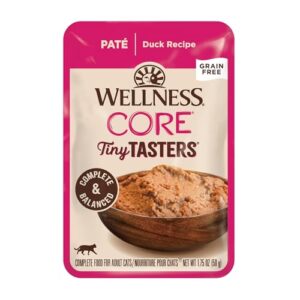
Wellness CORE Tiny Tasters Duck Pâté, 1.75 oz, 12 pouches
Best for: An adult cat when you want one small pouch instead of a leftover half can
- Named proteins
- Duck, then chicken
- Pack on the listing
- 1.75 oz, 12 pouches
- Crude protein, minimum
- 10.5%
- Crude fat, minimum
- 7.5%
- Moisture, maximum
- 78%
The Amazon listing is Wellness CORE Tiny Tasters duck pâté, 1.75 oz pouches, 12 to a pack. The brand page lists duck, then chicken, chicken broth, water, natural flavors, and tapioca starch, plus locust bean gum, guar gum, and xanthan gum. The guaranteed analysis on that page is 10.5% minimum crude protein, 7.5% minimum crude fat, 1% maximum crude fiber, 78% maximum moisture, and 0.10% minimum taurine. The feeding guide says one pouch is 1.75 oz, and that feeding it alone means about 3 to 4 pouches a day for each 6 to 8 lb of body weight. If you also feed dry food, the same guide says to cut about 1/8 cup of dry food for every pouch. Read the AAFCO line on the pouch before you use it as the only food.
Pros
- One pouch is one meal, so an opened can is not sitting in the fridge
- Duck is the first ingredient on the brand list
Cons
- Chicken is the second ingredient, so this is not a duck-only diet
- Tapioca starch and gums are in the recipe
Frequently asked questions
What is the best wet cat food?
There is no single best can. For an adult cat with no prescribed diet, start with the texture and the protein you already know they eat. On this page, Merrick is one chicken pâté, Open Farm is a chicken stew you can use as a meal or a topper, the Wellness case rotates three pâtés, and the CORE pouch is a small duck-and-chicken meal. Then read the AAFCO life-stage line. A maintenance statement does not cover a kitten.
How much wet food should I feed my cat?
Use the feeding guide on the package, then adjust for body condition. Open Farm says about one carton a day for every 5 to 8 lb when the rustic blend is the whole meal. Wellness CORE says about 3 to 4 of the 1.75 oz duck pouches a day for each 6 to 8 lb when the pouch is the whole meal. Merrick’s published “one can per 4 lb” line is for the 3 oz can, and the listing on this page is 5.5 oz, so do not copy that line onto the larger can. If your cat gains or loses weight, change the amount. Ask your veterinarian before you change food for a cat with a disease.
Do cats need wet food every day?
A cat can live on a complete dry food and a water bowl. Wet food is still the easier way to get more water into a cat who ignores the bowl. Any of these four can be the whole meal only if the label says it is complete and balanced for that cat’s life stage. Open Farm also says you can use the rustic blend as a topper and cut back the dry food. The CORE guide says to cut about 1/8 cup of dry food per pouch.
Is wet food better than dry food?
Wet food is mostly water. That is the useful difference. It does not, by itself, make a recipe complete, grain-free, or safe for a sick cat. Dry food can be complete and still leave a cat short on water if they do not drink. Read the AAFCO line on both foods. If a veterinarian has prescribed a dry therapeutic diet, do not replace it with one of these cans because the can is wet.
Why does wet cat food list only 7% to 11% protein?
Those numbers are as-fed. Most of the can is water. Open Farm prints 7% minimum protein and 82% maximum moisture. Merrick prints 10% minimum protein and 78% maximum moisture. A dry bag’s 30% or 40% protein is not the same kind of number. A rough check is to divide the protein minimum by the dry share, which is 100 minus the moisture maximum. That math is an estimate, because moisture is a ceiling, not an assay. It is enough to stop you from throwing out a stew because the front of the label looks “low protein” next to kibble.
Can I use these cans for a urinary, kidney, or diabetic cat?
No. Nothing on this page is a therapeutic diet. Weight, diabetes, and urinary foods are veterinarian decisions. The four cans here are grocery foods with maintenance-style labels. If your cat is already on a prescribed diet, keep that diet.
Sources
Going away? Keep your cat's routine on track.
Cats Luv Us Boarding Hotel & Grooming in Laguna Niguel, Orange County.