Kitten Foods for Diarrhea: Growth Dry, Stew, and Sachet Stay Apart (2026)
Kitten foods for diarrhea are not a cure and not an adult bag. Cornell says a diet change can loosen stool for a few days. A sick kitten needs a veterinarian before a new bag.

In this review 6 sections
CatsLuvUs Copilot Search
Ask this review — not the open web
Answers are generated from this Cats Luv Us review only. We may earn a commission from Amazon links. Not veterinary advice.
Answer from this review
This score is editorial — based on labels, recall history, and veterinary guidance, not a lab test. How we evaluated.
Match the growth line, then stop
Kitten foods for diarrhea on this page are not one diet and not a treatment. Cornell says an abrupt food change can loosen stool for a few days, and that diarrhea lasting longer than a day or two with poor appetite, lethargy, or vomiting needs a veterinarian. Hill’s Sensitive Stomach and Skin dry is the salmon and brown rice bag at 518 kcal per cup, with a feeding-test line for growing kittens and for gestating or lactating cats. The matching stew is 2.8 oz and 54 kcal per can, and that page says it is not for pregnant or lactating cats. Purina Pro Plan Sensitive Skin and Stomach kitten is the 3.5 lb salmon and rice bag at 583 kcal per cup, formulated for growth and for gestation and lactation. FortiFlora is a 1 g sachet for diarrhea, not a meal. The score 4.3 is an editorial label fit for keeping those jobs apart.
Three growth foods and one sachet
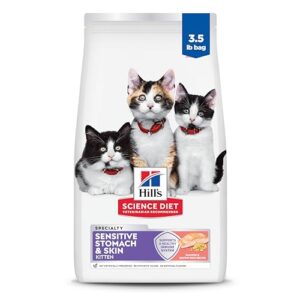
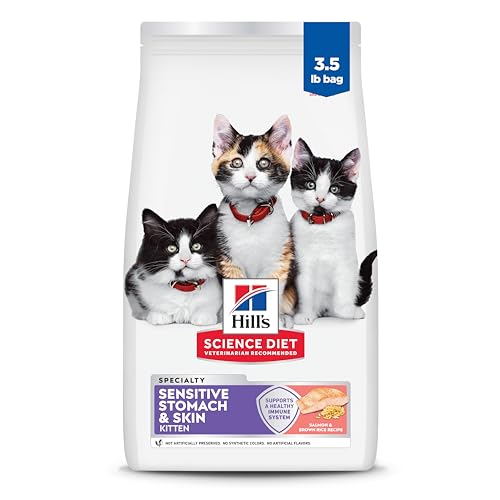
- 3.5 lb listing, 518 kcal per cup
- Feeding test for growth and for nursing cats
- 7-day mix, not a 7-to-10-day mix
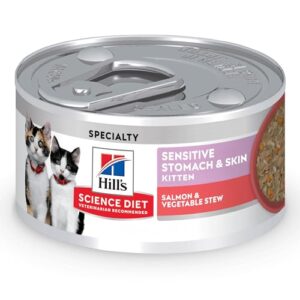
- 2.8 oz, 54 kcal per can
- Growing kittens only on the feeding test
- Not for pregnant or lactating cats
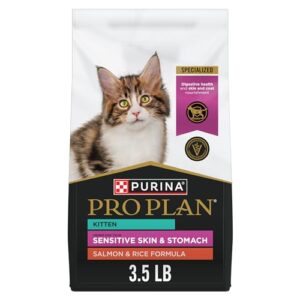
- 3.5 lb salmon and rice, 583 kcal per cup
- Formulated for growth and for gestation
- Switch over 7 to 10 days
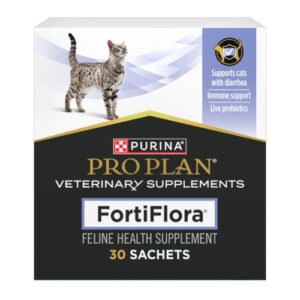
- 1 g sachet, one packet a day
- For diarrhea, in kittens and adults
- Not a growth food and not a fecal test
How we evaluated
This evaluation uses published product labels, guaranteed analyses, and recall records.
The score is an editorial label fit for kitten foods for diarrhea. This page uses Cornell’s diarrhea, parasite, and panleukopenia notes plus the four products already linked. A calorie stays on the cup or can that printed it. A pregnancy line stays on the page that printed it. No product here is a diagnosis.
Editorial evaluation from published labels / literature — not a lab test or boarding trial.
Editorial picks are not sold to brands. How we make money.
What Cornell says before a new kitten food
Cornell’s diarrhea page says an abrupt change in diet may cause diarrhea for a few days, and that kittens may be at higher risk as they adjust to solid food. Extended or recurrent diarrhea can also come from conditions outside the intestine, including viral infection and panleukopenia. If diarrhea persists longer than a day or two and the cat also shows a poor appetite, lethargy, or vomiting, Cornell says to seek veterinary care as soon as possible. The same page says some over-the-counter medications can be harmful to cats. That is not a 7-day feeding chart.
The parasite page says kittens can ingest roundworm larvae in an infected queen’s milk, and that untreated roundworms can lead to life-threatening anemia. Isospora usually causes little trouble in adult cats, but in kittens it may destroy the intestinal lining and cause mucousy diarrhea. Panleukopenia still shows up in young cats: diarrhea, vomiting, fever, lethargy, loss of appetite, and dehydration, with sudden death most often in kittens under 5 months. Cornell says to contact a veterinarian immediately if those signs appear. A sensitive-stomach bag does not replace that call. A different published page on gentle kitten foods is sensitive-stomach kitten foods. Grocery growth cans are a separate comparison at wet food for kittens.
| Product | Size that stays | Number that stays with it | Do not move here |
|---|---|---|---|
| Hill’s sensitive kitten dry | 3.5 lb listing | 518 kcal per cup, 7-day mix | 583 kcal, a 147 g cup, or an as-fed 33% protein line |
| Hill’s sensitive kitten stew | 2.8 oz | 54 kcal per can, kittens up to 1 year | The dry bag’s pregnancy column, or a grain-free claim |
| Pro Plan sensitive kitten | 3.5 lb salmon and rice | 583 kcal per cup, 7 to 10 days | The adult oatmeal bullet, or 492 kcal |
| FortiFlora | 1 g sachet | 1×10^8 CFU and taurine 5 mg | A cup of growth food, or a fecal result |
Hill’s Science Diet Kitten Sensitive Stomach and Skin dry, salmon and brown rice
Best for: A weaned kitten, or a pregnant or nursing cat, when a veterinarian wants this sensitive-stomach dry
- Bag on the listing
- 3.5 lb salmon and brown rice. The recipe page also lists a 6 lb bag.
- Calorie
- 4150 kcal/kg. 518 kcal per cup. That cup is 4.4 oz of this food by weight.
- Dry matter, not as fed
- Protein 37.7%, fat 24.8%, carbohydrate 27.6%, crude fiber 1.5%.
- Who it names
- From weaning until 1 year, and pregnant or nursing cats. Not adult maintenance.
- 6 lb row
- Printed 6 (2,7): 7/8 cup under 4 months, 3/4 cup at 4 to 6 months, 5/8 cup at 7 to 12 months and pregnancy.
The linked bag is Hill’s Science Diet Kitten Sensitive Stomach and Skin, salmon and brown rice, 3.5 lb. The US recipe page lists the same dry food in 6 lb and 3.5 lb. Ingredients begin with salmon, brown rice, chicken, chicken meal, and chicken fat, then pea protein and corn protein meal. Feeding tips say to mix increasing amounts of the new food with decreasing amounts of the old food over a 7-day period, and to keep fresh water available. The growth table is in cups and grams. At 1 lb, shown as 1 (0,5), a kitten under 4 months is 1/4 cup (30 g), and the older columns are blank. At the row printed 6 (2,7), under 4 months is 7/8 cup (110 g), 4 to 6 months is 3/4 cup (95 g), and 7 to 12 months and pregnancy is 5/8 cup (80 g). The rest of the rows stay on the Hill’s page. Do not fill a blank cell.
Calorie content is 4150 kcal/kg and 518 kcal per cup. The footnote says an 8 fl oz cup of this product weighs 4.4 oz. The nutrient table is dry matter: protein 37.7%, fat 24.8%, carbohydrate 27.6%, crude fiber 1.5%, calcium 1.34%, phosphorus 1.19%, taurine 0.45%. Dry matter is the food after water is removed. It is not the percentage in the cup. The page opened did not print an as-fed guaranteed analysis, so a retailer line near 33% protein, 4% fiber, or a DHA percentage stays off this card. Hill’s says the formula includes DHA for brain development and does not print a DHA percent here. The feeding-test sentence says animal feeding tests using AAFCO procedures substantiate that it provides complete and balanced nutrition for growing kittens and gestating or lactating adult female cats. On the page opened, the product name is missing between “that” and “provides.” Recommended for kittens from weaning until 1 year and for pregnant or nursing cats, including those with a sensitive stomach or skin. Not recommended for adult cats, cats 7 and older, or obese or obese-prone cats. Highly digestible, prebiotic fiber, and the antioxidant lines are Hill’s sentences. They are not a result from this page.
Pros
- The cup calorie, the 7-day switch, and the pregnancy column are on the same page
- Salmon is the first ingredient, ahead of brown rice and chicken
Cons
- The feeding-test sentence on the page opened does not print the product name
- The page does not print an as-fed protein guarantee
Hill’s Science Diet Kitten Sensitive Stomach and Skin salmon and vegetable stew
Best for: A kitten up to 1 year whose veterinarian wants this stew, and not a pregnant or nursing cat
- Can
- 2.8 oz, also printed as 79 g. A shop case is 24 cans.
- Calorie
- 687 kcal/kg. 54 kcal per can.
- Dry matter
- Protein 36.4%, fat 23.4%, carbohydrate 30%, crude fiber 0.7%.
- Who it names
- Kittens up to 1 year. Not adult cats, and not pregnant or lactating cats.
- 1 lb row
- Printed 1 (0,5): 2 1/8 cans under 4 months. The older columns are blank.
The linked stew is Hill’s Science Diet Kitten Sensitive Stomach and Skin, salmon and vegetable, in 2.8 oz cans. A shop case is 24 cans. Ingredients begin with chicken broth, salmon, carrots, turkey, and pork liver, then spinach, rice starch, and rice. Salmon is not first. The name does not make this a salmon-only can. Feeding tips again say a 7-day mix and fresh water. The growth table is in 2.8 oz (79 g) cans. At 1 lb, shown as 1 (0,5), a kitten under 4 months is 2 1/8 cans, and the older columns are blank. At the row printed 6 (2,7), under 4 months is 8 1/4 cans, 4 to 6 months is 6 3/4 cans, and 7 to 12 months is 5 1/2 cans. That third column is growth only. It is not a pregnancy column. A generated line of about 1 can per 3.5 lb does not match this table.
Calorie content is 687 kcal/kg and 54 kcal per can. Dry matter is protein 36.4%, fat 23.4%, carbohydrate 30%, crude fiber 0.7%, and taurine 0.39%. Animal feeding tests using AAFCO procedures substantiate that this named stew provides complete and balanced nutrition for growing kittens. Recommended for kittens up to 1 year. Not recommended for adult cats, cats 7 and older, obese or obese-prone cats, or pregnant and lactating cats. The dry bag on this page includes pregnant and nursing cats. This stew does not. A shop card that lists the pet age as kitten, pregnant, or nursing disagrees with the recipe page. A shop line that calls the stew grain-free also disagrees with rice starch and rice in the ingredient list. Do not repair either slip. Prebiotic fiber and the antioxidant lines are Hill’s sentences. A prescription digestive kitten can is a different product and is not linked here.
Pros
- The feeding-test sentence names this stew and stops at growing kittens
- The pregnancy exclusion is printed, so the dry bag's nursing column cannot move here
Cons
- A shop line calls the stew grain-free while the ingredient list includes rice
- A shop age line names pregnant or nursing cats, and the recipe page does not
Purina Pro Plan Kitten Sensitive Skin and Stomach, salmon and rice
Best for: A kitten, or a pregnant or nursing cat, when the bag in hand is this salmon and rice formula
- Bag
- 3.5 lb salmon and rice. A 7 lb size is a different listing.
- As-fed guarantee
- Protein 42% min, fat 19% min, fiber 2.5% max, moisture 12% max, DHA 0.02% min.
- Minerals on that panel
- Calcium 1.0% min, phosphorus 0.8% min, taurine 0.18% min.
- Calorie and cup
- 3966 kcal/kg. 583 kcal per cup. The cup is about 147 g of this food.
- Youngest row
- 4 to 12 weeks, 1 to 3 lb: 1/4 to 1/3 cup, 37 to 49 g.
The linked bag is Purina Pro Plan Kitten Sensitive Skin and Stomach, salmon and rice, 3.5 lb. The label code on the US deck is A478524, manufactured by Nestle Purina PetCare Company, St. Louis, MO 63164 USA. Ingredients begin with salmon, rice, chicken by-product meal, and corn protein meal. Later lines include dried chicory root and fish oil. The deck does not start with oatmeal. A shopping bullet that describes an adult salmon food with rice and oatmeal is a different formula pasted onto this listing. Guaranteed analysis: crude protein 42.0% minimum, crude fat 19.0% minimum, crude fiber 2.5% maximum, moisture 12.0% maximum, linoleic acid 1.9% minimum, DHA 0.02% minimum, calcium 1.0% minimum, phosphorus 0.8% minimum, vitamin A 10,000 IU/kg minimum, vitamin E 400 IU/kg minimum, taurine 0.18% minimum. Omega-6 fatty acids are 2.0% minimum and are marked not recognized as an essential nutrient by the AAFCO Cat Food Nutrient Profiles.
The formula is formulated to meet AAFCO Cat Food Nutrient Profiles for growth of kittens and gestation or lactation. That is a formulation statement, not the feeding-test sentence on the Hill’s pages. Calorie content is 3966 kcal/kg and 583 kcal per cup. The measuring note says a standard 8 oz cup holds about 147 g of this food. Do not use Hill’s 4.4 oz cup, or an adult sensitive bag near 492 kcal per cup, on this row. The youngest feeding row is 4 to 12 weeks and 1 to 3 lb: 1/4 to 1/3 cup, 37 to 49 g. At 12 to 24 weeks and 3 to 5 lb the deck says 1/3 to 1/2 cup, 49 to 74 g. A Canada table that prints 12 to 14 weeks for that second row stays in Canada. Kittens may nibble solid food at 3 to 4 weeks. If water is added, use no more than one part warm, not hot, liquid to three parts food. The switch is 7 to 10 days, a little less of the previous food each day. For reproduction, the deck says not to add supplemental vitamins or minerals, to feed the pregnant cat for body condition, and that intake by the fourth week of lactation can be 2 to 3 times the intake before breeding. Those sentences are Purina’s. They are not a diarrhea result.
Pros
- The label prints an as-fed guarantee, a DHA floor, and a cup weight
- The adequacy line covers growth and gestation or lactation
Cons
- A shopping bullet pastes an adult oatmeal line onto this kitten bag
- The switch is 7 to 10 days, not Hill's 7-day line
Purina Pro Plan Veterinary Supplements FortiFlora cat probiotic
Best for: A kitten or adult cat with diarrhea, when the meal is already a complete food the veterinarian accepts
- Sachet
- 1 g. Cats only, including kittens and adults. One packet daily.
- Active ingredients
- Enterococcus faecium SF68 at 1x10^8 CFU. Taurine 5 mg.
- Inactive ingredients
- Liver flavor, yeast.
- Job
- Assist the management of diarrhea. Not a growth diet.
- Leave off
- A kit that names Enterococcus lactis, a 1.5 g synbiotic, and a Canada calorie.
Purina’s US page for FortiFlora describes a probiotic powder for the dietary management of diarrhea in kittens and adult cats. Active ingredients per 1 g sachet are Enterococcus faecium SF68 at 1×10^8 CFU and taurine 5 mg. Inactive ingredients are liver flavor and yeast. Directions say for use in cats only, and one packet daily or as a veterinarian directs. The product description says the powder is sprinkled on the regular food. It does not replace that food, and it does not print a growth statement. A shop extract adds code A-9302, says to stop the product if the condition worsens or does not improve, says safe use in pregnant animals or animals intended for breeding has not been proven, and recommends a veterinary examination first.
A Canada card near 3.7 kcal per sachet, a UK sheet with a higher CFU floor, a diarrhea kit whose sachet extract names Enterococcus lactis, and a 1.5 g synbiotic with 7.5 mg of taurine stay off this card. Direct opening of the US product page was blocked on the day of this rebuild. The search extracts of that URL and of the shop page agreed on faecium, 1×10^8 CFU, 5 mg of taurine, liver flavor, and yeast. Cornell’s parasite page still matters: kittens can take in roundworm larvae through the queen’s milk, and Isospora can cause mucousy diarrhea in kittens. A sachet is not that workup.
Pros
- The US extracts name kittens and adults and still limit the job to diarrhea
- The one-packet direction cannot be read as a cup of growth food
Cons
- It does not print a meal calorie on the US extracts used here
- It does not replace a fecal exam or a prescribed treatment
What has to stay on its own card
The two Hill’s foods share a sensitive-stomach name and a 7-day mix. They do not share a life-stage line. The dry page includes pregnant and nursing cats and prints 518 kcal per cup. The stew excludes pregnant and lactating cats and prints 54 kcal per can. Pro Plan’s kitten bag is a third calorie, 583 kcal per cup, with a formulation statement and a 7-to-10-day switch. FortiFlora is not in that comparison. It has no cup.
Hill’s dry-matter protein of 37.7% and Pro Plan’s as-fed protein minimum of 42% are not the same kind of number. Hill’s dry-matter fiber of 1.5% and Pro Plan’s as-fed fiber maximum of 2.5% are not the same kind of number either. A retailer DHA percent on the Hill’s bag was not on the recipe page opened here. Pro Plan’s DHA floor of 0.02% minimum stays on Pro Plan. None of the four is a promise that stool will firm on a schedule.
Use one of these products when
- The stew's pregnancy exclusion stays off the dry bag
- Each dry food keeps its own cup weight and switch length
- The sachet stays a diarrhea packet, not a growth diet
- Cornell's day-or-two line is not rewritten as a food rule
Skip the food trial when
- None of these products treats parasites or panleukopenia
- The dry Hill's page does not print an as-fed guarantee
- A shop card calls the rice stew grain-free
- An adult oatmeal bullet does not belong on the kitten salmon bag
Kitten foods for diarrhea FAQ
Will one of these foods treat a kitten's diarrhea?
No. Cornell says an abrupt diet change may cause diarrhea for a few days, and that kittens may be at higher risk while they adjust to solid food. Extended or recurrent diarrhea can also come from disease outside the bowl. These three growth foods are complete diets with sensitive-stomach marketing. The sachet is labeled only for the management of diarrhea. None of them is a dewormer or a test.
Can the stew stand in for the dry bag in a nursing cat?
Not on the pages opened here. The dry recipe is recommended for kittens from weaning until 1 year and for pregnant or nursing cats. The stew is recommended for kittens up to 1 year and is not recommended for pregnant or lactating cats. The stew is 54 kcal per 2.8 oz can. The dry is 518 kcal per cup. A shop card that puts nursing cats on the stew does not erase the recipe page.
Are the two dry bags the same calorie and the same switch?
No. Hill’s prints 518 kcal per cup and a cup weight of 4.4 oz, with a 7-day mix. Pro Plan prints 583 kcal per cup and a cup of about 147 g, with a 7-to-10-day mix. Hill’s protein figure of 37.7% is dry matter. Pro Plan’s 42% protein minimum is as fed. Hill’s uses a feeding-test sentence. Pro Plan uses a formulation sentence. An adult sensitive cup near 492 kcal stays on the adult bag.
Does the sachet replace a fecal check?
No. FortiFlora’s direction is one packet a day on the food the cat is already eating. Cornell’s parasite page says roundworm infections in kittens can come through the queen’s milk, and that Isospora can destroy the intestinal lining and cause mucousy diarrhea in kittens. Those problems are a veterinary visit. The sachet’s label does not name a parasite.
When is diarrhea a veterinary visit rather than a new bag?
Cornell’s feline diarrhea page says to seek veterinary care as soon as possible if diarrhea lasts longer than a day or two and the cat also has a poor appetite, lethargy, or vomiting. It also says some over-the-counter medications can be harmful to cats. Panleukopenia can cause diarrhea, vomiting, and dehydration, and sudden death is most often seen in kittens under 5 months. Those signs are a call to a veterinarian, not a slower food transition.
Sources
- Hill's Science Diet Kitten Sensitive Stomach and Skin salmon and brown rice dry, 518 kcal per cup
- Hill's Science Diet Kitten Sensitive Stomach and Skin salmon and vegetable stew, 54 kcal per 2.8 oz can
- Purina label deck A478524, Pro Plan Kitten Sensitive Skin and Stomach salmon and rice, 583 kcal per cup
- Purina US, Pro Plan Veterinary Supplements FortiFlora cat powder, 1 g sachet
- Cornell Feline Health Center, Diarrhea
- Cornell Feline Health Center, Gastrointestinal Parasites of Cats
- Cornell Feline Health Center, Feline Panleukopenia Virus
Going away? Keep your cat's routine on track.
Cats Luv Us Boarding Hotel & Grooming in Laguna Niguel, Orange County.