Feeding Cats with Feline Leukemia: Four Labels, Not a Cure (2026)
Feeding cats with feline leukemia starts with the clinic, not a bag that claims to reverse the virus. Cornell says there is no definitive cure. These four labels do not share one calorie.

In this review 6 sections
CatsLuvUs Copilot Search
Ask this review — not the open web
Answers are generated from this Cats Luv Us review only. We may earn a commission from Amazon links. Not veterinary advice.
Answer from this review
This score is editorial — based on labels, recall history, and veterinary guidance, not a lab test. How we evaluated.
Read the job on the label, then stop
Feeding cats with feline leukemia is not a virus diet. Cornell’s FeLV page, updated 2024, says there is currently no definitive cure, and that loss of appetite and progressive weight loss are on the sign list. The four products already linked do different jobs. Royal Canin Recovery Ultra Soft Mousse is the 5.1 oz can at 149 kcal, with an AAFCO growth-and-maintenance statement for cats and dogs. Hill’s Prescription Diet a/d is the 5.5 oz can at 196 kcal, limited on that page to intermittent or supplemental feeding and not recommended past 6 months. Purina Pro Plan FortiFlora is a 1 g sachet for diarrhea, one packet a day, not a meal. Virbac Rebound is a 5.1 oz liquid the brand says is not a critical care diet. The score 4.3 is an editorial label fit for keeping those four labels apart.
Four labels, four jobs
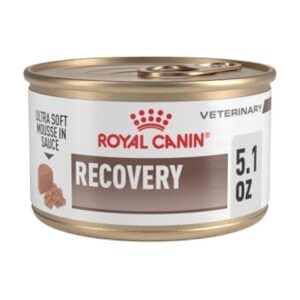
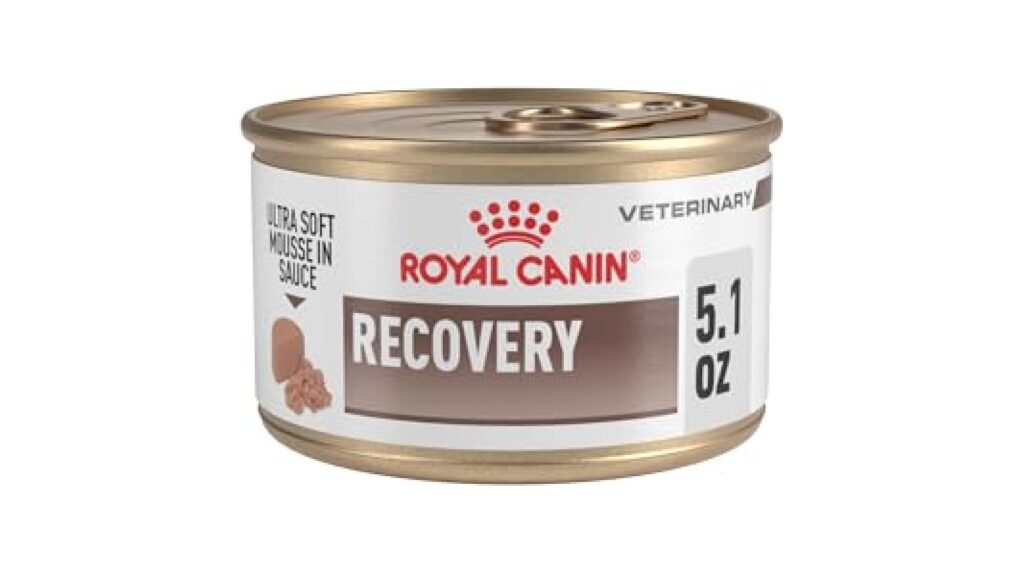
- 5.1 oz, 149 kcal per can on the US page
- AAFCO growth and maintenance, cats and dogs
- No US gram table on the page opened
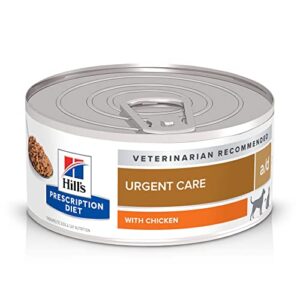
- 5.5 oz, 196 kcal per can
- Intermittent or supplemental, not past 6 months
- 44% protein is dry matter, not the as-fed guarantee
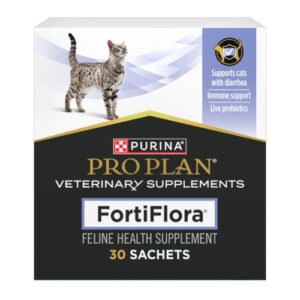
- 1 g sachet, one packet a day
- Enterococcus faecium SF68 at 1x10^8 CFU
- Taurine 5 mg, not a calorie can
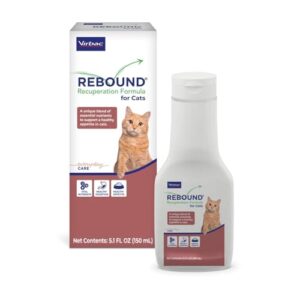
- 5.1 oz liquid, refrigerate 7 days once open
- Not a critical care liquid diet
- No calorie number on the Virbac page opened
How we evaluated
This evaluation uses published product labels, guaranteed analyses, and recall records.
The score is an editorial label fit for feeding cats with feline leukemia. This page uses Cornell, the AAFP management sheet, and the four labels already linked. A calorie stays on the product that printed it. A clinic sentence stays on the clinic page. No product here is an antiviral.
Editorial evaluation from published labels / literature — not a lab test or boarding trial.
Editorial picks are not sold to brands. How we make money.
What Cornell says about feeding cats with feline leukemia
Cornell’s FeLV page, updated 2024, says the virus affects about 2 to 3 percent of all cats in the United States and Canada, and that rates are higher, up to 30 percent, in cats that are ill or otherwise at high risk. It says there is currently no definitive cure. Signs can include loss of appetite and progressive weight loss, and a cat can also show no signs at first. The prognosis paragraph says cats can live prolonged periods, with a median survival of 2.5 years after diagnosis and longer for some regressive infections. Watch weight, appetite, activity, elimination, the mouth, the eyes, and behavior. A change in one of those is a reason to call a veterinarian. That 2.5 year figure is not a feeding result.
The same page says the only sure protection is to prevent exposure. Test cats before introducing them, house infected and uninfected cats separately, and do not share food bowls, water bowls, or litter boxes between them. FeLV does not survive long outside the body, probably less than a few hours in a normal household, so infection from the environment without prolonged close contact is unlikely. The AAFP management sheet says infected cats can live many years with a high quality of life, that euthanasia of positive cats is not recommended, and that FeLV transmission includes shared food and water bowls, allogrooming, and alloplay. House infected cats indoors or in an enclosed outdoor area. A news note that about 4 percent of tested cats in North America are positive is a tested-cat figure. It is not the same sentence as Cornell’s 2 to 3 percent of all cats.
| Label | Size that stays | Number that stays with it | Do not move here |
|---|---|---|---|
| Royal Canin Recovery mousse | 5.1 oz | 149 kcal per can, 1025 kcal/kg | 986 kcal, the UK gram table, or Hill’s 6-month cap |
| Hill’s a/d | 5.5 oz (156 g) | 196 kcal per can, not past 6 months | 180 kcal, or 44% protein read as as-fed |
| FortiFlora cat sachet | 1 g | 1×10^8 CFU and taurine 5 mg | A meal calorie, Enterococcus lactis, or 7.5 mg taurine |
| Rebound for cats | 5.1 oz liquid | No kcal on the Virbac page opened | 149 kcal, 196 kcal, or 13.8 kcal per 30 ml |
Royal Canin Veterinary Diet Recovery Ultra Soft Mousse
Best for: A cat whose veterinarian named this recovery mousse, including during hospitalization or convalescence
- Can
- 5.1 oz. The page heading also says wet food for dog. The product is feline and canine.
- US calorie
- 1025 kcal ME/kg. 149 kcal ME/can, as fed, calculated.
- Guaranteed analysis
- Protein 9.4% min, fat 5.2% min, fiber 3.1% max, moisture 78.9% max.
- Adequacy
- AAFCO Cat and Dog Food Nutrient Profiles for growth and maintenance, including large dogs of 70 lb or more as adults.
- What the page does not print
- No US gram chart. No 6-month cap. An older index line of 986 kcal and 143 kcal stays off.
Royal Canin’s US page calls this a high-energy wet critical-care diet for canine and feline patients, including puppies and kittens, and a highly digestible complete and balanced food for cats and dogs when a veterinarian directs it. The veterinary formula is sold through select retailers and clinics. The page says to consult a veterinarian, or to use a trusted partner if you have a prescription. It does not say every checkout will ask for that prescription. Benefits named on the page are high energy density in a reduced volume, a texture for syringe and feeding-tube use, and a high protein level to help maintain muscle during hospitalization and convalescence. This page does not give a tube size, a rate, or a how-to. The first ingredients are water sufficient for processing, chicken, and chicken liver.
Guaranteed analysis on that US page: crude protein 9.4% minimum, crude fat 5.2% minimum, crude fiber 3.1% maximum, moisture 78.9% maximum. Calorie content is 1025 kcal ME/kg and 149 kcal ME/can, as fed, calculated. The nutritional adequacy statement says the mousse is formulated to meet AAFCO Cat and Dog Food Nutrient Profiles for growth and maintenance, including growth of large-size dogs of 70 lb or more as adults. The same page’s heading still says wet food for dog. Leave that slip visible. A Spanish rendering of this formula prints fiber at 2.0% maximum. A UK page prints protein 12.7%, fat 6.4%, and moisture 73%, plus a gram table. Those figures stay on those pages. An older index line of 986 kcal/kg and 143 kcal/can was not on the US page opened for this rebuild. Do not paste Hill’s 6-month limit onto this can. The US page opened here did not print a feeding chart in grams.
Pros
- The US page prints both the per-can calorie and the AAFCO sentence
- The texture line names syringe and feeding-tube use without turning this page into a tube procedure
Cons
- The same statement covers cats and large-breed dog growth, so a dog chart does not belong here
- A UK analytical panel and a Spanish fiber maximum are different pages
Hill’s Prescription Diet a/d Urgent Care with Chicken
Best for: A dog or cat recovering from surgery, illness, or injury, when a veterinarian directed this can and the feeding stays short of the long-term limit
- Can
- 5.5 oz, also printed as 156 g. Made in the USA with global ingredients.
- US calorie
- 1262 kcal/kg. 196 kcal/can.
- Dry matter, not as fed
- Protein 44%, fat 31%, carbohydrate 15.3%, crude fiber 0.1%.
- How long
- Intermittent or supplemental feeding only. Not recommended for more than 6 months.
- 6 lb cat row
- Printed 6 (2,7): 3/4 can at cage rest, 1 can for surgery, sepsis, cancer, trauma, fever, or feline hepatic lipidosis, 1 1/4 can for severe burn, injury, or head trauma.
Hill’s US page describes a/d with Chicken as canned nutritional support for dogs and cats recovering from surgery, illness, or injury. The size is 5.5 oz. Ingredients begin with turkey giblets, water, pork liver, and chicken, then corn flour and spray-dried pork stock. Feeding tips say individual needs vary with the medical condition, and to use the food only as directed by a veterinarian. The cat table is in 5.5 oz (156 g) cans. At the row printed 6 (2,7), cage rest is 3/4 can, the surgery, sepsis, cancer, trauma, fever, and feline hepatic lipidosis schedule is 1 can, and severe burn, injury, or head trauma is 1 1/4 can. At 8 lb the same three columns are 1, 1, and 1 1/2. The rest of the cat rows stay on the Hill’s page. A milliliter table on that page is labeled weight of animal, not cat. An 8 lb line of 146, 175, and 234 ml is that table. It is not a second reading of the cat-can row. A dog-can table is also on the page. Do not feed a dog row to a cat.
The page says a/d is intended for intermittent or supplemental feeding only, and is not recommended for long-term feeding of more than 6 months. A site block about transitioning foods over 7 days does not erase that cap. Calorie content is 1262 kcal/kg and 196 kcal/can. The nutrient table is dry matter: protein 44%, fat 31%, carbohydrate 15.3%, crude fiber 0.1%. Hill’s defines dry matter as the nutrient after moisture is removed. It is not the percentage in the can. The page opened for this rebuild did not print an as-fed protein or fat guarantee and did not print an AAFCO statement. Do not borrow one. A retailer card that prints about 180 kcal per 5.5 oz can, and an as-fed line near 8.5% protein and 5.2% fat, is a different panel. A New Zealand card near 1151 kcal/kg stays off this 196 kcal can. A listing that starts with water and names pork protein isolate is not the ingredient order on the US page opened here. Hill’s says the texture is smooth, soft, moist, and thixotropic, and that stirring makes it more liquid, with feeding by hand, bowl, spoon, syringe, or tube. High digestible protein and fat, and the antioxidant sentence, are Hill’s claims. They are not a result from this page.
Pros
- The calorie, the can size, and the 6-month limit are on the same US page
- The cat table names three schedules instead of one daily can
Cons
- The page opened did not print an as-fed guaranteed analysis or an AAFCO statement
- A reseller calorie of 180 kcal does not replace 196 kcal
Purina Pro Plan Veterinary Supplements FortiFlora cat probiotic
Best for: A kitten or adult cat with diarrhea, when the meal is already a complete food the veterinarian accepts
- Sachet
- 1 g. Cats only, including kittens and adults. One packet daily.
- Active ingredients
- Enterococcus faecium SF68 at 1x10^8 CFU. Taurine 5 mg.
- Inactive ingredients
- Liver flavor, yeast.
- Job
- Assist the management of diarrhea. Not a growth diet.
- Leave off
- A kit that names Enterococcus lactis, a 1.5 g synbiotic, and a Canada calorie.
Purina’s US cat page for FortiFlora describes a probiotic powder for the dietary management of diarrhea, for kittens and adult cats. The feeding guide prints active ingredients per 1 g sachet: Enterococcus faecium SF68 at 1×10^8 CFU, and taurine 5 mg. Inactive ingredients are liver flavor and yeast. The manufacturer line is Nestle Purina PetCare Company, St. Louis, MO 63164 USA. Directions say for use in cats only, recommended to assist the management of cats with diarrhea, and administer one packet daily or as directed by a veterinarian. The product description says a microencapsulation process is meant to help the organisms survive until the intestinal tract, and that the supplement contains antioxidants to support the immune system. That antioxidant sentence is Purina’s. It is not a claim that the powder treats feline leukemia. The sachet is sprinkled on the regular food. It does not replace the food.
The shop product-facts extract adds code A-9302, says the condition should stop the product if it worsens or does not improve, says safe use in pregnant animals or animals intended for breeding has not been proven, recommends a veterinary examination first, and says it is not for human consumption. A Canada card prints animal digest and brewer’s yeast, 3.663 kcal/g, and 3.7 kcal per sachet, with a guaranteed analysis near 43% protein. Those lines stay in Canada. A UK veterinary sheet prints a higher CFU floor and a two-hour gap from antibiotics. That sheet stays in the UK. A 2026 diarrhea-response kit pairs a kaolin-and-pectin stick with a sachet whose extract names Enterococcus lactis SF68, not faecium. FortiFlora Pro is a different 1.5 g packet with psyllium and 7.5 mg of taurine. A dog packet’s 4 kcal line stays on the dog packet. This card keeps faecium, 1×10^8 CFU, 5 mg of taurine, liver flavor, and yeast until the sachet in hand says otherwise.
Pros
- The US extracts name kittens and adults and still limit the job to diarrhea
- The one-packet direction cannot be read as a cup of growth food
Cons
- It does not print a meal calorie on the US extracts used here
- It does not replace a fecal exam or a prescribed treatment
Virbac Rebound Recuperation Formula for Cats
Best for: A cat whose veterinarian named this recuperation liquid for intermittent or supplemental use
- Bottle
- 5.1 oz. About 3 to 5 days by patient size. Refrigerate 7 days after opening.
- What it is
- A nutritional supplement for intermittent or supplemental feeding. Not a critical care liquid diet.
- Guaranteed analysis per 30 ml
- Protein 2.5% min, fat 2.0% min, fiber 0.5% max, moisture 88% max, taurine 0.1% min.
- How it can be given
- With food, with water, on its own, or by syringe. Separate dog and cat formulas.
- Calorie
- The Virbac page opened here does not print kcal. A reprint of 13.8 kcal per 30 ml stays off.
Virbac’s veterinary page calls Rebound a palatable liquid for dogs and cats, meant to help promote eating and drinking during recovery. The cat bottle is 5.1 oz. The same bullet says it lasts about 3 to 5 days depending on the size of the patient, can be used in hospital or at home, and is stable in the refrigerator for 7 days once opened. It says the formulas are specific for dogs and cats, low calorie, and without an age restriction. It may be given with food, with water, on its own, or syringe fed. The page then says Rebound is not a critical care liquid diet. It is a nutritional supplement for intermittent or supplemental feeding only. Do not move Royal Canin’s 149 kcal can, or Hill’s 196 kcal can, onto this bottle. Do not treat low calorie as a number the page did not print.
Ingredients begin with water, spray-dried chicken liver, poultry broth, and poultry fat. Guaranteed analysis per 30 ml on that page: crude protein 2.5% minimum, crude fat 2.0% minimum, crude fiber 0.5% maximum, moisture 88% maximum, arginine 0.14% minimum, lysine 0.1% minimum, methionine 0.05% minimum, phenylalanine 0.08% minimum, linoleic acid 0.3% minimum, alpha-linolenic acid under 0.1%, EPA under 0.1%, DHA under 0.1%, calcium 0.2% minimum, and taurine 0.1% minimum. The asterisks beside glutamine, biotin, and taurine say those nutrients are not recognized as essential by the AAFCO Dog Food Nutrient Profiles. That is the dog-profile note printed on the cat page. It is not a cat-profile sentence, and it is not a reason to delete the taurine line. A drug-reference reprint that lists fat at 1.9% minimum and 2.5% maximum, moisture at 89%, and 13.8 kcal per 30 ml was not the panel on the Virbac page opened here. An owner brochure that lists 24 ml, 36 ml, and 48 ml by weight band, and a label line of 3 ml per lb, stay off this card for the same reason. The opened page did not print them.
Pros
- The brand separates this liquid from a critical-care diet in one sentence
- The guaranteed analysis is printed per 30 ml, so it cannot be read as a can of mousse
Cons
- No calorie was on the veterinary page opened for this rebuild
- The taurine asterisk cites the AAFCO dog profiles, not a cat-profile sentence
What has to stay on its own card
Two of these products are complete veterinary foods with different calories and different time limits. One is a diarrhea sachet. One is a liquid the maker says is not a critical-care diet. Putting one protein percentage, one CFU, or one kcal on all four would erase the print. Royal Canin’s fiber maximum is 3.1% as fed. Hill’s 0.1% crude fiber is a dry-matter cell. They are not the same basis. FortiFlora’s 5 mg of taurine is per 1 g sachet. Rebound’s taurine line is 0.1% minimum per 30 ml, with a dog-profile asterisk. Those are not the same taurine claim.
A stable cat may stay on the complete diet the veterinarian already approved. This page does not name a grocery bag for that job. When appetite fails, the recovery can or the a/d can is a clinic decision, and a/d’s own page stops the long run at 6 months. The sachet and the liquid do not become that can. None of the four replaces a test, a vaccine decision, or a plan for separating infected and uninfected cats.
Use one of these labels when
- Each product keeps its own calorie, or the absence of one
- Cornell's no-cure sentence stays off the feeding chart
- a/d keeps the 6-month limit
- Rebound stays a supplement, not a second recovery can
Stop and call the clinic when
- None of the four treats feline leukemia
- FortiFlora and Rebound are not meals
- The US a/d page does not print an as-fed guarantee
- A shared bowl is a transmission route, not a minor housekeeping note
Feeding cats with feline leukemia FAQ
Is there a food that treats feline leukemia?
No. Cornell’s FeLV page, updated 2024, says there is currently no definitive cure. Veterinarians usually treat the specific problem in front of them, such as a bacterial infection or severe anemia. Recovery mousse and a/d are convalescence foods. FortiFlora is labeled for diarrhea. Rebound is a recuperation supplement. None of the four is an antiviral.
Are the recovery mousse and the a/d can interchangeable?
No. Royal Canin’s US page prints 149 kcal in a 5.1 oz can and an AAFCO growth-and-maintenance statement. Hill’s prints 196 kcal in a 5.5 oz can, says intermittent or supplemental feeding only, and says not to use it long term past 6 months. The Hill’s page opened here did not print that AAFCO sentence. A retailer line of 180 kcal does not replace 196.
Can the sachet or the liquid replace the meal?
No. FortiFlora’s direction is one packet a day on the regular food, for diarrhea, in cats only. Rebound’s own page says it is not a critical care liquid diet and is for intermittent or supplemental feeding. After the early recuperation window, the cat still needs the diet the veterinarian named. A grocery kitten variety pack is a different job, covered in the kitten wet food review.
Should a cat with FeLV eat raw food, or share bowls with a negative cat?
Cornell does not recommend raw or gently cooked diets, because they may carry bacteria, viruses, and parasites. The toxoplasmosis page says clinical disease is more likely when the immune system is suppressed, including by FeLV, and says to feed commercially prepared cooked food rather than uncooked meat. Cornell also says not to share food bowls, water bowls, or litter boxes between infected and uninfected cats. The AAFP management sheet lists shared bowls, allogrooming, and alloplay as FeLV transmission routes.
Does a median survival number belong on a food label?
No. Cornell’s prognosis paragraph says the median survival time after diagnosis is 2.5 years, and longer for some regressive infections. That sentence is not a calorie, and it is not a result of these four products. The same paragraph says to watch weight, appetite, activity, elimination, the mouth, the eyes, and behavior, and to call a veterinarian when one of those changes. It does not assign a weekday or a home scale.
Sources
- Royal Canin US, Feline and Canine Recovery Ultra Soft Mousse in Sauce, 5.1 oz, 149 kcal per can
- Hill's Prescription Diet a/d with Chicken, US page, 196 kcal per 5.5 oz can, 6-month limit
- Purina US, Pro Plan Veterinary Supplements FortiFlora cat powder, 1 g sachet
- Virbac US veterinary page, Rebound Recuperation Formula for Cats, not a critical care diet
- Cornell Feline Health Center, Feline Leukemia Virus, updated 2024
- Cornell Feline Health Center, Feeding Your Cat, raw and gently cooked diets, updated April 30, 2026
- AAFP Retrovirus Educational Toolkit, Management of infected cats
Going away? Keep your cat's routine on track.
Cats Luv Us Boarding Hotel & Grooming in Laguna Niguel, Orange County.