Tabby Types (2026): Classic vs Mackerel Patterns Explained
Tabby is a coat pattern—not a breed. We compare classic (blotched / bullseye) vs mackerel (striped) markings, sketch Ta^M / Ta^b genetics without invented percentages, demystify the forehead “M,” and briefly place spotted, ticked, and patched tabbies using CFA and veterinary genetics literature—not boarding trials.

In this review 13 sections
CatsLuvUs Copilot Search
Ask this review — not the open web
Answers are generated from this Cats Luv Us review only. We may earn a commission from Amazon links. Not veterinary advice.
Answer from this review
This score is editorial — based on labels, recall history, and veterinary guidance, not a lab test. How we evaluated.
Call tabby a pattern, not a breed: mackerel means narrow side stripes; classic (blotched) means broad swirls and a side “bullseye.” Genetics sketch Ta^M dominant over Ta^b—skip invented rarity percentages and “M” folklore as science.
Short answer: Tabby is a coat pattern, not a breed. Mackerel tabbies show narrow, fishbone-like vertical pencilings and a narrow spine “saddle.” Classic (blotched) tabbies show broader swirls, butterfly shoulder markings, and a large side blotch often ringed like a bullseye. CFA describes both; modern genetics maps the classic/mackerel split largely to the Tabby / Taqpep (LVRN) locus—Ta^M (mackerel) is dominant to Ta^b (classic), so classic cats are typically Ta^b/Ta^b.
The forehead “M” is a standard part of tabby facial patterning. Mary-and-manger or Muezza stories are folklore—not a separate “M gene.” Spotted, ticked, and patched tabbies sit nearby for context (soft-link our Egyptian Mau vs Tabby, Bengal vs Tabby, Dragon Li vs Tabby, and tortie vs calico explainers). Optional Creators-verified gear: a Hertzko slicker and a stainless comb.
Optional coat-care gear (Creators-verified)
How we compared classic vs mackerel tabby (literature, not litter tests)
This is a coat-pattern genetics and care guide for people who typed “tabby types classic vs mackerel” into a search box. The Cats Luv Us Team did not board striped and swirled cats side-by-side for a personality scorecard. We mapped CFA Cat Talk’s tabby-pattern standards language, CFA coat-and-color “pattern not breed” framing, CFA genetic-testing notes on Taqpep/DKK4, and published Tabby-locus literature (Kaelin, Eizirik, OMIA), then translated that into household language.
Amazon cards below are optional coat-care gear verified through the Creators API (tag catsluvus03-20, rel="sponsored nofollow noopener").
The key point: tabby is a pattern, not a breed
If you remember one sentence from this article, make it this:
- Tabby — a coat pattern (stripes, swirls, spots, or ticking on an agouti background), found across many breeds and random-bred cats.
- Classic vs mackerel — two common subtypes of that pattern: broad blotched swirls versus narrow vertical stripes.
CFA’s coat-and-color materials say it outright: descriptors like tabby, calico, and tortoiseshell describe the coat, not the breed. Asking “what breed is a tabby?” is like asking “what breed is a calico?”—the label is about pigment layout. For breed-vs-pattern deep dives, see our live guides on Bengal vs Tabby, Egyptian Mau vs Tabby, and Dragon Li vs Tabby.
Side-by-side: classic vs mackerel (and nearby types)
| Label | What you usually see | Genetics sketch |
|---|---|---|
| Mackerel tabby | Narrow vertical body pencilings; spine lines form a narrow saddle; barred legs/tail | Ta^M present (Ta^M/Ta^M or Ta^M/Ta^b) at Taqpep/LVRN |
| Classic / blotched tabby | Broad swirls; butterfly shoulders; large side blotch often ringed (bullseye) | Typically Ta^b/Ta^b (recessive blotched alleles) |
| Spotted tabby | Distinct body spots (round, oblong, or broken-stripe look) | Often modifiers on a mackerel (Ta^M) background; not a single simple allele in all breeds |
| Ticked tabby | Agouti banding on body hairs; torso usually free of bold stripes; face/legs still marked | Separate Ticked locus (DKK4); can mask classic/mackerel on the body |
| Patched tabby (torbie) | Any tabby layout plus red/cream patches | Sex-linked orange mosaicism on a tabby background — see tortie/calico guide |
CFA Cat Talk’s tabby explainer calls mackerel the wild-type striped pattern and classic/blotched the broad-swirl cousin. Outside North America you will still hear “blotched” more often than “classic.” Spotted, ticked, and patched types are real—but this article’s job is the classic↔mackerel contrast searchers ask for first.
Classic (blotched) tabby: the bullseye look
CFA’s classic/blotched description is almost architectural. Expect:
- Forehead “M” plus unbroken lines from the outer eye corners and cheek swirls.
- Butterfly shoulder markings where head lines meet the body.
- Three parallel spine lines from the butterfly toward the tail, separated by ground color.
- A large solid blotch on each flank, ideally encircled by one or more unbroken rings—the famous bullseye.
- Bracelets, necklaces, tail rings, and belly “buttons” shared with other tabby types.
Markings should be dense and clearly defined against a contrasting agouti ground. Real pets are messier than show diagrams—faint rings, broken butterflies, and “almost mackerel” flanks are common in random-bred cats. That does not make the genetics imaginary; it means modifiers and developmental noise still matter.
Mackerel tabby: the striped “wild-type” look
Mackerel is the fishbone stripe pattern many people picture when they say “tabby.” CFA language emphasizes:
- Narrow pencillings running around the body—dense and clearly defined when contrast is good.
- Spine lines that fuse into a narrow saddle rather than three bold classic lines with a huge side blotch.
- Even leg bracelets rising to meet the body stripes; barred tail rings.
- Distinct necklaces on neck and chest “like so many chains.”
- The same forehead “M” and unbroken lines running back from the eyes.
Literature often treats mackerel as the ancestral periodic stripe layout. Classic/blotched expands and warps that periodicity into wider whorls when Taqpep function is lost. Spotted coats in breeds such as the Egyptian Mau or Ocicat are typically discussed as modifiers acting on a mackerel genetic background—not as a free-floating fourth allele that ignores Ta^M.
Genetics at a useful height: Ta^M, Ta^b, and friends
Older cat-color books described one Tabby locus with a neat dominance ladder (ticked > spotted > mackerel > blotched). Mapping work revised that picture. For household reading, keep three layers:
- Tabby / Taqpep (also called LVRN) — the main classic↔mackerel switch. Alleles are often written Ta^M (mackerel) and Ta^b (blotched/classic). Mackerel is dominant: cats with one or two Ta^M alleles look mackerel (when not masked). Classic cats are typically homozygous Ta^b/Ta^b. Kaelin and colleagues linked blotched phenotypes to loss-of-function variants in Taqpep (nonsense and related alleles such as W841X and S59X in the literature).
- Ticked / DKK4 — a separate locus. Dominant ticked alleles can suppress bold torso markings and showcase agouti banding (Abyssinian/Singapura-type looks). Ticked is epistatic over the classic/mackerel pattern on the body.
- Spotting modifiers — still incompletely pinned to one universal gene. In several pedigreed spotted breeds, spotting appears only when Ta^M is present, which fits “broken mackerel” more than “independent fourth allele.”
CFA’s genetic-testing overview for pedigreed cats lists Taqpep (classic vs mackerel) and DKK4 (ticked) among coat-pattern tests. OMIA’s tabby entry tracks the same gene history (Taqpep → LVRN) and the Ta^M / Ta^b nomenclature used in modern papers.
The forehead “M”: folklore vs pattern genetics
Every clear tabby type CFA describes shares facial striping that forms a letter-like M on the forehead. That shared mark fuels lovely stories:
- A Christian manger legend in which Mary strokes a helpful cat and leaves an “M.”
- Islamic folklore around the Prophet Muhammad’s cat Muezza (sleeve and serpent variants circulate online).
- Folk links to Egyptian mau (“cat”).
Fun dinner-table material. Weak molecular biology. The “M” is simply how tabby facial pigment lines resolve on an agouti-patterned forehead—not a separate blessing locus stamped onto classic cats only. If a solid non-agouti cat shows ghost stripes in certain light, you are peeking at residual pattern machinery, not a miracle.
Spotted, ticked, and patched — brief context only
You asked for classic vs mackerel; these neighbors keep the map honest without turning this page into five articles:
- Spotted — body spots of varying shape; face still reads tabby. Think Egyptian Mau / Ocicat show ideals; see Egyptian Mau vs Tabby.
- Ticked — torso free of bold blotches/stripes; agouti banding; face and legs still marked. Abyssinian and Singapura are textbook examples.
- Rosetted / marbled — Bengal standards language for elaborate spotted and swirled tabby-like looks; see Bengal vs Tabby.
- Patched / torbie — any tabby layout plus red or cream patches from sex-linked orange. For the orange/white mosaic story, use tortoiseshell vs calico.
Care notes that actually matter
Classic and mackerel tabbies do not need a special “stripe diet.” They need ordinary excellent cat care:
- Grooming: short coats usually need light weekly brushing; longer or denser coats need more frequent combing. Creators-verified examples: Hertzko slicker and Cafhelp stainless combs.
- Skin checks: busy striped or swirled coats can hide fleas, hot spots, or mats—part the fur during grooming.
- Enrichment: wand play, puzzle feeders, vertical space—pattern does not reduce boredom.
- Veterinary partnership: wellness visits, vaccines, parasite prevention. Coat pattern is not a diagnosis.
- Diet: complete feline nutrition appropriate to life stage per your veterinarian.
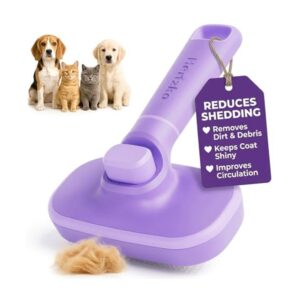
Hertzko Self Cleaning Slicker Brush for Dogs and Cats
Best for: Households managing spring/fall Siberian coat blowouts
- Style
- Self-cleaning slicker (retractable bristles)
- Creators brand
- Hertzko
- Use case
- Loose hair / light detangle on semi-long triple coats
Hertzko’s self-cleaning slicker () is here as a coat-maintenance tool, not a “tabby-branded” product. Classic swirls and mackerel stripes shed like any other domestic—weekly light passes pull loose undercoat before it paints the sofa in brown, silver, or orange bands.
Keep pressure light and finish with a comb through the ruff and behind the ears where medium coats can tangle.
Pros
- Push-button retract helps dump hair into the trash without picking bristles by hand
- Useful on both male and female Siberians—coat structure is not sex-specific in CFA standards
- Creators-verified image already in Media Library for honest affiliate linking
Cons
- Angled pins can scratch thin skin if you press hard—use light strokes
- Not a dematting rake for neglected knots; pair with a metal comb
- Grooming gear, not a medical or allergen-reduction product
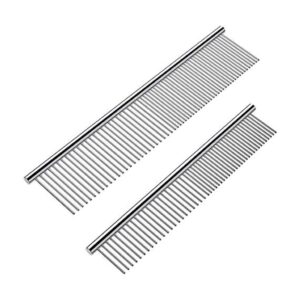
Cafhelp 2 Pack Dog Combs with Rounded Ends Stainless Steel Teeth
Best for: Owners who already brush but still find tangles in high-friction zones
- Style
- Stainless steel comb, rounded tips (2-pack)
- Creators brand
- Cafhelp
- Use case
- Finish pass after slicker; find hidden mats
Cafhelp’s 2-pack stainless comb set () is the finish tool after a slicker pass. Use the finer spacing around the face (where every tabby shows that forehead “M”); save broader strokes for the body. Affiliate honesty: ordinary pet grooming hardware, not a show-grooming system.
Pros
- Rounded tips are gentler than sharp dematting blades for routine checks
- Two-pack means one bathroom comb and one travel/backup
- Pairs cleanly with CFA’s advice to feel underside, tail, and britches several times per week
Cons
- Will not replace professional dematting if a coat is severely neglected
- Larger males can be harder to wrangle for rear-end work—patience and treats help
- Not an allergy or medical device
Who this guide is for
| Reader | Takeaway |
|---|---|
| Shopping “tabby breeders” | Ask which breed (ASH, Maine Coon…) — tabby is the pattern class |
| Comparing shelter classic vs mackerel | Pattern preference only; meet the individual |
| Curious about bullseye vs tiger stripes | Classic = blotched swirls; mackerel = narrow pencilings |
| Told the forehead “M” is a blessing mark | Folklore is fine; genetics explains the facial striping |
| Comparing to Mau / Bengal / Dragon Li | Those are breeds with tabby-like standards—use our soft-linked guides |
What we like
- Leads with pattern-not-breed clarification searchers actually need
- Classic vs mackerel visuals grounded in CFA Cat Talk language
- Genetics framed with Taqpep/LVRN + DKK4 literature—no invented allele frequencies for pet owners
- Forehead “M” folklore labeled anecdote, not science
- Soft-links related live breed-vs-tabby and tortie/calico posts without duplicating them
- Thin Creators grooming ASINs reuse existing Media Library IDs
What we don't
- Individual cats vary more than any stripe-shape personality claim
- Affiliate ASIN set is grooming gear, not genetics tests
- Related Engaging coat posts may still exist elsewhere—this page is the dedicated classic-vs-mackerel explainer under /reviews/
Tabby Types: Classic vs Mackerel — FAQ
Is a tabby a breed?
No. CFA coat-and-color materials treat tabby as a coat pattern, not a breed. You can have mackerel or classic tabbies among American Shorthairs, Maine Coons, Persians, and random-bred shelter cats—and some recognized breeds are defined partly by a tabby subtype (for example spotted Mau/Ocicat looks, or Bengal rosettes/marble).
What is the difference between a classic and a mackerel tabby?
Mackerel shows dense, narrow vertical pencilings around the body and a narrow spine saddle. Classic (blotched) shows broader swirls, butterfly-shaped shoulder markings, three spine lines, and a large side blotch often encircled by rings—the look many people call a “bullseye.” Both usually share facial mascara lines, necklaces, bracelets, belly buttons, and the forehead “M.”
What do Ta^M and Ta^b mean?
They are shorthand alleles at the modern Tabby locus (gene Taqpep / LVRN). Ta^M is associated with the dominant mackerel pattern; Ta^b is associated with recessive classic/blotched, so classic cats are typically Ta^b/Ta^b. Older textbooks sometimes wrote a single four-allele series; mapping work showed ticked and spotting involve additional loci.
Why do tabby cats have an “M” on their forehead?
Because facial striping is part of the tabby pattern CFA describes for every tabby type. Folklore stories (Mary marking a manger cat, or legends about Muhammad’s cat Muezza, or links to Egyptian “mau”) are cultural anecdotes. There is no separate “blessing gene” that stamps only the letter M.
What about spotted, ticked, and patched tabbies?
Spotted body markings often look like broken mackerel stripes and usually require a mackerel genetic background plus modifiers. Ticked (Abyssinian-type) suppresses torso stripes via a separate DKK4 pathway while often keeping facial and leg markings. Patched (torbie) adds red/cream patches via sex-linked orange—see our tortie vs calico explainer.
Can a Bengal, Egyptian Mau, or Dragon Li be “a tabby”?
Those names are breeds (or landrace breeds); tabby describes pattern. Bengals are selected for rosetted/marble tabby-like markings; Egyptian Maus for spotted tabby; Dragon Li for a boldly striped/broken tabby look. We compare each to everyday tabbies in dedicated guides: Bengal vs Tabby, Egyptian Mau vs Tabby, Dragon Li vs Tabby.
Do classic or mackerel tabbies need special grooming?
Not because of stripe shape. Match grooming to coat length and density. A light weekly slicker and metal comb routine helps most short-to-medium coats; longhaired tabbies need more. Optional Creators-verified tools: Hertzko slicker and Cafhelp combs.
Sources
- CFA Cat Talk — Patterns in the Domesticated Cat – Part 2 Tabby Patterns (mackerel, classic/blotched, spotted, ticked, patched, forehead “M”): cfa.org Cat Talk tabby patterns
- CFA — Coat & Color Descriptions (tabby describes pattern, not breed): cfa.org/coat-color-descriptions
- CFA Cat Talk — Genetic Testing for Pedigreed Cats (Taqpep classic vs mackerel; DKK4 ticked): cfa.org genetic testing
- OMIA 001429-9685 — Coat colour, tabby in Felis catus (Ta^M / Ta^b; Taqpep → LVRN): omia.org/OMIA001429/9685
- Kaelin et al., Science (2012) — Specifying and Sustaining Pigmentation Patterns… (Taqpep / Tabulin; blotched alleles): PMC3709578
- Eizirik et al., Genetics (2010) — Defining and Mapping Mammalian Coat Pattern Genes (Tabby vs Ticked; multi-locus): PMC2815922
- Nature Communications / related DKK4 literature — Developmental genetics of color pattern establishment (Ticked epistasis; spotting on Ta^M background): doi:10.1038/s41467-021-25348-2
- Amazon Creators API — product titles/images for ASINs , (partner tag catsluvus03-20; media reuse 82194–82195)
Going away? Keep your cat's routine on track.
Cats Luv Us Boarding Hotel & Grooming in Laguna Niguel, Orange County.