Short-Haired vs Long-Haired Cats (2026): Grooming Comparison
Coat length changes your weekly vacuum and brush schedule—not which cat is “better.” We compare short-haired vs long-haired lifestyle costs: grooming time, mats, hairballs, shedding seasonality, the Fel d 1 allergy myth, and heat/climate honesty using Cornell, VCA, and allergy literature—not boarding scorecards.

In this review 14 sections
CatsLuvUs Copilot Search
Ask this review — not the open web
Answers are generated from this Cats Luv Us review only. We may earn a commission from Amazon links. Not veterinary advice.
Answer from this review
This score is editorial — based on labels, recall history, and veterinary guidance, not a lab test. How we evaluated.
Choose the coat you will actually maintain: shorthairs are lower weekly brush time; longhairs need denser combing to prevent mats and hairballs—hair length does not decide allergies or temperament.
Short answer: Short-haired cats usually need light weekly brushing; long-haired cats often need near-daily combing (texture matters—Persian cotton mats faster than silky Maine Coon). Long coats raise mat and hairball risk (Cornell). Both lengths shed; indoor cats often shed year-round (VCA). Fel d 1—not hair length—drives most cat allergies, so “short hair = hypoallergenic” is a myth. Soft-links: Ragdoll vs Norwegian Forest Cat, tabby types, nail clippers, Soft Claws & booties, cats cleaner than dogs?.
Optional Creators gear: Hertzko slicker and Cafhelp stainless comb.
Optional coat-care gear (Creators-verified)
How we compared short vs long coats (literature, not litter tests)
This is a coat-length lifestyle guide for people who typed “short-haired vs long-haired cats” into a search box. The Cats Luv Us Team did not board fluffballs and sleek domestics side-by-side for a better-breed scorecard. We mapped Cornell Feline Health Center hairball guidance, VCA Animal Hospitals coat-care recommendations, CFA Persian grooming notes as a high-maintenance longhair example, and published allergy literature on Fel d 1—then translated that into household language.
Amazon cards below are optional coat-care gear verified through the Creators API (tag catsluvus03-20, rel="sponsored nofollow noopener").
Side-by-side: short-haired vs long-haired lifestyle
| Factor | Short-haired | Long-haired |
|---|---|---|
| Typical brush schedule | About 1–2× weekly (VCA: less frequent than long coats) | Often daily or near-daily for silky/cottony coats; never skip armpits & britches |
| Mat risk | Low on healthy coats; still check behind ears | High—especially cottony undercoats (Persian-type) and friction zones |
| Hairball risk | Present; usually lower volume swallowed | Higher risk (Cornell cites Persians & Maine Coons as examples) |
| Visible shed on clothes/sofa | Often shorter fibers; still year-round indoors | Longer fibers more noticeable; seasonal undercoat clumps outdoors |
| Allergy (Fel d 1) | Not “safer” by hair length | Not “worse” by hair length—allergen is salivary/sebaceous |
| Heat / climate | Usually fine; sparse coats need sun sense outdoors | Most cope without a full shave; lion cuts for chronic mats, not fashion alone |
| Tool starter kit | Soft bristle / light slicker | Steel comb first, then slicker; professional help for severe mats |
Grooming time: what your calendar actually owes the coat
VCA’s coat-care guidance is blunt: all cats benefit from regular brushing, but cats with long, silky, or curly coats need daily brushing to keep hair from tangling—especially around the ears, armpits, and along the backs of the legs. Short coats may need less frequent sessions.
Texture beats the word “long.” CFA’s Persian materials call for a serious steel-comb commitment and note that kittens should learn grooming early. Silky semi-long coats (think many Maine Coons or Ragdolls) often tolerate a few thorough sessions per week if you never skip friction zones—see our Ragdoll vs Norwegian Forest Cat coat notes. Cottony undercoats compress into mats faster than silky guard hair.
- Short single coats — five to ten minutes once or twice weekly with a soft bristle or light slicker is often enough.
- Dense double / semi-long coats — plan several comb-throughs weekly, more in spring molt.
- Ultra-long or cottony coats — daily combing is the realistic baseline; add professional baths if home care slips.
Optional Creators-verified tools for either side of the table: a Hertzko slicker and a Cafhelp stainless comb.
Mats: where they start and why scissors are the wrong hero
Mats are not a moral failure—they are physics. Friction zones (armpits, groin, behind ears, britches) and cottony undercoat lock loose hair into a felted clump that pulls on skin. VCA advises inspecting those areas daily on long coats.
- Small tangles — tease gently with a metal comb; work from the tip of the mat toward the skin.
- Large mats — stop. VCA is explicit: use clippers, never scissors, because scissors cut skin easily under a felted mat. Professional groomer or veterinary grooming is the safe path when mats are extensive.
- After baths — comb before bathing; wet mats can become nearly impossible to remove.
Seniors and overweight cats that cannot reach their backs are mat-prone even when the coat is only medium-length. Coat condition is also a health signal—dull, greasy, or suddenly neglected coats deserve a veterinary look, not just more shampoo.
Hairballs: long coats raise risk—not every hack is “just hair”
Cats swallow loose hair because tongue papillae push it toward the throat. Most hair passes in feces; some clumps in the stomach as a trichobezoar (hairball). Cornell’s Feline Health Center notes that long-haired breeds such as Persians and Maine Coons are at significantly greater risk than short-haired cats, and hairballs are more common in heavy shedding seasons.
Cornell’s clinicians also draw a hard line between routine and emergency:
- Occasional cigar-shaped hairballs (about weekly or every couple of weeks for some cats) can be normal.
- Lethargy, refusing food more than a day, or repeated unproductive retching → veterinary care now. A hairball can obstruct intestine, or the hacking may be asthma or another respiratory problem—not “more laxative paste.”
Prevention starts with brushing so hair hits the trash, not the stomach. Cornell’s list also includes professional haircuts for cats that will not tolerate home grooming and veterinary-guided hairball remedies—not internet megadoses of human products.
Shedding seasonality: indoors vs outdoors
VCA notes that cats in cooler climates often have two heavy seasonal sheds (late spring and late fall) if they spend time outdoors, when undercoat falls in clumps. Cats that live fully indoors often shed undercoat and guard hairs at low levels year-round because artificial light and stable temperatures blur seasonal cues.
So “short-haired cats don’t shed” is false advertising. Shorter fibers may be less dramatic on black pants, but the vacuum still earns its keep. Long fibers and seasonal undercoat clumps are simply more visible. Daily or near-daily brushing during molt helps both lengths—and reduces airborne dander for some mildly allergic households (VCA).
Allergy myth honesty: Fel d 1 vs hair length
If you are choosing coat length to dodge allergies, pause. The major cat allergen Fel d 1 is produced mainly in salivary and sebaceous glands (also smaller amounts in other glands), then spread onto hair and skin as the cat grooms. Reviews for veterinarians and allergy practice parameters are consistent on several points:
- All cats produce Fel d 1—including hairless breeds. There is no truly hypoallergenic cat breed backed by solid evidence.
- Hair length is not a reliable predictor of household Fel d 1. A 2001 letter in the Journal of Allergy and Clinical Immunology reported domestic living-room Fel d 1 levels unrelated to cat color or hair length.
- Production varies widely between individual cats (and over time). Intact males often produce more than neutered males; hormonal status matters more than fluff.
Practical takeaway: meet the specific cat, talk with an allergist about exposure control, and treat brushing as one small lever—not a guarantee. Coat length is a grooming decision, not an immunology cheat code.
Heat, climate, and the summer shave question
VCA’s answer surprises many first-time longhair owners: most cats—even long-haired ones—cope with hot summers without needing a haircut. A full shave is not automatic climate control. A “lion cut” (body short, face/feet/tail tip left longer) can help cats that chronically mat or refuse brushing, but it is a management tool, not a fashion requirement.
- If the cat goes outdoors after a clip, VCA advises leaving at least about 1 inch (2.5 cm) of coat to reduce sunburn risk.
- Sparse or hairless coats need sun sense and skin care—different problem, same “coat is not optional armor” idea.
- Sedation may be needed for extensive mat removal; that is a veterinary/groomer decision, not a living-room scissors project.
Starter tools (and what else belongs in the drawer)
VCA’s tool map is simple: stiff bristles for short/sparse coats; long-toothed metal combs for medium and long coats; specialty undercoat combs for heavy seasonal sheds. Our Creators-verified pair covers the everyday slicker + stainless finish comb many households actually use:
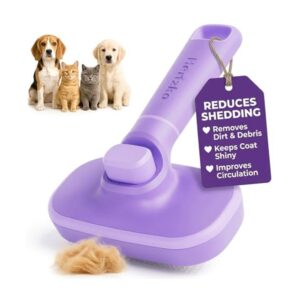
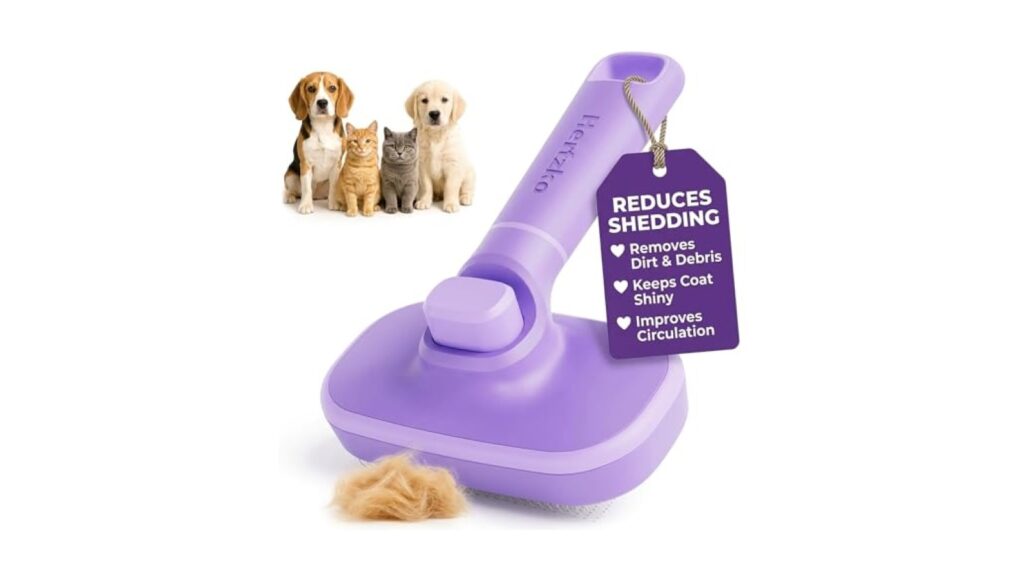
Hertzko Self Cleaning Slicker Brush for Dogs and Cats
Best for: Households managing spring/fall Siberian coat blowouts
- Style
- Self-cleaning slicker (retractable bristles)
- Creators brand
- Hertzko
- Use case
- Loose hair / light detangle on semi-long triple coats
Hertzko’s self-cleaning slicker () is here as a coat-maintenance tool, not a “short vs long brand.” VCA notes stiff bristles help short coats; long coats still benefit from light slicker passes that lift loose hair before a steel comb finishes the job.
Keep pressure light. On long coats, comb to the skin afterward—especially armpits, britches, and behind the ears where mats start.
Pros
- Push-button retract helps dump hair into the trash without picking bristles by hand
- Useful on both male and female Siberians—coat structure is not sex-specific in CFA standards
- Creators-verified image already in Media Library for honest affiliate linking
Cons
- Angled pins can scratch thin skin if you press hard—use light strokes
- Not a dematting rake for neglected knots; pair with a metal comb
- Grooming gear, not a medical or allergen-reduction product
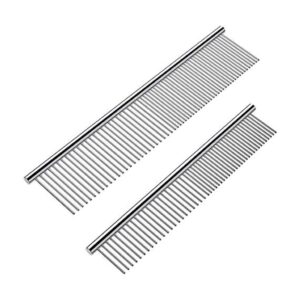
Cafhelp 2 Pack Dog Combs with Rounded Ends Stainless Steel Teeth
Best for: Owners who already brush but still find tangles in high-friction zones
- Style
- Stainless steel comb, rounded tips (2-pack)
- Creators brand
- Cafhelp
- Use case
- Finish pass after slicker; find hidden mats
Cafhelp’s 2-pack stainless comb set () is the finish tool after a slicker pass. VCA recommends long-toothed metal combs for medium and long coats; CFA’s Persian care notes likewise put a steel comb at the center of daily maintenance.
Use finer spacing around the face and feathered britches; save broader strokes for seasonal undercoat. Affiliate honesty: ordinary pet grooming hardware, not a hands-on boarding scorecard.
Pros
- Rounded tips are gentler than sharp dematting blades for routine checks
- Two-pack means one bathroom comb and one travel/backup
- Pairs cleanly with CFA’s advice to feel underside, tail, and britches several times per week
Cons
- Will not replace professional dematting if a coat is severely neglected
- Larger males can be harder to wrangle for rear-end work—patience and treats help
- Not an allergy or medical device
Related care that pairs with coat length
- Claws: indoor cats still need tip trims on a schedule—see cat nail clippers. Between trims, Soft Claws-class caps can blunt furniture damage; we sorted caps vs short-session booties in Paw Protection.
- Overall cleanliness: cats are famous self-groomers, but coat length changes how much help they need—context in Are cats cleaner than dogs?.
- Pattern ≠ length: tabby swirls and stripes are pigment layout, not fluff length—see classic vs mackerel tabby types.
- Big fluffy breeds: if you are comparing two longhair lifestyles specifically, use Ragdoll vs Norwegian Forest Cat.
Who should choose which coat?
| Your situation | Lean toward |
|---|---|
| Limited daily time; hate vacuuming long fibers | Short-haired—still plan weekly brush + vacuum |
| Enjoy daily comb bonding; want a plush look | Long-haired—budget time and a steel comb |
| Mild allergies; hoping coat length will save you | Neither guarantee—talk to an allergist; Fel d 1 ≠ hair length |
| Hot climate + outdoor access | Either can work; skip impulsive full shaves; ask vet/groomer |
| Senior or overweight cat already struggling to groom | Shorter or professionally maintained coat may be kinder |
| Want a specific breed look | Research that breed’s coat texture—not just “long vs short” |
What we like
- Leads with lifestyle coat-care costs searchers actually need (time, mats, hairballs)
- Fel d 1 allergy myth called out with allergy literature—not “short hair is safer” folklore
- Cornell hairball risk + when-to-vet caveats without invented percentages
- Climate / summer-shave honesty from VCA (not blanket lion-cut marketing)
- Soft-links related live posts without duplicating breed or pattern guides
- Thin Creators brush/comb ASINs reuse existing Media Library IDs
What we don't
- Individual cats vary more than any coat-length personality claim
- Affiliate ASIN set is grooming gear, not veterinary products
- Engaging apex path intentionally left 404—no redirect from /cat-grooming/…
Short-Haired vs Long-Haired Cats — FAQ
Do short-haired cats shed less than long-haired cats?
Not reliably in the way marketing implies. Both lengths shed. Indoor cats often shed year-round (VCA). Long fibers and seasonal undercoat clumps are usually more visible on clothes and furniture, but short coats still leave hair on the sofa. Brushing frequency and vacuum habits matter more than the label on the coat.
How often should I brush a short-haired vs long-haired cat?
VCA: short coats may need less frequent brushing; long, silky, or curly coats often need daily brushing, especially ears, armpits, and backs of the legs. Many domestic shorthairs do well with about 1–2 sessions per week. Cottony ultra-long coats (Persian-type) are usually a daily steel-comb job. Increase frequency during heavy seasonal sheds.
Are long-haired cats more prone to hairballs?
Yes—higher risk. Cornell’s Feline Health Center notes long-haired breeds such as Persians and Maine Coons are at significantly greater risk than short-haired cats, especially in shedding seasons. Daily combing removes hair before it is swallowed. Unproductive retching, lethargy, or refusing food needs a veterinarian—do not assume every hack is a harmless hairball.
Are short-haired cats better if I have allergies?
Hair length is not a reliable allergy fix. The major allergen Fel d 1 comes mainly from salivary and sebaceous glands, not from “long hair itself.” All cats produce it, including hairless breeds. Living-room Fel d 1 levels have been reported as unrelated to hair length. Talk with an allergist; consider individual cats and exposure control rather than coat-length folklore.
Should I shave my long-haired cat in the summer?
Usually no—not automatically. VCA notes most cats cope with heat without a haircut. A lion cut can help chronic matters or cats that refuse brushing. If the cat goes outdoors after clipping, leave about an inch of coat to reduce sunburn risk. Never cut mats with scissors—use clippers or a professional.
Is a Domestic Shorthair or Domestic Longhair a breed?
They are coat-length labels for random-bred cats, not single CFA championship breeds the way Persian or Siamese are. Shelter “DSH” / “DLH” describe fur length and mixed ancestry. Pattern (tabby, tortie) and breed standards are separate conversations—see our tabby types guide.
What grooming tools do I need?
Short coats: soft bristle or light slicker. Medium/long coats: steel comb first, then slicker; undercoat tools during heavy sheds. Optional Creators-verified examples: Hertzko self-cleaning slicker and Cafhelp stainless combs. Keep nail tools too—see nail clippers.
Does coat length decide temperament?
No. Energy, sociability, and trainability track genetics, early socialization, health, and individual personality far more than fluff length. Choosing “longhair because they are chill” is a stereotype, not a care plan.
Sources
- Cornell University College of Veterinary Medicine, Feline Health Center — “A Hairy Dilemma” (hairball formation; longhair risk; prevention): vet.cornell.edu …/hairy-dilemma
- Cornell Feline Health Center — “The Danger of Hairballs”: vet.cornell.edu …/danger-hairballs
- VCA Animal Hospitals — “Grooming and Coat Care for Your Cat” (brush frequency by coat; mat safety; seasonal shed; summer clip notes): vcahospitals.com …/grooming-and-coat-care-for-your-cat
- CFA — Persian breed profile (grooming commitment; steel comb; professional help): cfa.org/breed/persian
- Bonnet et al. — “Human allergy to cats…” (PMC8721530): Fel d 1 production not affected by hair length; no proven hypoallergenic breeds: PMC8721530
- Siebers et al., J Allergy Clin Immunol (2001) — Fel d 1 levels in living rooms not related to cat color or hair length (letter).
- Portnoy et al. / practice-parameter literature on furry-animal allergens — Fel d 1 primary sources; hair-length interventions not recommended as allergen control.
- Amazon Creators API — product titles/images for ASINs , (partner tag catsluvus03-20; media reuse 82194–82195).
- Related Cats Luv Us reviews — Ragdoll vs NFC (83119); tabby types (82974); nail clippers (82942); Soft Claws/booties (82253); Cleanliness Compared (82507).
Going away? Keep your cat's routine on track.
Cats Luv Us Boarding Hotel & Grooming in Laguna Niguel, Orange County.